Riphah College of Rehabilitation & Allied Health Sciences, Riphah International University, Islamabad 46000, Pakistan.
Foundation Institute of Rehabilitation Sciences, Foundation University, Islamabad 44000, Pakistan.
Sensors (Basel). 2023 Dec 8;23(24):9718. doi: 10.3390/s23249718.
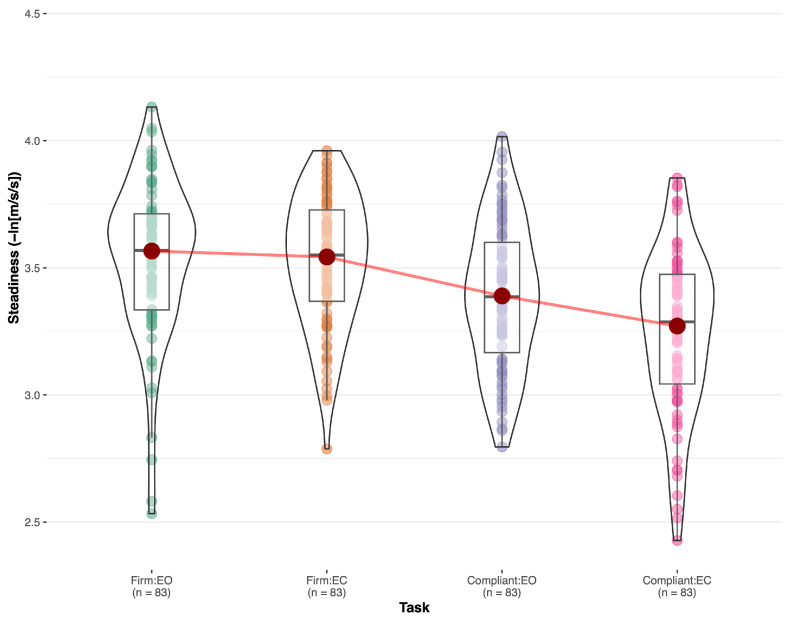
Smartphone applications (apps) that utilize embedded inertial sensors have the potential to provide valid and reliable estimations of different balance and gait parameters in older adults with mild balance impairment. This study aimed to assess the reliability, validity, and sensitivity of the Gait&Balance smartphone application (G&B App) for measuring gait and balance in a sample of middle- to older-aged adults with mild balance impairment in Pakistan. Community-dwelling adults over 50 years of age (N = 83, 50 female, range 50-75 years) with a Berg Balance Scale (BBS) score between 46/56 and 54/56 were included in the study. Data collection involved securing a smartphone to the participant's lumbosacral spine. Participants performed six standardized balance tasks, including four quiet stance tasks and two gait tasks (walking looking straight ahead and walking with head turns). The G&B App collected accelerometry data during these tasks, and the tasks were repeated twice to assess test-retest reliability. The tasks in quiet stance were also recorded with a force plate, a gold-standard technology for measuring postural sway. Additionally, participants completed three clinical measures, the BBS, the Functional Reach Test (FRT), and the Timed Up and Go Test (TUG). Test-retest reliability within the same session was determined using intraclass correlation coefficients (ICCs) and the standard error of measurement (SEM). Validity was evaluated by correlating the G&B App outcomes against both the force plate data and the clinical measures using Pearson's product-moment correlation coefficients. To assess the G&B App's sensitivity to differences in balance across tasks and repetitions, one-way repeated measures analyses of variance (ANOVAs) were conducted. During quiet stance, the app demonstrated moderate reliability for steadiness on firm (ICC = 0.72) and compliant surfaces (ICC = 0.75) with eyes closed. For gait tasks, the G&B App indicated moderate to excellent reliability when walking looking straight ahead for gait symmetry (ICC = 0.65), walking speed (ICC = 0.93), step length (ICC = 0.94), and step time (ICC = 0.84). The TUG correlated with app measures under both gait conditions for walking speed (r -0.70 and 0.67), step length (r -0.56 and -0.58), and step time (r 0.58 and 0.50). The BBS correlated with app measures of walking speed under both gait conditions (r 0.55 and 0.51) and step length when walking with head turns (r = 0.53). Force plate measures of total distance wandered showed adequate to excellent correlations with G&B App measures of steadiness. Notably, G&B App measures of walking speed, gait symmetry, step length, and step time, were sensitive to detecting differences in performance between standard walking and the more difficult task of walking with head turns. This study demonstrates the G&B App's potential as a reliable and valid tool for assessing some gait and balance parameters in middle-to-older age adults, with promise for application in low-income countries like Pakistan. The app's accessibility and accuracy could enhance healthcare services and support preventive measures related to fall risk.
智能手机应用程序(apps)利用嵌入式惯性传感器,有潜力为轻度平衡障碍的老年人提供不同平衡和步态参数的有效和可靠估计。本研究旨在评估步态和平衡智能手机应用程序(G&B App)在巴基斯坦轻度平衡障碍的中老年人群中的可靠性、有效性和敏感性。共有 83 名年龄在 50 岁以上(50 名女性,年龄 50-75 岁)、伯格平衡量表(BBS)评分为 46/56 至 54/56 的社区居住成年人参与了这项研究。数据采集涉及将智能手机固定在参与者的腰骶部。参与者完成了六项标准化的平衡任务,包括四项静态平衡任务和两项步态任务(直视行走和头部转动行走)。G&B App 在这些任务中收集了加速度计数据,并且重复了两次以评估测试-重测信度。在静态平衡任务中,还使用力板记录了数据,力板是测量姿势摆动的金标准技术。此外,参与者还完成了三项临床测量,即 BBS、功能性伸展测试(FRT)和计时起立行走测试(TUG)。使用组内相关系数(ICC)和测量标准误差(SEM)在同一会话内确定测试-重测信度。通过使用皮尔逊积差相关系数,将 G&B App 结果与力板数据和临床测量值相关联,评估了有效性。为了评估 G&B App 在不同任务和重复中对平衡差异的敏感性,进行了单向重复测量方差分析(ANOVAs)。在静态站立时,应用程序在闭眼时在坚硬(ICC = 0.72)和顺应性表面(ICC = 0.75)上的稳定性具有中等可靠性。对于步态任务,当直走时,G&B App 显示出从中等到极好的步态对称性(ICC = 0.65)、行走速度(ICC = 0.93)、步长(ICC = 0.94)和步时(ICC = 0.84)的可靠性。TUG 在两种步态条件下与应用程序的行走速度(r -0.70 和 0.67)、步长(r -0.56 和 -0.58)和步时(r 0.58 和 0.50)相关。BBS 与两种步态条件下的应用程序行走速度(r 0.55 和 0.51)以及头部转动行走时的步长(r = 0.53)相关。总距离徘徊的力板测量值与 G&B App 的稳定性测量值具有足够到极好的相关性。值得注意的是,G&B App 的行走速度、步态对称性、步长和步时测量值,能够敏感地检测到标准行走和更困难的头部转动行走任务之间的表现差异。本研究表明,G&B App 作为一种可靠且有效的工具,具有评估中老年人群某些步态和平衡参数的潜力,有望在巴基斯坦等低收入国家应用。该应用程序的可及性和准确性可以增强与跌倒风险相关的医疗保健服务和支持预防措施。
