U.S. Centers for Disease Control and Prevention, Atlanta, GA 30333, USA.
Michigan Department of Agriculture and Rural Development, Lansing, MI 48933, USA.
Viruses. 2023 Dec 15;15(12):2436. doi: 10.3390/v15122436.
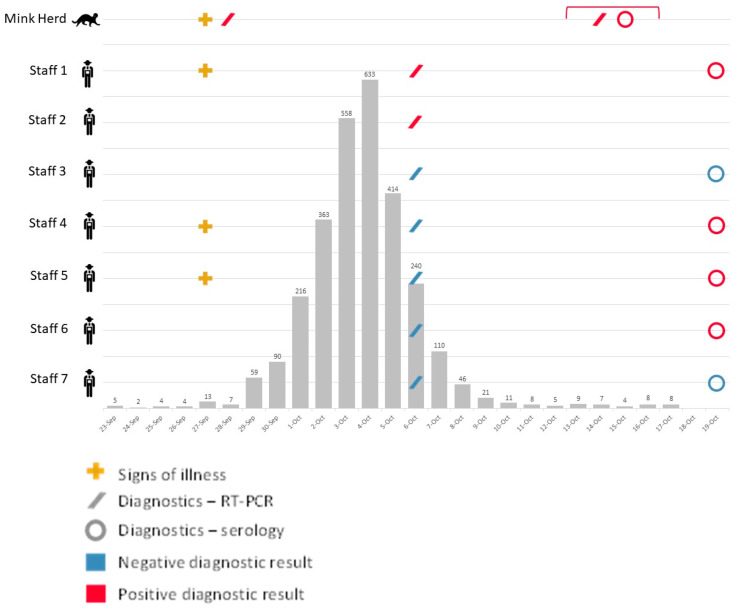
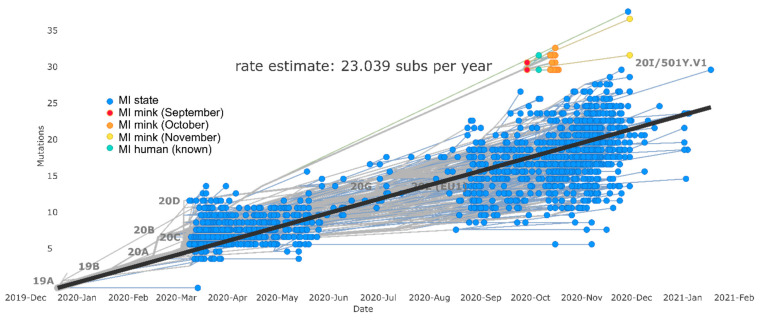
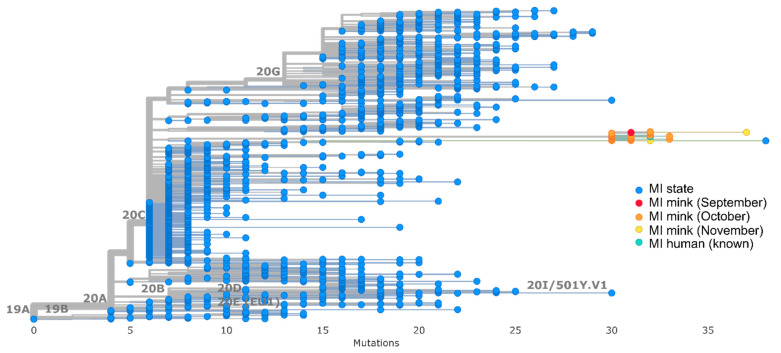
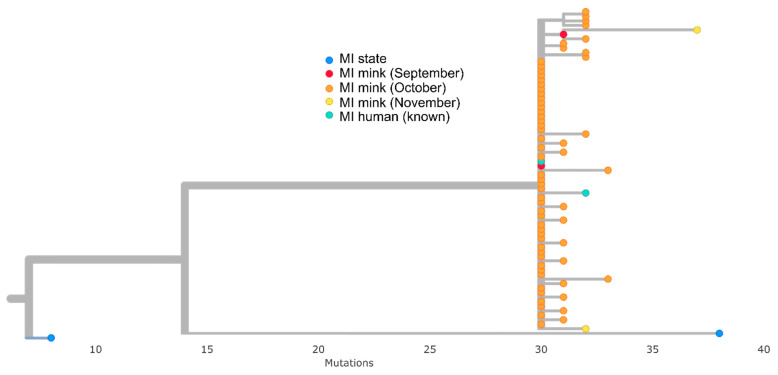
Farmed mink are one of few animals in which infection with SARS-CoV-2 has resulted in sustained transmission among a population and spillback from mink to people. In September 2020, mink on a Michigan farm exhibited increased morbidity and mortality rates due to confirmed SARS-CoV-2 infection. We conducted an epidemiologic investigation to identify the source of initial mink exposure, assess the degree of spread within the facility's overall mink population, and evaluate the risk of further viral spread on the farm and in surrounding wildlife habitats. Three farm employees reported symptoms consistent with COVID-19 the same day that increased mortality rates were observed among the mink herd. One of these individuals, and another asymptomatic employee, tested positive for SARS-CoV-2 by real-time reverse transcription PCR (RT-qPCR) 9 days later. All but one mink sampled on the farm were positive for SARS-CoV-2 based on nucleic acid detection from at least one oral, nasal, or rectal swab tested by RT-qPCR (99%). Sequence analysis showed high degrees of similarity between sequences from mink and the two positive farm employees. Epidemiologic and genomic data, including the presence of F486L and N501T mutations believed to arise through mink adaptation, support the hypothesis that the two employees with SARS-CoV-2 nucleic acid detection contracted COVID-19 from mink. However, the specific source of virus introduction onto the farm was not identified. Three companion animals living with mink farm employees and 31 wild animals of six species sampled in the surrounding area were negative for SARS-CoV-2 by RT-qPCR. Results from this investigation support the necessity of a One Health approach to manage the zoonotic spread of SARS-CoV-2 and underscores the critical need for multifaceted public health approaches to prevent the introduction and spread of respiratory viruses on mink farms.
养殖水貂是少数几种感染 SARS-CoV-2 后可在人群中持续传播并发生水貂向人类溢出的动物之一。2020 年 9 月,密歇根州一家农场的水貂因感染 SARS-CoV-2 而出现发病率和死亡率上升。我们开展了一项流行病学调查,以确定水貂最初感染的来源,评估设施内水貂总体种群的传播程度,并评估该农场及其周围野生动物栖息地中病毒进一步传播的风险。三名农场员工在观察到水貂群死亡率上升的同一天报告了与 COVID-19 相符的症状。其中一人和另一名无症状员工在 9 天后经实时逆转录聚合酶链反应(RT-qPCR)检测 SARS-CoV-2 呈阳性。基于至少一个口腔、鼻腔或直肠拭子的 RT-qPCR 核酸检测,除一个外,农场所有水貂均呈 SARS-CoV-2 阳性(99%)。序列分析显示,水貂与两个阳性农场员工的序列之间存在高度相似性。流行病学和基因组数据,包括被认为是水貂适应而产生的 F486L 和 N501T 突变的存在,支持了两个检测到 SARS-CoV-2 核酸的员工从水貂感染 COVID-19 的假设。然而,农场病毒传入的具体来源并未确定。与水貂养殖场员工一起生活的 3 只伴侣动物和在周围地区采集的 6 种野生动物中的 31 只均经 RT-qPCR 检测 SARS-CoV-2 为阴性。该调查结果支持采用“同一健康”方法来管理 SARS-CoV-2 的人畜共患病传播,并强调需要采取多方面的公共卫生方法来防止呼吸道病毒在水貂养殖场的传入和传播。