• 文献检索
  • 文档翻译
  • 深度研究
  • 学术资讯
  • Suppr Zotero 插件Zotero 插件
  • 邀请有礼
  • 套餐&价格
  • 历史记录
应用&插件
Suppr Zotero 插件Zotero 插件浏览器插件Mac 客户端Windows 客户端微信小程序
定价
高级版会员购买积分包购买API积分包
服务
文献检索文档翻译深度研究API 文档MCP 服务
关于我们
关于 Suppr公司介绍联系我们用户协议隐私条款
关注我们

Suppr 超能文献

核心技术专利:CN118964589B侵权必究
粤ICP备2023148730 号-1Suppr @ 2026

文献检索

告别复杂PubMed语法,用中文像聊天一样搜索,搜遍4000万医学文献。AI智能推荐,让科研检索更轻松。

立即免费搜索

文件翻译

保留排版,准确专业,支持PDF/Word/PPT等文件格式,支持 12+语言互译。

免费翻译文档

深度研究

AI帮你快速写综述,25分钟生成高质量综述,智能提取关键信息,辅助科研写作。

立即免费体验

基于网络的远程康复计划对脑损伤儿童和青少年的影响:系统评价和荟萃分析。

The Effect of Web-Based Telerehabilitation Programs on Children and Adolescents With Brain Injury: Systematic Review and Meta-Analysis.

机构信息

School of Nursing, Jilin University, Changchun, China.

The Second Hospital of Jilin University, Jilin University, Changchun City, China.

出版信息

J Med Internet Res. 2023 Dec 25;25:e46957. doi: 10.2196/46957.

DOI:10.2196/46957
PMID:38145485
原文链接:https://pmc.ncbi.nlm.nih.gov/articles/PMC10775025/
Abstract

BACKGROUND

Acquired brain injury (ABI) in children and adolescents can lead to motor and executive impairments that often require long-term treatment. The implementation of web-based telerehabilitation therapy at home is a method to improve the functional status of patients. Therefore, we performed a systematic review of the effects of web-based telerehabilitation programs on functional outcomes in children and adolescents with brain injury and supplemented the findings with a meta-analysis.

OBJECTIVE

This study evaluated the therapeutic effect of web-based telerehabilitation training on children and adolescents with brain injury to determine whether web-based telerehabilitation therapy improved motor function, executive function, physical activity level, lower limb strength, hand and upper limb function, visual processing skills, and occupational functional performance in children and adolescents with brain injury.

METHODS

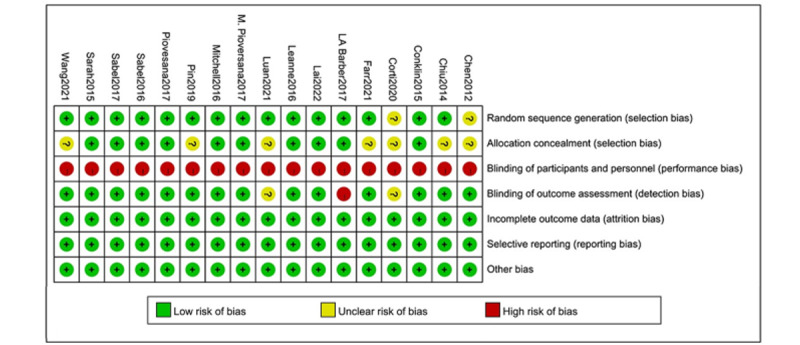
PubMed, Embase, Scopus, Web of Science, and the Cochrane Library were searched for randomized controlled trials on web-based telerehabilitation programs in children and adolescents with brain injury until December 2022, and the risk of bias was evaluated using the Cochrane Collaboration Tool. Relevant data were extracted, and a meta-analysis was performed using RevMan5.3 software.

RESULTS

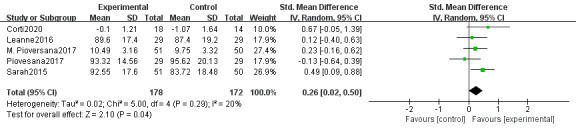
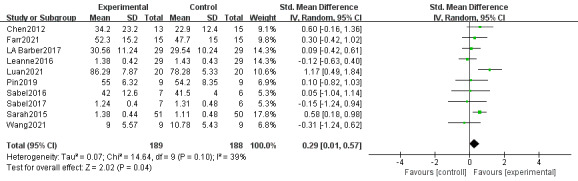
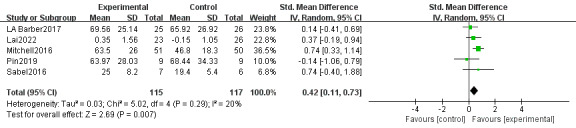
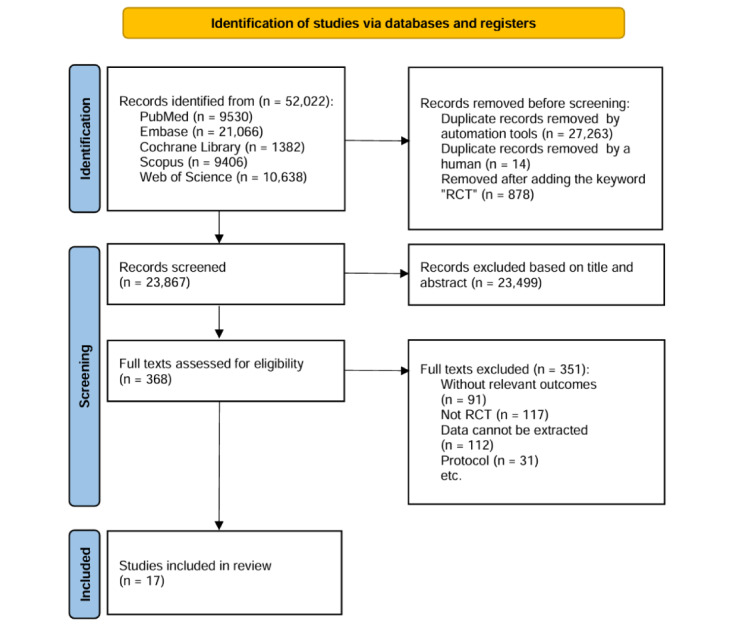
Overall, 17 studies involving 848 patients were included. Web-based telerehabilitation therapy improved the motor function (standardized mean difference [SMD] 0.29, 95% CI 0.01-0.57; P=.04), physical activity level (SMD 0.42, 95% CI 0.11-0.73; P=.007), lower limb strength (SMD 0.52, 95% CI 0.13-0.90; P=.009), and visual processing skills (SMD 0.26, 95% CI 0.02-0.50; P=.04) of children and adolescents with brain injury. It also improved executive function in letter-number sequencing (SMD 1.26, 95% CI 0.26-2.26; P=.01), attention (SMD 0.38, 95% CI 0.09-0.66; P=.009), and symbol search (SMD 1.18, 95% CI 0.43-1.93, P=.002).

CONCLUSIONS

Web-based telerehabilitation therapy improved motor function, physical activity level, lower limb strength, letter-number sequencing, attention, and symbol search, which improved the quality of life in children and adolescents with brain injury. Web-based telerehabilitation programs provide great convenience for children and adolescents with ABI who need long-term treatment and allow them to exercise at home for rehabilitation training. The widespread implementation of remote interventions also provides children and adolescents in remote areas with better access to rehabilitation services. This review provides evidence for the effectiveness of web-based telerehabilitation therapy, but there was heterogeneity in some of the results because of different disease types and intervention programs. Future studies can expand the sample size according to disease type and increase follow-up time according to different exercise prescriptions to further refine the long-term effects of this intervention on various functions of children and adolescents with ABI.

TRIAL REGISTRATION

PROSPERO CRD42023421917; https://www.crd.york.ac.uk/prospero/display_record.php?RecordID=421917.
摘要

背景

儿童和青少年获得性脑损伤 (ABI) 可导致运动和执行功能障碍,通常需要长期治疗。在家中实施基于网络的远程康复治疗是改善患者功能状态的一种方法。因此,我们对基于网络的远程康复计划对脑损伤儿童和青少年的功能结果的影响进行了系统评价,并进行了荟萃分析。

目的

本研究评估了基于网络的远程康复训练对脑损伤儿童和青少年的治疗效果,以确定基于网络的远程康复治疗是否可以改善脑损伤儿童和青少年的运动功能、执行功能、身体活动水平、下肢力量、手和上肢功能、视觉处理技能和职业功能表现。

方法

检索 PubMed、Embase、Scopus、Web of Science 和 Cochrane 图书馆中关于儿童和青少年脑损伤的基于网络的远程康复计划的随机对照试验,直到 2022 年 12 月,并使用 Cochrane 协作工具评估偏倚风险。提取相关数据,并使用 RevMan5.3 软件进行荟萃分析。

结果

共有 17 项研究纳入 848 名患者。基于网络的远程康复治疗可改善运动功能(标准化均数差 [SMD] 0.29,95%置信区间 [CI] 0.01-0.57;P=.04)、身体活动水平(SMD 0.42,95% CI 0.11-0.73;P=.007)、下肢力量(SMD 0.52,95% CI 0.13-0.90;P=.009)和视觉处理技能(SMD 0.26,95% CI 0.02-0.50;P=.04)。它还改善了脑损伤儿童和青少年的执行功能(字母-数字排序[SMD]1.26,95% CI 0.26-2.26;P=.01)、注意力(SMD 0.38,95% CI 0.09-0.66;P=.009)和符号搜索(SMD 1.18,95% CI 0.43-1.93,P=.002)。

结论

基于网络的远程康复治疗可改善运动功能、身体活动水平、下肢力量、字母-数字排序、注意力和符号搜索,从而提高脑损伤儿童和青少年的生活质量。基于网络的远程康复计划为需要长期治疗的脑损伤儿童和青少年提供了极大的便利,使他们可以在家中进行康复训练。远程干预的广泛实施也为远程地区的儿童和青少年提供了更好的康复服务机会。本综述为基于网络的远程康复治疗的有效性提供了证据,但由于不同的疾病类型和干预方案,结果存在一定的异质性。未来的研究可以根据疾病类型扩大样本量,并根据不同的运动处方增加随访时间,进一步细化这种干预对脑损伤儿童和青少年各种功能的长期影响。

试验注册

PROSPERO CRD42023421917;https://www.crd.york.ac.uk/prospero/display_record.php?RecordID=421917.

https://cdn.ncbi.nlm.nih.gov/pmc/blobs/a43b/10775025/b4368ec742dd/jmir_v25i1e46957_fig7.jpg
https://cdn.ncbi.nlm.nih.gov/pmc/blobs/a43b/10775025/fc3e36f1ec8d/jmir_v25i1e46957_fig1.jpg
https://cdn.ncbi.nlm.nih.gov/pmc/blobs/a43b/10775025/f9972e7cfd7e/jmir_v25i1e46957_fig2.jpg
https://cdn.ncbi.nlm.nih.gov/pmc/blobs/a43b/10775025/1537c791c2e2/jmir_v25i1e46957_fig3.jpg
https://cdn.ncbi.nlm.nih.gov/pmc/blobs/a43b/10775025/a35c01c2fdc7/jmir_v25i1e46957_fig4.jpg
https://cdn.ncbi.nlm.nih.gov/pmc/blobs/a43b/10775025/5e219bdfd089/jmir_v25i1e46957_fig5.jpg
https://cdn.ncbi.nlm.nih.gov/pmc/blobs/a43b/10775025/487ee5a6af29/jmir_v25i1e46957_fig6.jpg
https://cdn.ncbi.nlm.nih.gov/pmc/blobs/a43b/10775025/b4368ec742dd/jmir_v25i1e46957_fig7.jpg
https://cdn.ncbi.nlm.nih.gov/pmc/blobs/a43b/10775025/fc3e36f1ec8d/jmir_v25i1e46957_fig1.jpg
https://cdn.ncbi.nlm.nih.gov/pmc/blobs/a43b/10775025/f9972e7cfd7e/jmir_v25i1e46957_fig2.jpg
https://cdn.ncbi.nlm.nih.gov/pmc/blobs/a43b/10775025/1537c791c2e2/jmir_v25i1e46957_fig3.jpg
https://cdn.ncbi.nlm.nih.gov/pmc/blobs/a43b/10775025/a35c01c2fdc7/jmir_v25i1e46957_fig4.jpg
https://cdn.ncbi.nlm.nih.gov/pmc/blobs/a43b/10775025/5e219bdfd089/jmir_v25i1e46957_fig5.jpg
https://cdn.ncbi.nlm.nih.gov/pmc/blobs/a43b/10775025/487ee5a6af29/jmir_v25i1e46957_fig6.jpg
https://cdn.ncbi.nlm.nih.gov/pmc/blobs/a43b/10775025/b4368ec742dd/jmir_v25i1e46957_fig7.jpg

相似文献

1
The Effect of Web-Based Telerehabilitation Programs on Children and Adolescents With Brain Injury: Systematic Review and Meta-Analysis.基于网络的远程康复计划对脑损伤儿童和青少年的影响:系统评价和荟萃分析。
J Med Internet Res. 2023 Dec 25;25:e46957. doi: 10.2196/46957.
2
Technological aids for the rehabilitation of memory and executive functioning in children and adolescents with acquired brain injury.脑损伤儿童和青少年记忆与执行功能康复的技术辅助手段。
Cochrane Database Syst Rev. 2016 Jul 1;7(7):CD011020. doi: 10.1002/14651858.CD011020.pub2.
3
Exercise interventions on health-related quality of life for people with cancer during active treatment.积极治疗期间针对癌症患者健康相关生活质量的运动干预措施。
Cochrane Database Syst Rev. 2012 Aug 15;2012(8):CD008465. doi: 10.1002/14651858.CD008465.pub2.
4
Physical activity, diet and other behavioural interventions for improving cognition and school achievement in children and adolescents with obesity or overweight.身体活动、饮食及其他行为干预措施对改善肥胖或超重儿童及青少年认知和学业成绩的作用
Cochrane Database Syst Rev. 2018 Mar 2;3(3):CD009728. doi: 10.1002/14651858.CD009728.pub4.
5
Physical activity, diet and other behavioural interventions for improving cognition and school achievement in children and adolescents with obesity or overweight.身体活动、饮食及其他行为干预对改善肥胖或超重儿童及青少年认知和学业成绩的作用
Cochrane Database Syst Rev. 2018 Jan 29;1(1):CD009728. doi: 10.1002/14651858.CD009728.pub3.
6
E-Health interventions for anxiety and depression in children and adolescents with long-term physical conditions.针对患有长期身体疾病的儿童和青少年焦虑与抑郁的电子健康干预措施。
Cochrane Database Syst Rev. 2018 Aug 15;8(8):CD012489. doi: 10.1002/14651858.CD012489.pub2.
7
Nurse-led Telehealth Intervention for Rehabilitation (Telerehabilitation) Among Community-Dwelling Patients With Chronic Diseases: Systematic Review and Meta-analysis.护士主导的远程康复(TeleRehabilitation)干预在慢性病社区患者中的应用:系统评价和荟萃分析。
J Med Internet Res. 2022 Nov 2;24(11):e40364. doi: 10.2196/40364.
8
Exercise interventions for cerebral palsy.脑瘫的运动干预
Cochrane Database Syst Rev. 2017 Jun 11;6(6):CD011660. doi: 10.1002/14651858.CD011660.pub2.
9
Education support services for improving school engagement and academic performance of children and adolescents with a chronic health condition.改善患有慢性病的儿童和青少年的学校参与度和学业成绩的教育支持服务。
Cochrane Database Syst Rev. 2023 Feb 8;2(2):CD011538. doi: 10.1002/14651858.CD011538.pub2.
10
Welfare-to-work interventions and their effects on the mental and physical health of lone parents and their children.从福利到工作的干预措施及其对单亲父母及其子女身心健康的影响。
Cochrane Database Syst Rev. 2018 Feb 26;2(2):CD009820. doi: 10.1002/14651858.CD009820.pub3.

引用本文的文献

1
The effect of telerehabilitation on activity performance and participation in daily life in children with developmental coordination disorder: A randomized controlled trial.远程康复对发育性协调障碍儿童活动表现及日常生活参与度的影响:一项随机对照试验。
PLoS One. 2025 Aug 21;20(8):e0330846. doi: 10.1371/journal.pone.0330846. eCollection 2025.
2
At-School Telerehabilitation for Rett Syndrome: Support Teachers Driving Cognitive and Communication Progress in a Randomized Trial.雷特综合征的在校远程康复治疗:在一项随机试验中支持教师推动认知和沟通进步
Children (Basel). 2025 Jul 14;12(7):928. doi: 10.3390/children12070928.
3

本文引用的文献

1
Effectiveness of eHealth Interventions on Moderate-to-Vigorous Intensity Physical Activity Among Patients in Cardiac Rehabilitation: Systematic Review and Meta-analysis.电子健康干预措施对心脏康复患者中中等至剧烈强度体力活动的有效性:系统评价和荟萃分析。
J Med Internet Res. 2023 Mar 29;25:e42845. doi: 10.2196/42845.
2
Telehealth Movement-to-Music to Increase Physical Activity Participation Among Adolescents With Cerebral Palsy: Pilot Randomized Controlled Trial.远程医疗运动与音乐相结合以提高脑瘫青少年的身体活动参与度:试点随机对照试验。
JMIR Form Res. 2022 Oct 28;6(10):e36049. doi: 10.2196/36049.
3
TEleRehabilitation Nepal (TERN) for People With Spinal Cord Injury and Acquired Brain Injury: A Feasibility Study.
Physiotherapist Online Assessment in Patients with Stroke: Protocol for a Systematic Review and Meta-Analysis.
中风患者的物理治疗师在线评估:系统评价与荟萃分析方案
J Clin Med. 2025 Mar 28;14(7):2311. doi: 10.3390/jcm14072311.
4
Sustainable Model of Early Intervention and Telerehabilitation for Children With Cerebral Palsy in Rural Bangladesh: The SMART-CP Randomized Clinical Trial.孟加拉国农村脑瘫儿童早期干预和远程康复的可持续模式:SMART-CP随机临床试验
JAMA Pediatr. 2025 Apr 7. doi: 10.1001/jamapediatrics.2025.0150.
5
Cost-Effectiveness of Telerehabilitation Compared to Traditional In-Person Rehabilitation: A Systematic Review and Meta-Analysis.远程康复与传统面对面康复的成本效益:系统评价与荟萃分析
Cureus. 2025 Feb 14;17(2):e79028. doi: 10.7759/cureus.79028. eCollection 2025 Feb.
6
Comparing Telerehabilitation and In-Person Interventions in School-Based Occupational Therapy for Specific Learning Disorder A Randomized Controlled Trial.针对特定学习障碍的学校职业治疗中远程康复与面对面干预的比较:一项随机对照试验
Iran J Child Neurol. 2024 Spring;18(2):83-101. doi: 10.22037/ijcn.v18i2.43985. Epub 2024 Mar 12.
尼泊尔脊髓损伤和后天性脑损伤患者的远程康复(TERN):一项可行性研究。
Rehabil Process Outcome. 2022 Oct 18;11:11795727221126070. doi: 10.1177/11795727221126070. eCollection 2022.
4
Psychotherapeutic Intervention for Adults With Acquired Brain Injury: A Case Study Using BackUp.针对成年后天性脑损伤患者的心理治疗干预:一项使用BackUp的案例研究
Front Rehabil Sci. 2022 Feb 18;3:771416. doi: 10.3389/fresc.2022.771416. eCollection 2022.
5
Remote Follow-Up Technologies in Traumatic Brain Injury: A Scoping Review.创伤性脑损伤的远程随访技术:范围综述。
J Neurotrauma. 2022 Oct;39(19-20):1289-1317. doi: 10.1089/neu.2022.0138.
6
Introduction to Topical Issue on mHealth for Brain Injury Rehabilitation.脑损伤康复移动健康专题介绍
J Head Trauma Rehabil. 2022;37(3):131-133. doi: 10.1097/HTR.0000000000000794.
7
Feasibility and Acceptability of a Complex Telerehabilitation Intervention for Pediatric Acquired Brain Injury: The Child in Context Intervention (CICI).针对小儿获得性脑损伤的复杂远程康复干预措施的可行性与可接受性:情境中的儿童干预(CICI)
J Clin Med. 2022 May 3;11(9):2564. doi: 10.3390/jcm11092564.
8
Sufficiency of the BOT-2 short form to screen motor competency in preschool children with strabismus.BOT-2简版筛查斜视学龄前儿童运动能力的充足性。
PLoS One. 2021 Dec 20;16(12):e0261549. doi: 10.1371/journal.pone.0261549. eCollection 2021.
9
Physical rehabilitation interventions in children with acquired brain injury: a scoping review.获得性脑损伤儿童的物理康复干预:范围综述。
Dev Med Child Neurol. 2022 Jan;64(1):40-48. doi: 10.1111/dmcn.14997. Epub 2021 Jul 26.
10
The effect of dance interventions on cognition, neuroplasticity, physical function, depression, and quality of life for older adults with mild cognitive impairment: A systematic review and meta-analysis.舞蹈干预对轻度认知障碍老年人认知、神经可塑性、身体功能、抑郁和生活质量的影响:系统评价和荟萃分析。
Int J Nurs Stud. 2021 Oct;122:104025. doi: 10.1016/j.ijnurstu.2021.104025. Epub 2021 Jun 30.