The University of Queensland, Brisbane, Australia.
The Australian National University, Canberra, Australian Capital Territory, Australia.
Pers Soc Psychol Rev. 2024 Aug;28(3):251-275. doi: 10.1177/10888683231216136. Epub 2023 Dec 26.
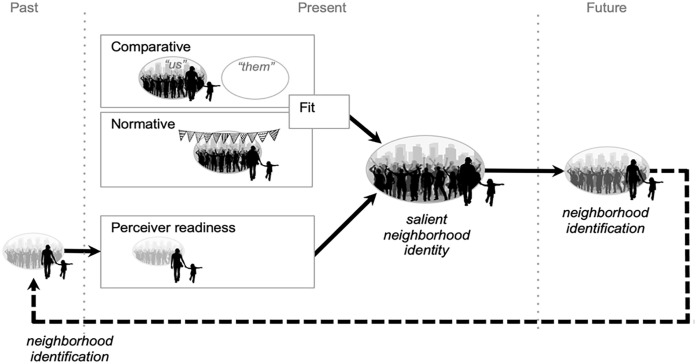
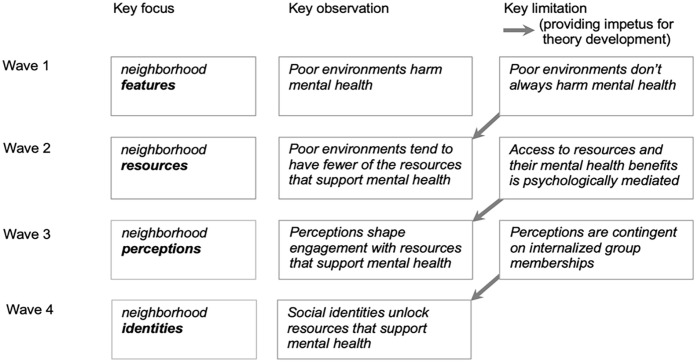
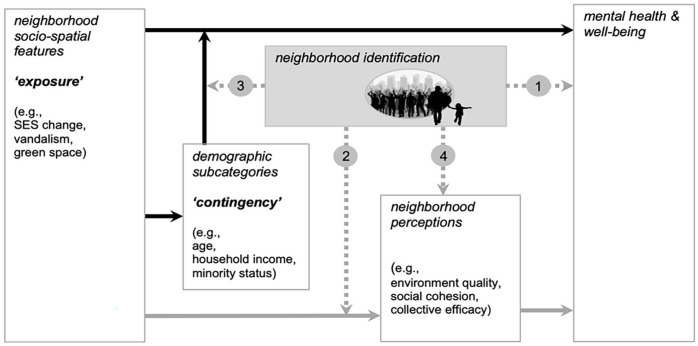
Integrative theorizing is needed to advance our understanding of the relationship between where a person lives and their mental health. To this end, we introduce a social identity model that provides an integrated explanation of the ways in which social-psychological processes mediate and moderate the links between neighborhood and mental health. In developing this model, we first review existing models that are derived primarily from a resource-availability perspective informed by research in social epidemiology, health geography, and urban sociology. Building on these, the social identity model implicates neighborhood identification in four key pathways between residents' local environment and their mental health. We review a wealth of recent research that supports this model and which speaks to its capacity to integrate and extend insights from established models. We also explore the implications of the social identity approach for policy and intervention.
We need to understand the connection between where people live and their mental health better than we do. This article helps us do this by presenting an integrated model of the way that social and psychological factors affect the relationship between someone's neighborhood and their mental health. This model builds on insights from social epidemiology, health geography, and urban sociology. Its distinct and novel contribution is to point to the importance of four pathways through which neighborhood identification shapes residents' mental health. A large body of recent research supports this model and highlights its potential to integrate and expand upon existing theories. We also discuss how our model can inform policies and interventions that seek to improve mental health outcomes in communities.
为了增进我们对于个体居住地点与其心理健康之间关系的理解,需要采用综合性的理论。为此,我们引入了一个社会认同模型,该模型提供了一个综合的解释,说明了社会心理过程在多大程度上调节和中介了邻里关系与心理健康之间的联系。在提出这个模型时,我们首先回顾了现有的主要基于资源可用性视角的模型,这些模型源自社会流行病学、健康地理学和城市社会学的研究。在此基础上,社会认同模型将邻里认同纳入了居民当地环境与其心理健康之间的四个关键途径。我们回顾了大量支持这一模型的最新研究,这些研究表明该模型具有整合和扩展现有模型的见解的能力。我们还探讨了社会认同方法对于政策和干预的意义。
我们需要更好地理解人们的居住地点与其心理健康之间的联系。本文通过提出一个综合模型,帮助我们做到了这一点。该模型展示了社会和心理因素如何影响个体的邻里关系与其心理健康之间的关系。这个模型建立在社会流行病学、健康地理学和城市社会学的见解之上。它的独特贡献在于指出了邻里认同影响居民心理健康的四个途径。大量的最新研究支持了这个模型,并强调了它整合和扩展现有理论的潜力。我们还讨论了我们的模型如何为旨在改善社区心理健康结果的政策和干预提供信息。