Institute for Human Neuroscience, Boys Town National Research Hospital, Boys Town, NE 68010, USA.
College of Medicine, University of Nebraska Medical Center, Omaha, NE 68198, USA.
Aging (Albany NY). 2023 Dec 27;15(24):14574-14590. doi: 10.18632/aging.205403.
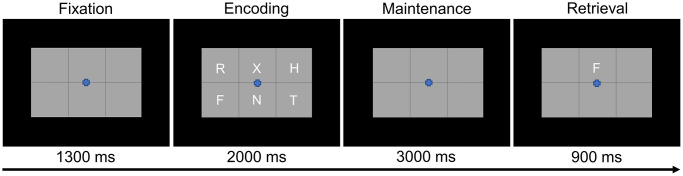
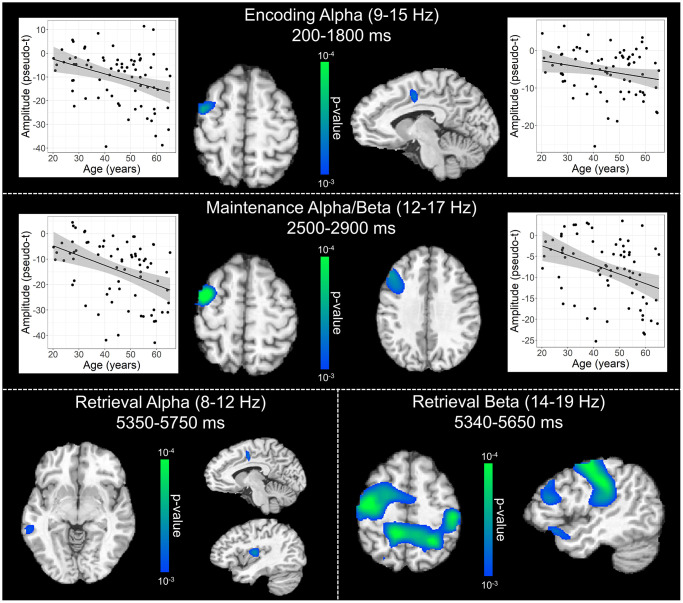
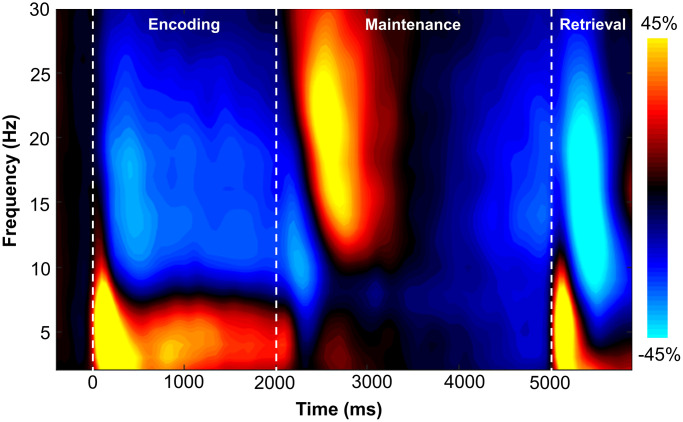
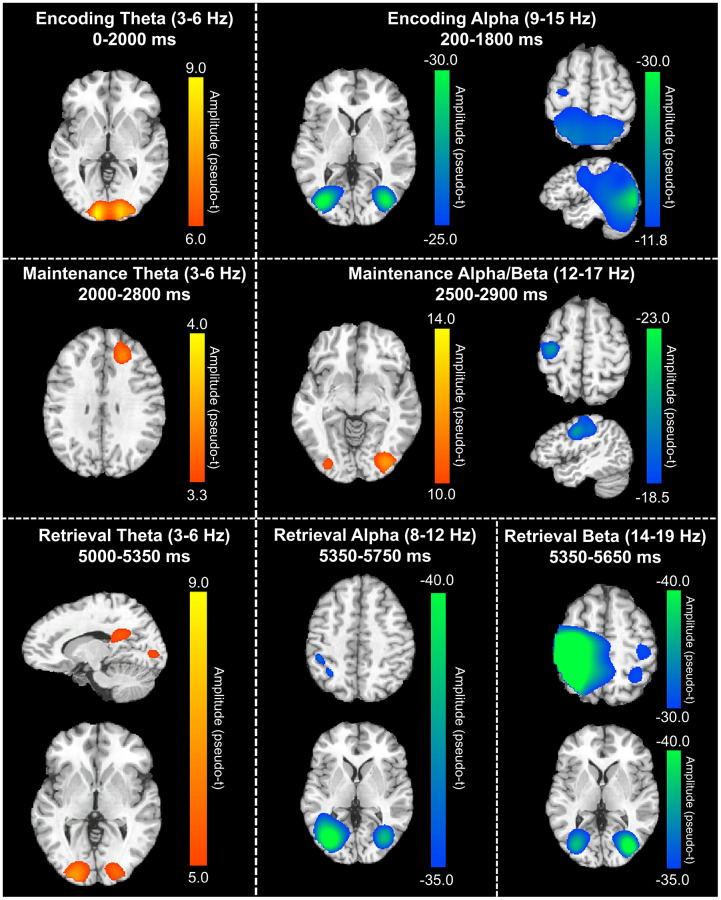
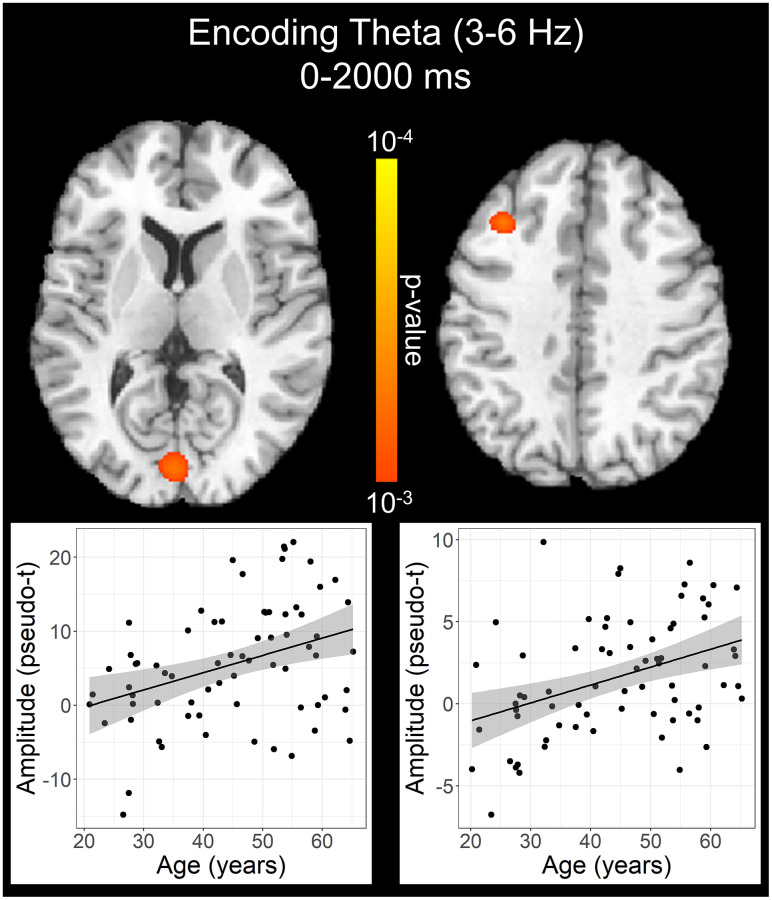
Working memory (WM) is a foundational cognitive function involving the temporary storage of information. Unfortunately, WM is also one of the most sensitive cognitive functions to the detrimental effects of aging. Expanding the field's understanding of age-related WM changes is critical to advancing the development of strategies to mitigate age-related WM declines. In the current study, we investigated the neural mechanisms serving WM function in seventy-eight healthy aging adults (range: 20.2-65.2 years) using magnetoencephalography (MEG) and a Sternberg WM task with letter stimuli. Neural activity during the different phases of the WM task (i.e., encoding, maintenance, and retrieval) were imaged using a time-frequency resolved beamformer and whole-brain statistics were performed. We found stronger increases in theta activity and stronger decreases in alpha and beta activity (i.e., more negative relative to baseline) as a function of healthy aging. Specifically, age-related increases in theta activity were detected during the encoding period in the primary visual and left prefrontal cortices. Additionally, alpha and beta oscillations were stronger (i.e., more negative) during both encoding and maintenance in the left prefrontal cortex in older individuals. Finally, alpha and beta oscillations during the retrieval phase were stronger (i.e., more negative) in older participants within the prefrontal, parietal, and temporal cortices. Together, these results indicate that healthy aging strongly modulates the neural oscillatory dynamics serving WM function.
工作记忆(WM)是一种基础认知功能,涉及信息的临时存储。不幸的是,WM 也是对衰老有害影响最敏感的认知功能之一。扩展该领域对与年龄相关的 WM 变化的理解对于推进减轻与年龄相关的 WM 下降的策略的发展至关重要。在当前的研究中,我们使用脑磁图(MEG)和 Sternberg WM 任务(使用字母刺激)研究了 78 名健康老年人(年龄范围:20.2-65.2 岁)的 WM 功能的神经机制。使用时频分辨波束形成器对 WM 任务的不同阶段(即编码、维持和检索)期间的神经活动进行成像,并进行全脑统计分析。我们发现,随着健康老龄化,θ 活动的增强和 α 和 β 活动的减弱(即相对于基线更负)。具体来说,在初级视觉和左侧前额叶皮层的编码期间检测到与年龄相关的 θ 活动增加。此外,在老年人中,左前额叶皮层在编码和维持期间的α 和β 振荡更强(即更负)。最后,在检索阶段,前额叶、顶叶和颞叶皮层内的老年参与者的α 和β 振荡更强(即更负)。总之,这些结果表明,健康老龄化强烈调节了支持 WM 功能的神经振荡动力学。