Hassan Salma, Hsu Ying, Mayer Sara K, Thomas Jacintha, Kothapalli Aishwarya, Helms Megan, Baker Sheila A, Laird Joseph G, Bhattarai Sajag, Drack Arlene V
Department of Anatomy and Cell Biology, Biomedical Science- Cell and Developmental Biology Graduate Program, Iowa City, IA, USA.
Department of Ophthalmology and Visual Sciences, IVR, Iowa City, IA, USA.
Saudi J Ophthalmol. 2023 Nov 18;37(4):313-320. doi: 10.4103/sjopt.sjopt_155_23. eCollection 2023 Oct-Dec.
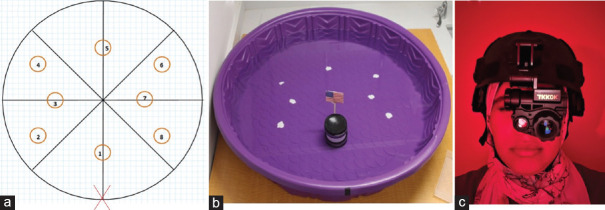
The purpose of this study was to develop a visually guided swim assay (VGSA) for measuring vision in mouse retinal disease models comparable to the multi-luminance mobility test (MLMT) utilized in human clinical trials.
Three mouse retinal disease models were studied: Bardet-Biedl syndrome type 1 (), = 5; Bardet-Biedl syndrome type 10 (), = 11; and X linked retinoschisis (retinoschisin knockout; KO), = 5. Controls were normally-sighted mice, = 10. Eyeless mice, n = 4, were used to determine the performance of animals without vision in VGSA.
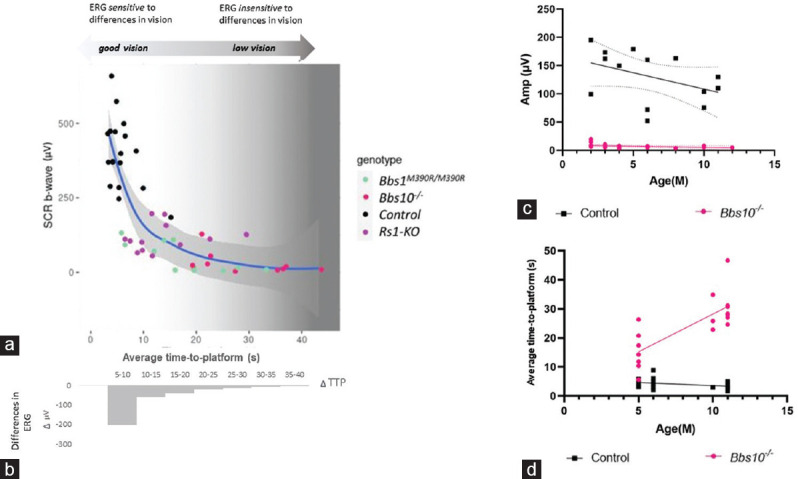
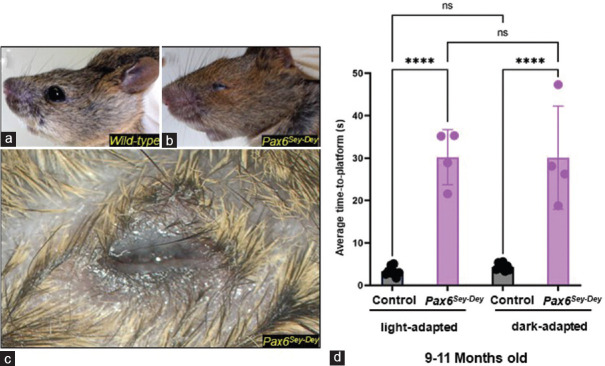
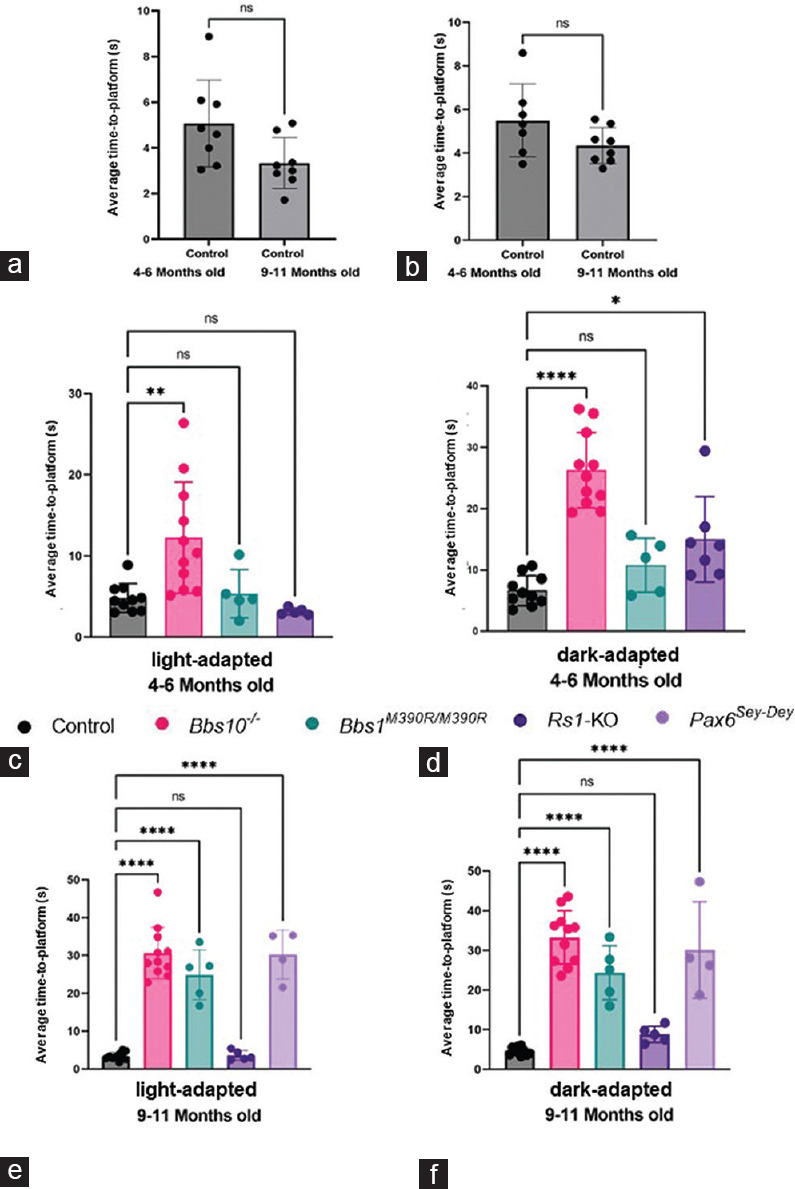
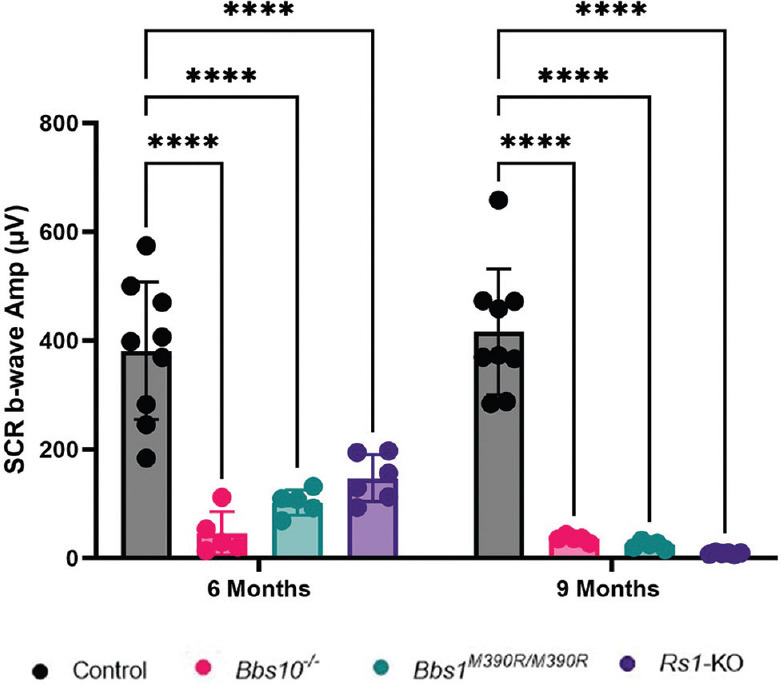
Eyeless mice had a VGSA time-to-platform (TTP) 7X longer than normally-sighted controls ( < 0.0001). Controls demonstrated no difference in their TTP in both lighting conditions; the same was true for . At 4-6 M, KO and had longer TTP in the dark than controls ( = 0.0156 and = 1.23 × 10, respectively). At 9-11 M, both BBS models had longer TTP than controls in light and dark with times similar to ( < 0.0001), demonstrating progressive vision loss in BBS models, but not in controls nor in KO. At 1 M, ERG light-adapted (cone) amplitudes were nonrecordable, resulting in a floor effect. VGSA did not reach a floor until 9-11 M. ERG combined rod/cone b-wave amplitudes were nonrecordable in all three mutant groups at 9-11 M, but VGSA still showed differences in visual function. ERG values correlate non-linearly with VGSA, and VGSA measured the continual decline of vision.
ERG is no longer a useful endpoint once the nonrecordable level is reached. VGSA differentiates between different levels of vision, different ages, and different disease models even after ERG is nonrecordable, similar to the MLMT in humans.
本研究的目的是开发一种视觉引导游泳试验(VGSA),用于在小鼠视网膜疾病模型中测量视力,该试验可与人类临床试验中使用的多亮度移动性测试(MLMT)相媲美。
研究了三种小鼠视网膜疾病模型:1型巴德-比埃尔综合征(BBS1),n = 5;10型巴德-比埃尔综合征(BBS10),n = 11;以及X连锁视网膜劈裂症(视网膜劈裂蛋白敲除;KO),n = 5。对照组为视力正常的小鼠,n = 10。无眼小鼠(n = 4)用于确定在VGSA中无视力的动物的表现。
无眼小鼠到达平台的时间(TTP)比视力正常的对照组长7倍(P < 0.0001)。对照组在两种光照条件下的TTP没有差异;BBS1也是如此。在4 - 6月龄时,KO和BBS10在黑暗中的TTP比对照组更长(分别为P = 0.0156和P = 1.23×10⁻⁴)。在9 - 11月龄时,两种BBS模型在明、暗条件下的TTP均比对照组更长,且与BBS10相似(P < 0.0001),表明BBS模型存在进行性视力丧失,而对照组和KO组则没有。在1月龄时,BBS1的视网膜电图(ERG)光适应(视锥细胞)振幅无法记录,导致出现下限效应。VGSA直到9 - 11月龄才达到下限。在9 - 11月龄时,所有三个突变组的ERG联合视杆/视锥细胞b波振幅均无法记录,但VGSA仍显示出视觉功能的差异。ERG值与VGSA呈非线性相关,并且VGSA测量了视力的持续下降。
一旦达到无法记录的水平,ERG就不再是一个有用的终点指标。即使在ERG无法记录之后,VGSA仍能区分不同水平的视力、不同年龄和不同疾病模型,这与人类的MLMT类似。