School of Information Engineering, Xijing University, Xi'an, China.
College of Grassland and Environment Sciences, Xinjiang Agricultural University, Urumqi, China.
BMC Bioinformatics. 2024 Jan 2;25(1):6. doi: 10.1186/s12859-023-05629-x.
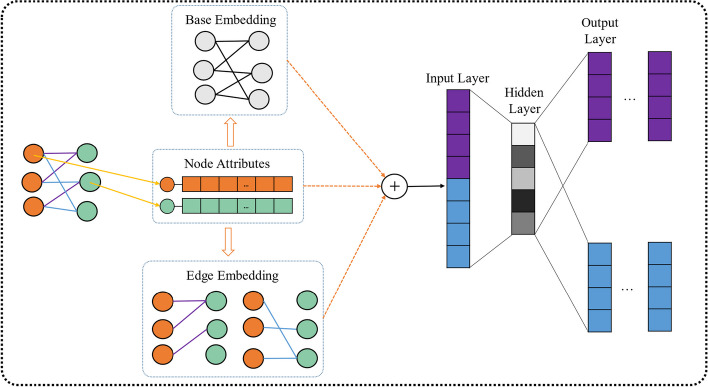
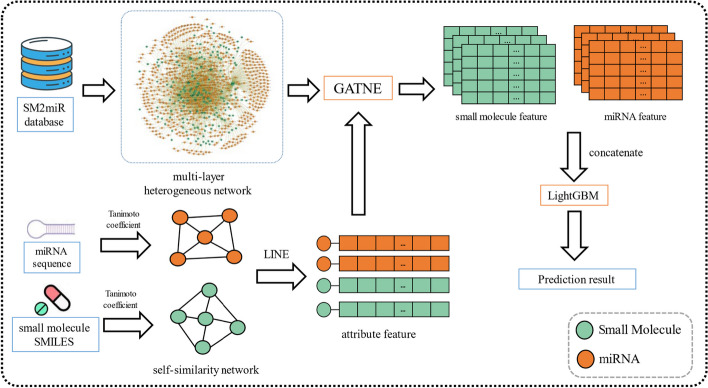
According to the expression of miRNA in pathological processes, miRNAs can be divided into oncogenes or tumor suppressors. Prediction of the regulation relations between miRNAs and small molecules (SMs) becomes a vital goal for miRNA-target therapy. But traditional biological approaches are laborious and expensive. Thus, there is an urgent need to develop a computational model. In this study, we proposed a computational model to predict whether the regulatory relationship between miRNAs and SMs is up-regulated or down-regulated. Specifically, we first use the Large-scale Information Network Embedding (LINE) algorithm to construct the node features from the self-similarity networks, then use the General Attributed Multiplex Heterogeneous Network Embedding (GATNE) algorithm to extract the topological information from the attribute network, and finally utilize the Light Gradient Boosting Machine (LightGBM) algorithm to predict the regulatory relationship between miRNAs and SMs. In the fivefold cross-validation experiment, the average accuracies of the proposed model on the SM2miR dataset reached 79.59% and 80.37% for up-regulation pairs and down-regulation pairs, respectively. In addition, we compared our model with another published model. Moreover, in the case study for 5-FU, 7 of 10 candidate miRNAs are confirmed by related literature. Therefore, we believe that our model can promote the research of miRNA-targeted therapy.
根据 miRNA 在病理过程中的表达情况,miRNA 可分为癌基因或肿瘤抑制因子。预测 miRNA 和小分子 (SMs) 之间的调控关系成为 miRNA 靶向治疗的重要目标。但传统的生物学方法既费力又昂贵。因此,迫切需要开发一种计算模型。在这项研究中,我们提出了一种计算模型来预测 miRNA 和 SMs 之间的调控关系是上调还是下调。具体来说,我们首先使用大规模信息网络嵌入 (LINE) 算法从自相似网络中构建节点特征,然后使用通用属性多重异质网络嵌入 (GATNE) 算法从属性网络中提取拓扑信息,最后利用 Light Gradient Boosting Machine (LightGBM) 算法预测 miRNA 和 SMs 之间的调控关系。在五重交叉验证实验中,所提出模型在 SM2miR 数据集上的上调对和下调对的平均准确率分别达到 79.59%和 80.37%。此外,我们还将我们的模型与另一个已发表的模型进行了比较。此外,在对 5-FU 的案例研究中,有 10 个候选 miRNA 中的 7 个被相关文献证实。因此,我们相信我们的模型可以促进 miRNA 靶向治疗的研究。