Department of Psychiatry & Neuroscience and CERVO Brain Research Center, Universite Laval, Quebec City, Canada.
Institute for Nuclear Sciences Applied to Health (ICNAS), University of Coimbra, Coimbra, Portugal.
Fluids Barriers CNS. 2024 Jan 4;21(1):2. doi: 10.1186/s12987-023-00496-3.
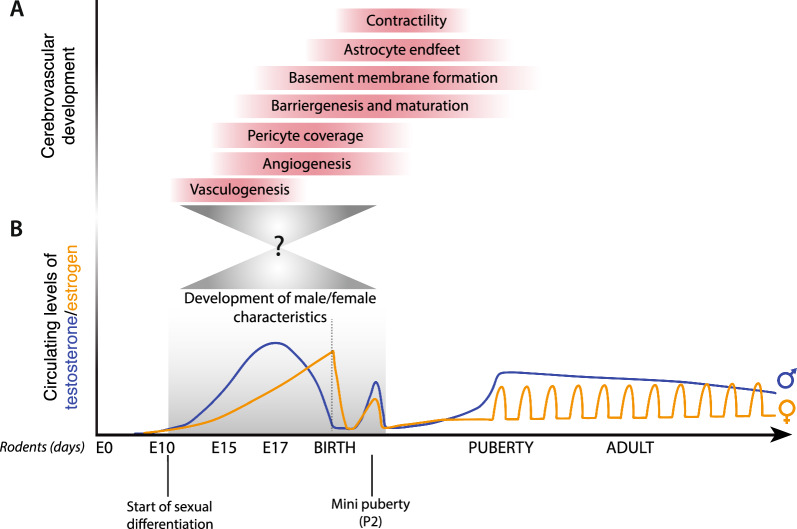
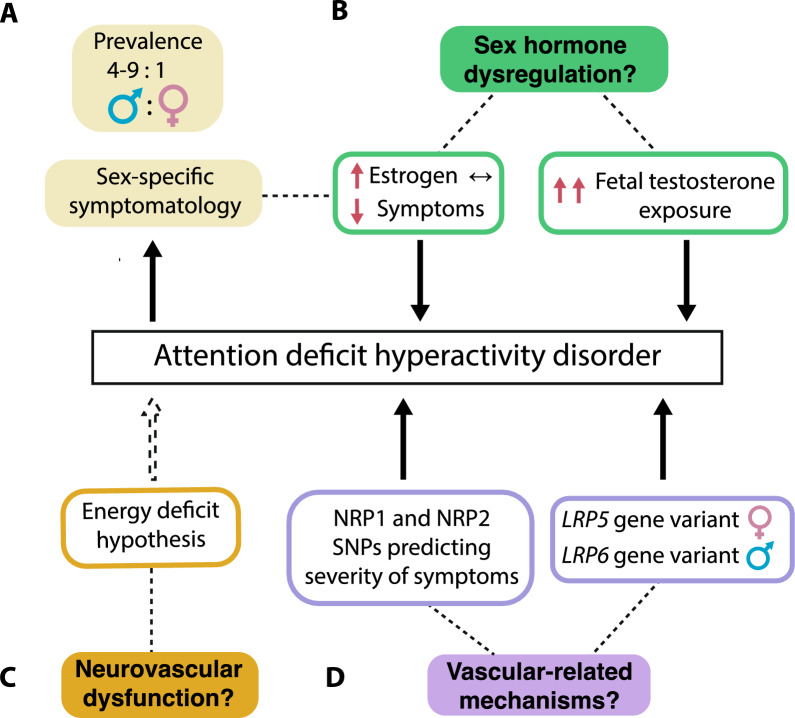
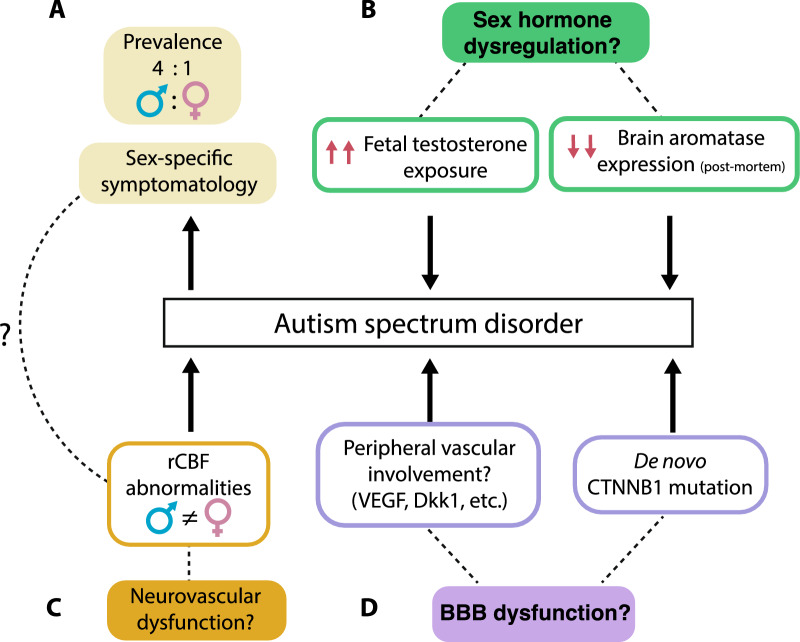
Proper cerebrovascular development and neurogliovascular unit assembly are essential for brain growth and function throughout life, ensuring the continuous supply of nutrients and oxygen. This involves crucial events during pre- and postnatal stages through key pathways, including vascular endothelial growth factor (VEGF) and Wnt signaling. These pathways are pivotal for brain vascular growth, expansion, and blood-brain barrier (BBB) maturation. Interestingly, during fetal and neonatal life, cerebrovascular formation coincides with the early peak activity of the hypothalamic-pituitary-gonadal axis, supporting the idea of sex hormonal influence on cerebrovascular development and barriergenesis.Sex hormonal dysregulation in early development has been implicated in neurodevelopmental disorders with highly sexually dimorphic features, such as autism spectrum disorder (ASD) and attention-deficit/hyperactivity disorder (ADHD). Both disorders show higher prevalence in men, with varying symptoms between sexes, with boys exhibiting more externalizing behaviors, such as aggressivity or hyperactivity, and girls displaying higher internalizing behaviors, including anxiety, depression, or attention disorders. Indeed, ASD and ADHD are linked to high prenatal testosterone exposure and reduced aromatase expression, potentially explaining sex differences in prevalence and symptomatology. In line with this, high estrogen levels seem to attenuate ADHD symptoms. At the cerebrovascular level, sex- and region-specific variations of cerebral blood flow perfusion have been reported in both conditions, indicating an impact of gonadal hormones on the brain vascular system, disrupting its ability to respond to neuronal demands.This review aims to provide an overview of the existing knowledge concerning the impact of sex hormones on cerebrovascular formation and maturation, as well as the onset of neurodevelopmental disorders. Here, we explore the concept of gonadal hormone interactions with brain vascular and BBB development to function, with a particular focus on the modulation of VEGF and Wnt signaling. We outline how these pathways may be involved in the underpinnings of ASD and ADHD. Outstanding questions and potential avenues for future research are highlighted, as uncovering sex-specific physiological and pathological aspects of brain vascular development might lead to innovative therapeutic approaches in the context of ASD, ADHD and beyond.
适当的脑血管发育和神经胶质血管单元组装对于大脑在整个生命周期中的生长和功能至关重要,确保了营养物质和氧气的持续供应。这涉及到产前和产后阶段的关键事件,包括血管内皮生长因子(VEGF)和 Wnt 信号通路。这些途径对于脑血管的生长、扩张和血脑屏障(BBB)的成熟至关重要。有趣的是,在胎儿和新生儿期,脑血管的形成与下丘脑-垂体-性腺轴的早期高峰活动同时发生,支持了性激素对脑血管发育和屏障形成有影响的观点。早期发育中的性激素失调与具有高度性别二态特征的神经发育障碍有关,如自闭症谱系障碍(ASD)和注意缺陷多动障碍(ADHD)。这两种疾病在男性中的患病率更高,且性别间症状存在差异,男孩表现出更多的外化行为,如攻击性或多动,女孩表现出更高的内化行为,包括焦虑、抑郁或注意力障碍。事实上,ASD 和 ADHD 与产前高睾酮暴露和芳香化酶表达减少有关,这可能解释了患病率和症状学的性别差异。与此一致的是,高雌激素水平似乎可以减轻 ADHD 症状。在脑血管水平,两种情况下都报道了大脑血流灌注的性别和区域特异性变化,这表明性腺激素对脑血管系统有影响,破坏了其对神经元需求的反应能力。本综述旨在概述性激素对脑血管形成和成熟以及神经发育障碍发生的影响的现有知识。在这里,我们探讨了性腺激素与脑血管和 BBB 发育和功能的相互作用的概念,特别关注 VEGF 和 Wnt 信号通路的调节。我们概述了这些途径如何参与 ASD 和 ADHD 的基础。突出了悬而未决的问题和未来研究的潜在途径,因为揭示大脑血管发育的性别特异性生理和病理方面可能会为 ASD、ADHD 及其他方面的创新治疗方法提供线索。