Research Center for Child Mental Development, Chiba University, 1-8-1 Inohana, Chuouku, Chiba, 260-8670, Japan.
United Graduate School of Child Development, Osaka University, Kanazawa University; Hamamatsu University School of Medicine, Chiba University, and University of Fukui, Osaka, Japan.
Mol Autism. 2024 Jan 4;15(1):1. doi: 10.1186/s13229-023-00579-w.
To examine the relationship between social camouflage and mental health in Japanese autistic adults and make an international comparison with a sample from the UK.
This study analysed secondary data of participants with a self-reported diagnosis of autism from Japan (N = 210; 123 men and 87 women) and the UK (N = 305; 181 women, 104, men, and 18 nonbinary). The relationships between the quadratic term of the Camouflaging Autistic Traits Questionnaire and mental health scales, including depression and anxiety, were assessed.
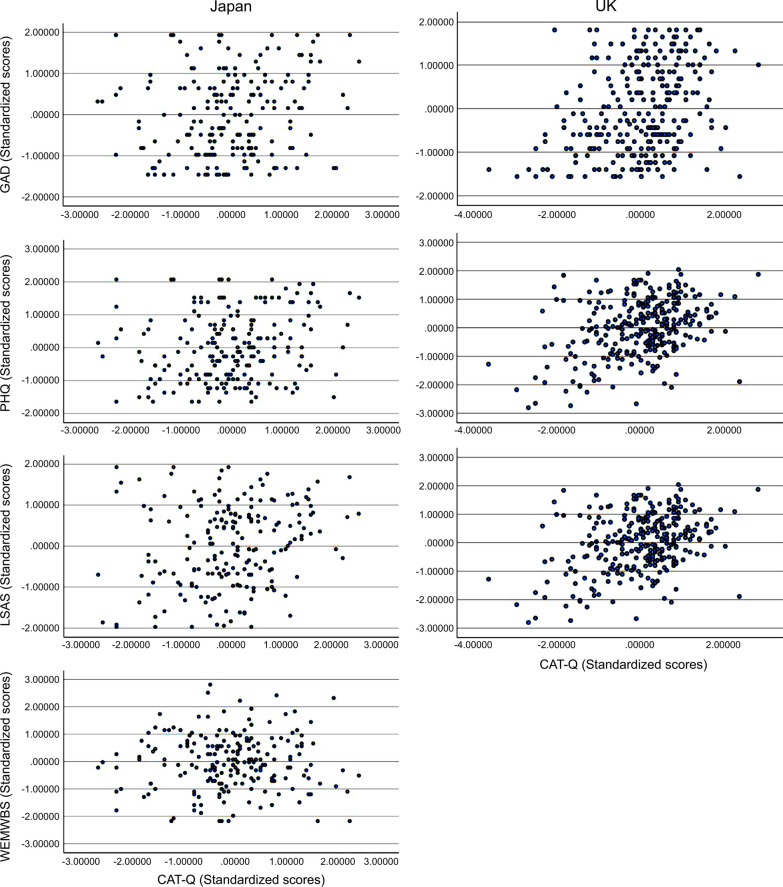
The UK sample showed linear relationships, whereas the Japanese sample showed significant nonlinear relationships. The quadratic terms of the Camouflaging Autistic Traits Questionnaire slightly explained generalised anxiety (β = .168, p = .007), depression (β = .121, p = .045), and well-being (β = - .127, p = .028). However, they did not explain the association between social anxiety and the Camouflaging Autistic Traits Questionnaire.
Participants had self-reported diagnoses, and while the autism-spectrum quotient provides a cut-off value for screening, it does not enable confirming diagnoses. Mean scores of the Japanese version of the Camouflaging Autistic Traits Questionnaire were lower as compared to the original CAT-Q, which implies that the social camouflage strategy types used by autistic people in Japan and the UK could differ. The cross-sectional design limits causal inferences.
In the UK, more social camouflage was associated with poorer mental health scores, whereas too little or too much social camouflage was associated with a low mental health score in Japan. The Japanese population is seemingly less aware of and educated on autistic characteristics and considers 'average' behaviour a good thing. This could influence Japanese autistic people's social camouflage use, differing from that of autistic people in the UK. The differences in the relationship between social camouflage and mental health between Japan and the UK could be associated with national-level divergence regarding the culture of autism.
本研究旨在探讨日本成年自闭症患者社会伪装与心理健康之间的关系,并与英国样本进行国际比较。
本研究分析了来自日本(N=210;123 名男性,87 名女性)和英国(N=305;181 名女性,104 名男性,18 名非二元性别)的自我报告自闭症诊断参与者的二级数据。评估了社会伪装特质问卷的二次项与心理健康量表(包括抑郁和焦虑)之间的关系。
英国样本呈线性关系,而日本样本呈显著非线性关系。社会伪装特质问卷的二次项略微解释了广泛性焦虑(β=0.168,p=0.007)、抑郁(β=0.121,p=0.045)和幸福感(β=-0.127,p=0.028)。然而,它们并不能解释社交焦虑与社会伪装特质问卷之间的关系。
参与者的诊断是自我报告的,尽管自闭症谱系商数提供了一个筛查的截止值,但它并不能确认诊断。日本版社会伪装特质问卷的平均分低于原始 CAT-Q,这意味着日本和英国的自闭症患者使用的社会伪装策略类型可能不同。横断面设计限制了因果推断。
在英国,更多的社会伪装与较差的心理健康评分相关,而在日本,过少或过多的社会伪装与心理健康评分较低相关。日本人口对自闭症特征的认识和教育程度似乎较低,他们认为“平均”行为是一件好事。这可能会影响日本自闭症患者的社会伪装使用,与英国自闭症患者的使用方式不同。日本和英国社会伪装与心理健康之间关系的差异可能与自闭症文化的国家层面差异有关。