Department of Epidemiology, The University of Texas MD Anderson Cancer Center, Houston, Texas, USA.
Department of Biostatistics, The University of Texas MD Anderson Cancer Center, Houston, Texas, USA.
Cancer Med. 2024 Jan;13(1):e6902. doi: 10.1002/cam4.6902. Epub 2024 Jan 5.
We examined the awareness, interest, and information sources relating to cannabis use for cancer management (including management of cancer symptoms and treatment-related side effects) and determined factors associated with cancer survivors' awareness and interest in learning about cannabis use for cancer management.
This was a cross-sectional study of adult cancer survivors (N = 1886) receiving treatment at a comprehensive cancer center. Weighted prevalence and multivariable logistic regression analyses were conducted.
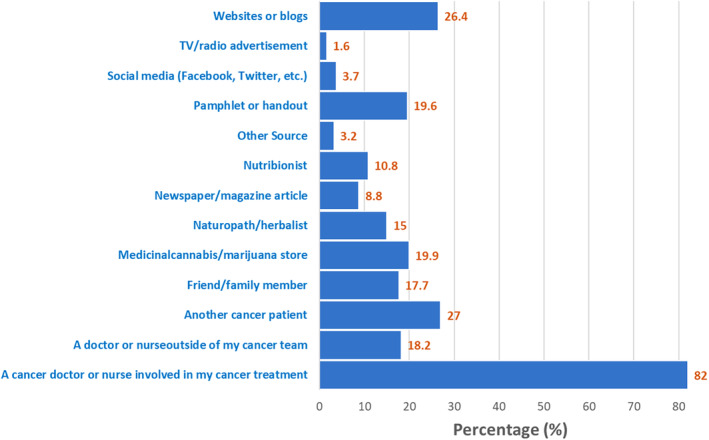
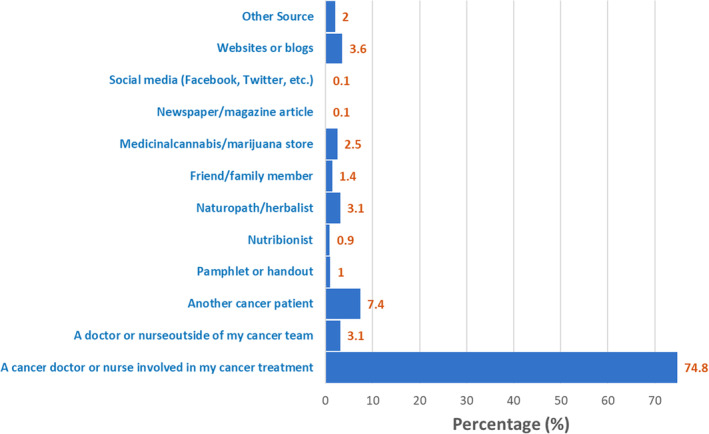
Among cancer survivors, 88% were aware and 60% were interested in learning about cannabis use for cancer management. Common sources of information to learn about cannabis use for cancer management were cancer doctors/nurses (82%), other patients with cancer (27%), websites/blogs (26%), marijuana stores (20%), and family/friends (18%). The odds of being aware of cannabis use for cancer management was lower among male compared to female survivors (adjusted odds ratio [AOR]: 0.61; 95% confidence interval [CI]: 0.41-0.90), non-Hispanic Blacks compared to non-Hispanic Whites (AOR: 0.36; 95% CI: 0.21-0.62), and survivors who do not support the legalization of cannabis for medical use compared to those who do (AOR: 0.10; 95% CI: 0.04-0.23). On the other hand, the odds of being interested in cannabis use for cancer management was higher among non-Hispanic Blacks compared to non-Hispanic Whites (AOR: 1.65; 95% CI: 1.04-2.62), and among cancer survivors actively undergoing cancer treatment compared to patients on non-active treatment (AOR: 2.25; 95% CI: 1.74-2.91).
Awareness of cannabis use for cancer management is high within the cancer survivor population. Results indicated health care providers are leading information source and should receive continued medical education on cannabis-specific guidelines. Similarly, tailored educational interventions are needed to guide survivors on the benefits and risks of cannabis use for cancer management.
我们调查了与大麻用于癌症治疗(包括癌症症状管理和治疗相关副作用管理)相关的认知、兴趣和信息来源,并确定了与癌症幸存者对了解大麻用于癌症治疗的认知和兴趣相关的因素。
这是一项在综合癌症中心接受治疗的成年癌症幸存者(N=1886)的横断面研究。进行了加权患病率和多变量逻辑回归分析。
在癌症幸存者中,88%的人知晓,60%的人有兴趣了解大麻用于癌症治疗。了解大麻用于癌症治疗的常见信息来源包括癌症医生/护士(82%)、其他癌症患者(27%)、网站/博客(26%)、大麻店(20%)和家人/朋友(18%)。与女性幸存者相比,男性幸存者对大麻用于癌症治疗的认知较低(调整后的优势比[OR]:0.61;95%置信区间[CI]:0.41-0.90),非西班牙裔黑人比非西班牙裔白人低(调整后的 OR:0.36;95%CI:0.21-0.62),与不支持大麻用于医疗合法化的幸存者相比,支持大麻用于医疗合法化的幸存者认知度较低(调整后的 OR:0.10;95%CI:0.04-0.23)。另一方面,与非西班牙裔白人相比,非西班牙裔黑人对大麻用于癌症治疗的兴趣更高(调整后的 OR:1.65;95%CI:1.04-2.62),与正在接受癌症治疗的癌症幸存者相比,与非活跃治疗的患者相比,癌症幸存者的兴趣更高(调整后的 OR:2.25;95%CI:1.74-2.91)。
癌症幸存者群体对大麻用于癌症治疗的认知度很高。结果表明,医疗保健提供者是主要的信息来源,应接受有关大麻特定指南的持续医学教育。同样,需要有针对性的教育干预措施来指导幸存者了解大麻用于癌症治疗的益处和风险。