MRC Integrative Epidemiology Unit at the University of Bristol, Oakfield House, Oakfield Grove, Bristol, BS8 2BN, UK.
Population Health Sciences, Bristol Medical School, University of Bristol, Bristol, UK.
Eur J Epidemiol. 2024 Mar;39(3):257-270. doi: 10.1007/s10654-023-01086-1. Epub 2024 Jan 6.
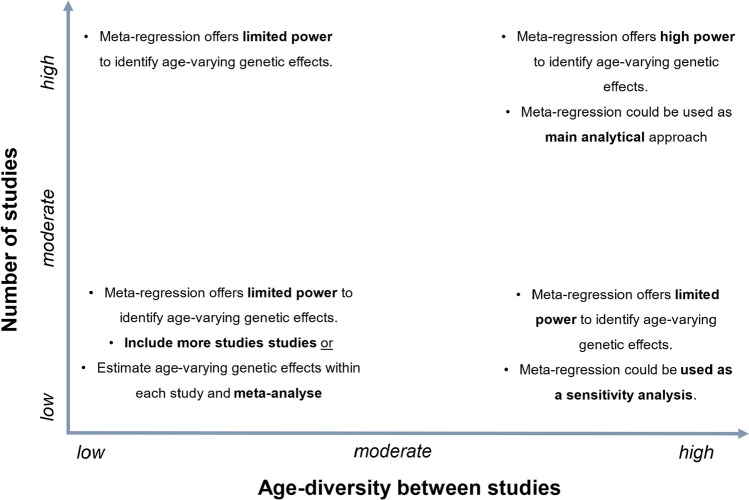
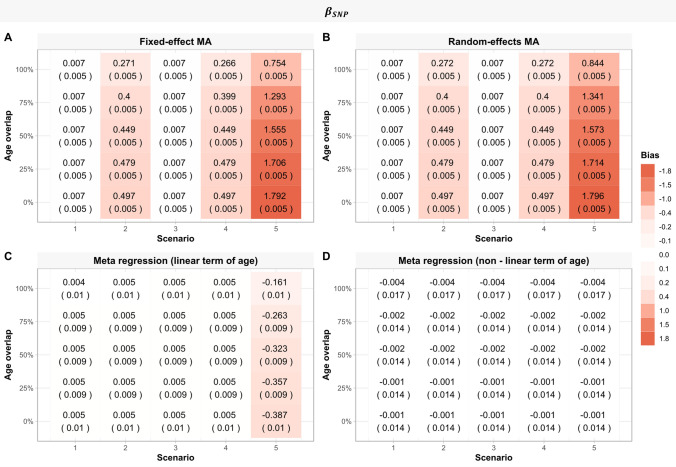
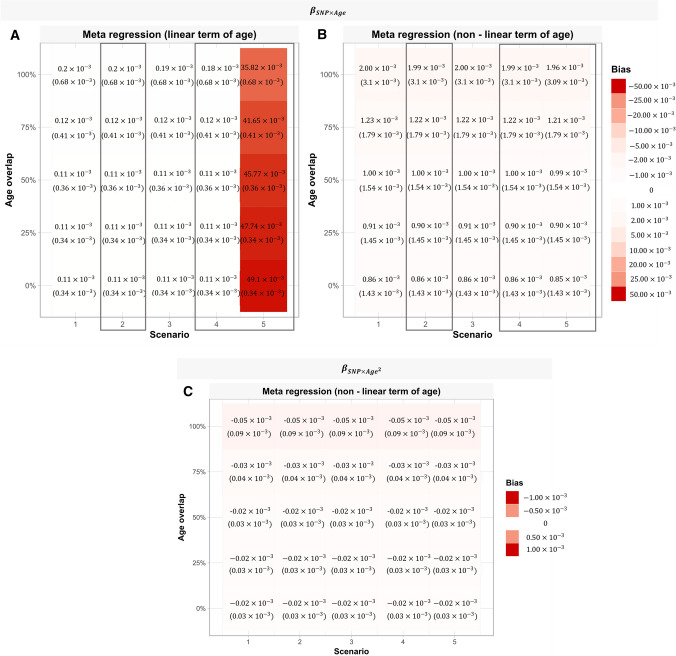
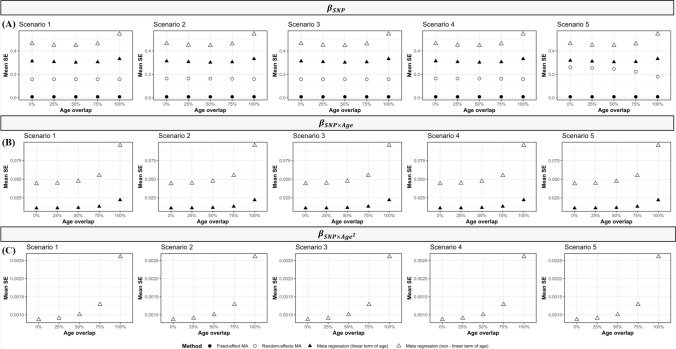
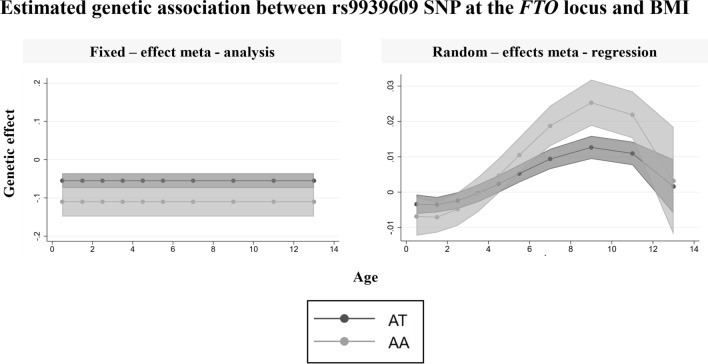
Fixed-effect meta-analysis has been used to summarize genetic effects on a phenotype across multiple Genome-Wide Association Studies (GWAS) assuming a common underlying genetic effect. Genetic effects may vary with age (or other characteristics), and not allowing for this in a GWAS might lead to bias. Meta-regression models between study heterogeneity and allows effect modification of the genetic effects to be explored. The aim of this study was to explore the use of meta-analysis and meta-regression for estimating age-varying genetic effects on phenotypes. With simulations we compared the performance of meta-regression to fixed-effect and random -effects meta-analyses in estimating (i) main genetic effects and (ii) age-varying genetic effects (SNP by age interactions) from multiple GWAS studies under a range of scenarios. We applied meta-regression on publicly available summary data to estimate the main and age-varying genetic effects of the FTO SNP rs9939609 on Body Mass Index (BMI). Fixed-effect and random-effects meta-analyses accurately estimated genetic effects when these did not change with age. Meta-regression accurately estimated both main genetic effects and age-varying genetic effects. When the number of studies or the age-diversity between studies was low, meta-regression had limited power. In the applied example, each additional minor allele (A) of rs9939609 was inversely associated with BMI at ages 0 to 3, and positively associated at ages 5.5 to 13. Our findings challenge the assumption that genetic effects are consistent across all ages and provide a method for exploring this. GWAS consortia should be encouraged to use meta-regression to explore age-varying genetic effects.
固定效应荟萃分析已被用于总结多个全基因组关联研究(GWAS)中对表型的遗传效应,假设存在共同的潜在遗传效应。遗传效应可能随年龄(或其他特征)而变化,如果在 GWAS 中不考虑这一点,可能会导致偏倚。荟萃回归模型可以在研究异质性之间进行,并可以探索遗传效应的作用修饰。本研究旨在探索荟萃分析和荟萃回归在估计表型的年龄相关遗传效应中的应用。通过模拟,我们比较了荟萃回归在估计(i)主要遗传效应和(ii)来自多个 GWAS 研究的年龄相关遗传效应(SNP 与年龄的相互作用)的性能,在一系列场景下,固定效应和随机效应荟萃分析。我们应用荟萃回归对公开可用的汇总数据进行分析,以估计 FTO SNP rs9939609 对体重指数(BMI)的主要和年龄相关遗传效应。当遗传效应不随年龄变化时,固定效应和随机效应荟萃分析可以准确估计遗传效应。荟萃回归可以准确估计主要遗传效应和年龄相关遗传效应。当研究数量或研究之间的年龄多样性较低时,荟萃回归的功效有限。在应用示例中,rs9939609 的每个额外的次要等位基因(A)与 0 至 3 岁时的 BMI 呈负相关,与 5.5 至 13 岁时的 BMI 呈正相关。我们的发现挑战了遗传效应在所有年龄段都一致的假设,并提供了一种探索这种假设的方法。应鼓励 GWAS 联盟使用荟萃回归来探索年龄相关的遗传效应。