Dreston Jana H, Neubaum German
Department of Human-Centered Computing and Cognitive Science, University of Duisburg-Essen, Duisburg, Germany.
Front Psychol. 2023 Dec 21;14:1250051. doi: 10.3389/fpsyg.2023.1250051. eCollection 2023.
Citizens are expected to make informed voting decisions. Theoretical approaches suggest that people are most likely to acquire their political knowledge through media. As more people turn to social media as a source of news, the political knowledge gains from using these technologies are called into question. Previous research has shown that rather than increasing objective political knowledge, the use of social media for news only increases people's metacognitive sense of being knowledgeable (subjective knowledge), which in turn increases their political participation. However, it remains to be understood which particular forms of social media use, e.g., incidental or intentional news exposure, are related to which dimension of political knowledge. The present work examines (a) the extent to which different motivational forms of social media news consumption foster subjective knowledge, and (b) whether this metacognition is related not only to political participation as a broad concept, but also to specific democratic outcomes such as voting intentions.
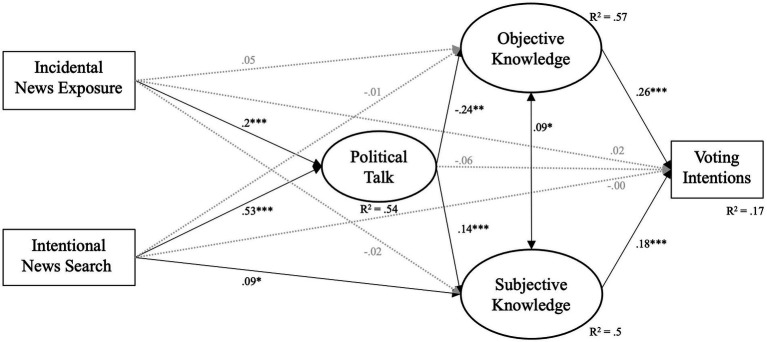
Results from a pre-registered, pre-election survey ( = 1,223) of social media users show that intentional news seeking, but not incidental news exposure on social media, is directly related to increased subjective knowledge. Subjective knowledge appears to explain the relationship between social media news use and voting.
By showing that incidental and intentional social media news use affect subjective knowledge differently, this study provides preliminary and nuanced insights into the ultimate role that social media technologies can play in democratic processes.
公民需要做出明智的投票决策。理论方法表明,人们最有可能通过媒体获取政治知识。随着越来越多的人转向社交媒体获取新闻,使用这些技术所带来的政治知识增长受到质疑。先前的研究表明,使用社交媒体获取新闻并没有增加客观政治知识,只是增强了人们自认为知识渊博的元认知感(主观知识),进而增加了他们的政治参与度。然而,仍有待了解社交媒体使用的哪些具体形式,例如偶然或有意接触新闻,与政治知识的哪个维度相关。本研究考察了(a)社交媒体新闻消费的不同动机形式在多大程度上促进主观知识,以及(b)这种元认知是否不仅与作为宽泛概念的政治参与相关,还与诸如投票意图等特定民主结果相关。
一项针对社交媒体用户的预注册、选举前调查(n = 1223)结果显示,有意寻求新闻,而非在社交媒体上偶然接触新闻,与主观知识的增加直接相关。主观知识似乎解释了社交媒体新闻使用与投票之间的关系。
通过表明偶然和有意使用社交媒体新闻对主观知识的影响不同,本研究为社交媒体技术在民主进程中最终可能发挥的作用提供了初步且细致入微的见解。