Department of Respiratory and Critical Care Medicine, West China Hospital of Sichuan University, Chengdu, Sichuan, China.
Division of Pulmonary Diseases, State Key Laboratory of Biotherapy of China, Chengdu, China.
Ther Adv Respir Dis. 2024 Jan-Dec;18:17534666231223002. doi: 10.1177/17534666231223002.
Early diagnosis of malignant pleural effusion (MPE) is of great significance. Current prediction models are not simple enough to be widely used in heavy clinical work.
We aimed to develop a simple and efficient clinical prediction scoring system to distinguish MPE from benign pleural effusion (BPE).
This retrospective study involved patients with MPE or BPE who were admitted in West China Hospital from December 2010 to September 2016.
Patients were divided into training, testing, and validation set. Prediction model was developed from training set and modified to a scoring system. The diagnostic efficacy and clinical benefits of the scoring system were estimated in all three sets.
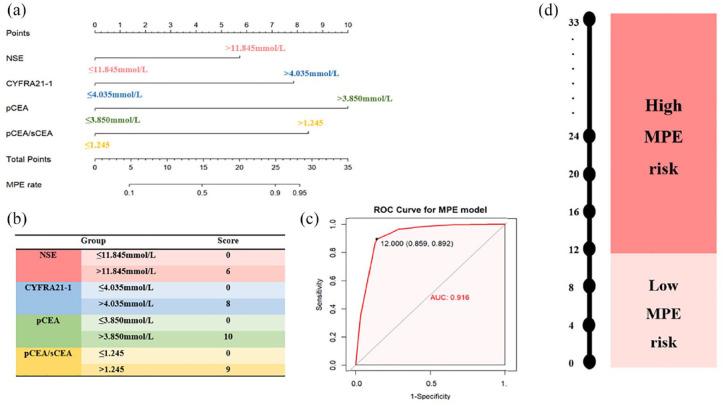
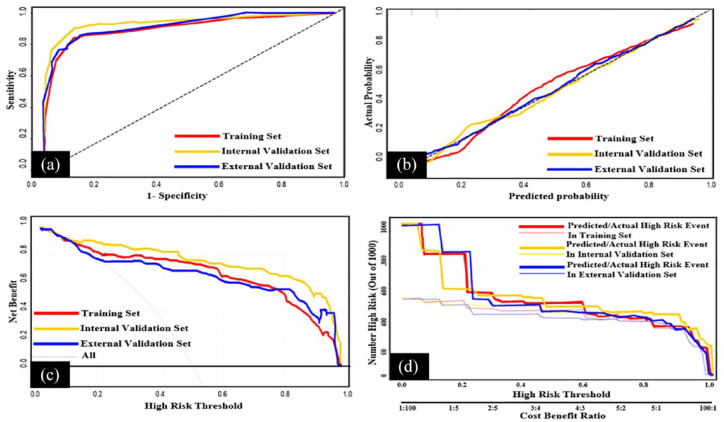
Finally, 598 cases of MPE and 1094 cases of BPE were included. Serum neuron-specific enolase, serum cytokeratin 19 fragment (CYFRA21-1), pleural carcinoembryonic antigen (CEA), and ratio of pleural CEA to serum CEA were selected to establish the prediction models in training set, which were modified to the scoring system with scores of 6, 8, 10, and 9 points, respectively. Patients with scores >12 points have high MPE risk while ⩽12 points have low MPE risk. The scoring system has a high predictive value and good clinical benefits to differentiate MPE from BPE or lung-specific MPE from BPE.
This study developed a simple clinical prediction scoring system and was proven to have good clinical benefits, and it may help clinicians to separate MPE from BPE.
恶性胸腔积液(MPE)的早期诊断具有重要意义。目前的预测模型不够简单,难以广泛应用于繁重的临床工作中。
旨在开发一种简单有效的临床预测评分系统,以区分 MPE 和良性胸腔积液(BPE)。
本回顾性研究纳入了 2010 年 12 月至 2016 年 9 月在华西医院住院的 MPE 或 BPE 患者。
患者分为训练集、测试集和验证集。从训练集中建立预测模型并将其修改为评分系统。在所有三组中评估评分系统的诊断效能和临床获益。
最终纳入 598 例 MPE 和 1094 例 BPE。选择血清神经元特异性烯醇化酶、血清细胞角蛋白 19 片段(CYFRA21-1)、胸腔癌胚抗原(CEA)和胸腔 CEA 与血清 CEA 的比值来建立训练集中的预测模型,将其修改为评分系统,得分分别为 6、8、10 和 9 分。得分>12 分的患者具有较高的 MPE 风险,而 ⩽12 分的患者具有较低的 MPE 风险。评分系统具有较高的预测价值和良好的临床获益,可用于区分 MPE 和 BPE,或肺特异性 MPE 和 BPE。
本研究开发了一种简单的临床预测评分系统,具有良好的临床获益,可能有助于临床医生区分 MPE 和 BPE。