Department of Respiratory and Critical Care Medicine, NHC Key Laboratory of Pulmonary Diseases, Union Hospital, Tongji Medical College, Huazhong University of Science and Technology, No.1277 Jiefang Avenue, Wuhan, Hubei 430022, China.
Department of Gastroenterology, Renmin Hospital of Wuhan University, Wuhan University, No.99 Zhang Zhi-dong road, Wuhan, Hubei 430060, China.
EBioMedicine. 2020 Aug;58:102924. doi: 10.1016/j.ebiom.2020.102924. Epub 2020 Jul 30.
This study aimed to establish and validate a novel scoring system based on a nomogram for the differential diagnosis of malignant pleural effusion (MPE) and benign pleural effusion (BPE).
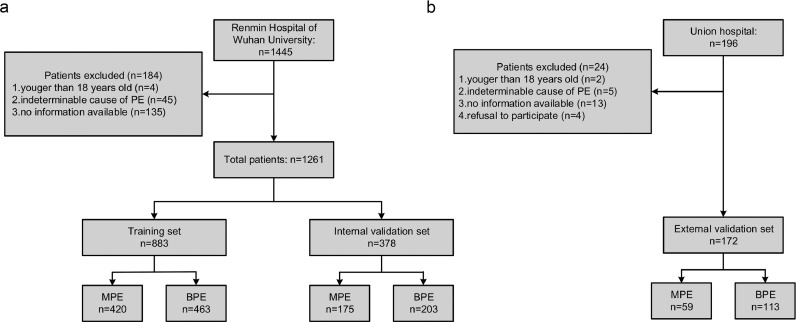
Patients with PE and confirmed aetiology who underwent diagnostic thoracentesis were included in this study. One retrospective set (N = 1261) was used to develop and internally validate the predictive model. The clinical, radiological and laboratory features were collected and subjected to logistic regression analyses. The primary predictive model was displayed as a nomogram and then modified into a novel scoring system, which was externally validated in an independent set (N = 172).
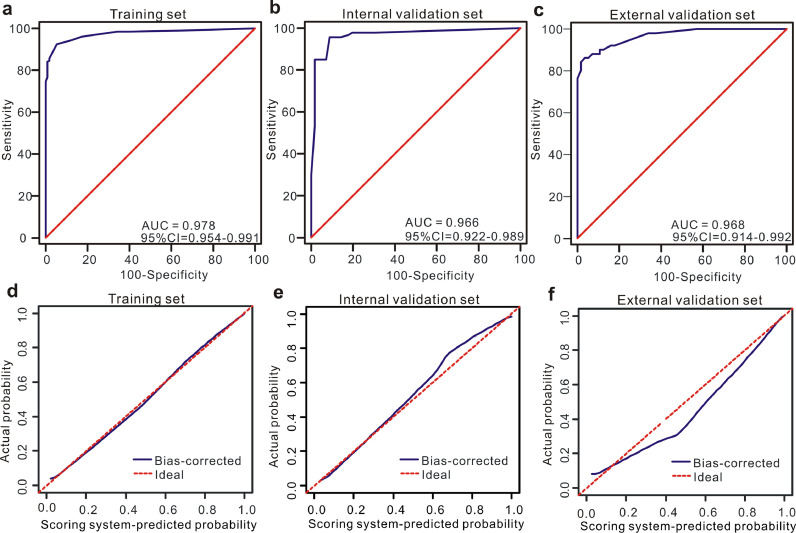
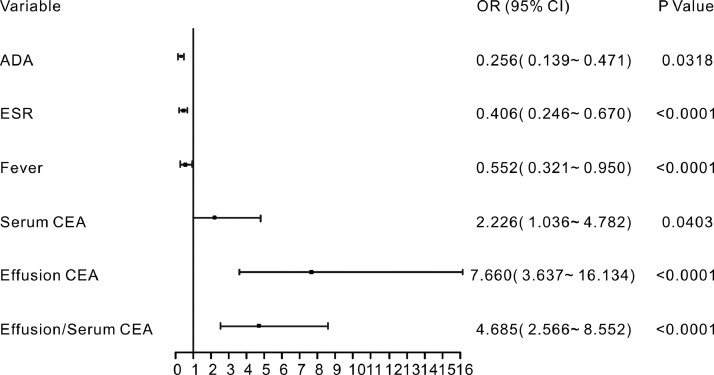
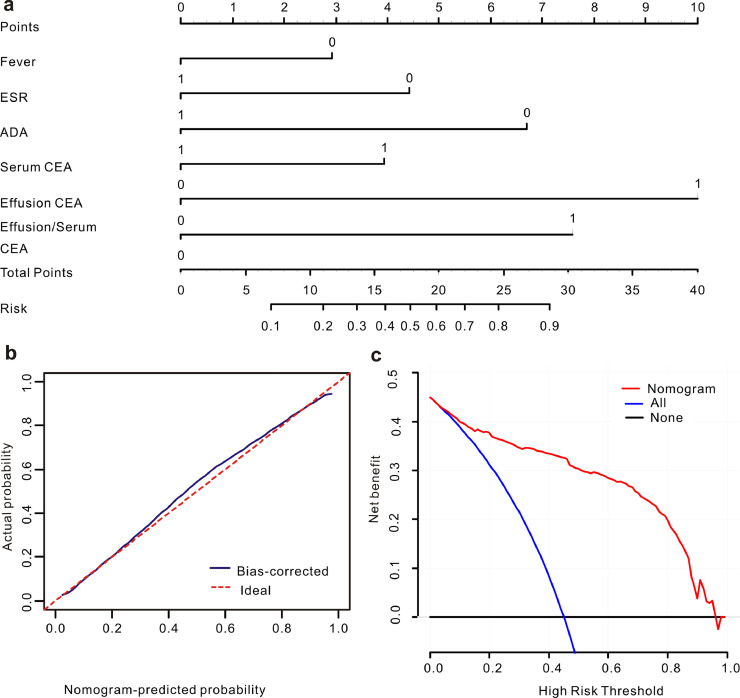
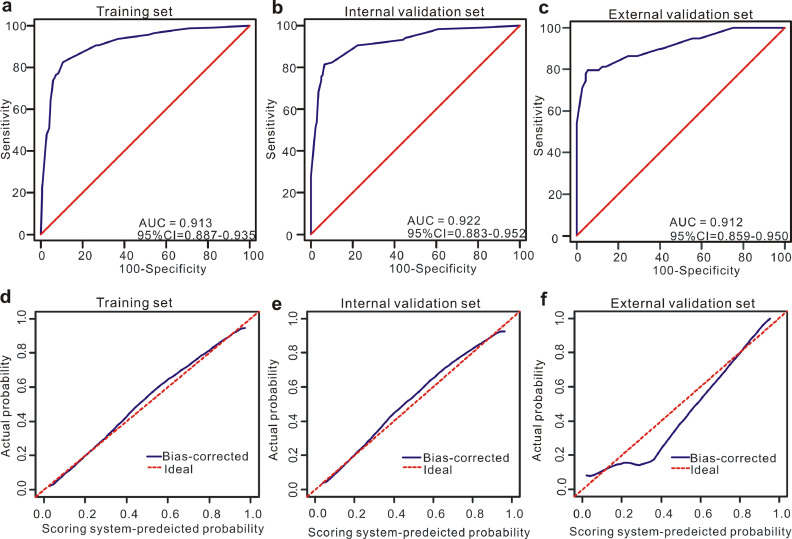
The novel scoring system was composed of fever (3 points), erythrocyte sedimentation rate (4 points), effusion adenosine deaminase (7 points), serum carcinoembryonic antigen (CEA) (4 points), effusion CEA (10 points) and effusion/serum CEA (8 points). With a cutoff value of 15 points, the area under the curve, specificity and sensitivity for identifying MPE were 0.913, 89.10%, and 82.63%, respectively, in the training set, 0.922, 93.48%, 81.51%, respectively, in the internal validation set and 0.912, 87.61%, 81.36%, respectively, in the external validation set. Moreover, this scoring system was exclusively applied to distinguish lung cancer with PE from tuberculous pleurisy and showed a favourable diagnostic performance in the training and validation sets.
This novel scoring system was developed from a retrospective study and externally validated in an independent set based on six easily accessible clinical variables, and it exhibited good diagnostic performance for identifying MPE.
NFSC grants (no. 81572942, no. 81800094).
本研究旨在建立并验证一种基于列线图的新评分系统,用于鉴别恶性胸腔积液(MPE)和良性胸腔积液(BPE)。
纳入接受诊断性胸腔穿刺术的胸腔积液患者。采用回顾性队列(N=1261)建立并内部验证预测模型。收集患者的临床、影像学和实验室特征,并进行逻辑回归分析。原始预测模型以列线图形式呈现,然后修改为新的评分系统,并在独立队列(N=172)中进行外部验证。
新的评分系统由发热(3 分)、红细胞沉降率(4 分)、胸腔积液腺苷脱氨酶(7 分)、血清癌胚抗原(CEA)(4 分)、胸腔积液 CEA(10 分)和胸腔积液/血清 CEA(8 分)组成。在训练组中,当截断值为 15 分时,曲线下面积、特异性和敏感度分别为 0.913、89.10%和 82.63%,内部验证组分别为 0.922、93.48%和 81.51%,外部验证组分别为 0.912、87.61%和 81.36%。此外,该评分系统专门用于区分肺癌合并胸腔积液与结核性胸膜炎,在训练和验证组中均表现出良好的诊断性能。
本研究基于 6 个易于获取的临床变量,从回顾性研究中开发并在独立队列中进行外部验证的新评分系统,对鉴别 MPE 具有良好的诊断性能。
国家自然科学基金(No. 81572942,No. 81800094)。