Parolin Laura, Milesi Alberto, Comelli Giovanni, Locati Francesca
Department of Psychology, University of Milano-Bicocca, Milan.
Department of Humanities, University of Pavia.
Res Psychother. 2023 Dec 31;26(3):707. doi: 10.4081/ripppo.2023.707.
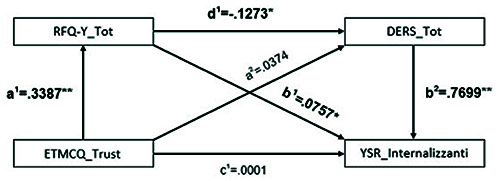
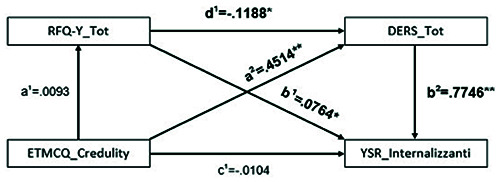
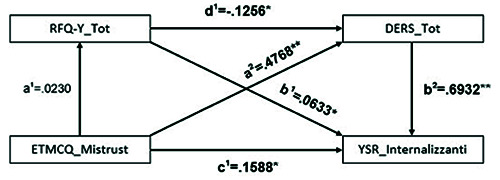
Mentalization is the ability to interpret actions as caused by intentional mental states. Moreover, mentalization facilitates the development of epistemic trust (ET), namely, the ability to evaluate social information as accurate, reliable, and relevant. Recent theoretical literature identifies mentalization as a protective factor, contrasting psychopathology and emotional dysregulation. However, few investigations have explored the concurrent associations between mentalization, ET and emotion dysregulation in the context of internalizing problems in adolescence. In the present study, 482 adolescents from the general population aged between 12 and 19 were assessed with the epistemic trust mistrust credulity questionnaire, the reflective functioning questionnaire- youth, the difficulties in emotion regulation scale, and the youth self-report. We tested the relationship between the variables through serial mediation models. Results showed that mentalization reduces internalizing problems via emotional dysregulation; ET is positively associated with mentalization but not symptomatology. Finally, both epistemic mistrust and epistemic credulity are significantly associated with internalizing symptomatology; those effects are mediated differently by difficulties in emotional regulation. In conclusion, the present study confirms mentalization's role as a protective factor in developmental psychopathology. Nevertheless, exploring the role of the different epistemic stances guarantees a better understanding of psychopathological pathways in adolescence.
心理化是一种将行为解释为由有意的心理状态所导致的能力。此外,心理化有助于认知信任(ET)的发展,即把社会信息评估为准确、可靠且相关的能力。最近的理论文献将心理化视为一种保护因素,与精神病理学和情绪失调形成对比。然而,很少有研究探讨在青少年内化问题背景下心理化、认知信任与情绪失调之间的并发关联。在本研究中,对482名年龄在12至19岁之间的普通青少年进行了评估,使用了认知信任 - 不信任 - 轻信问卷、青少年反思功能问卷、情绪调节困难量表和青少年自我报告。我们通过系列中介模型测试了变量之间的关系。结果表明,心理化通过情绪失调减少内化问题;认知信任与心理化呈正相关,但与症状学无关。最后,认知不信任和认知轻信均与内化症状学显著相关;这些影响通过情绪调节困难以不同方式介导。总之,本研究证实了心理化在发展性精神病理学中作为保护因素的作用。然而,探索不同认知立场的作用有助于更好地理解青少年的精神病理途径。