Campbell Chloe, Tanzer Michal, Saunders Rob, Booker Thomas, Allison Elizabeth, Li Elizabeth, O'Dowda Claire, Luyten Patrick, Fonagy Peter
Research Department of Clinical, Educational and Health Psychology, University College London, London, United Kingdom.
Anna Freud National Centre for Children and Families, London, United Kingdom.
PLoS One. 2021 Apr 16;16(4):e0250264. doi: 10.1371/journal.pone.0250264. eCollection 2021.
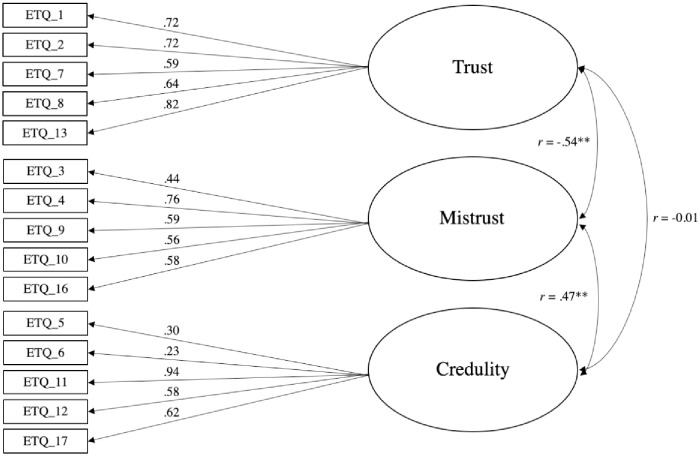
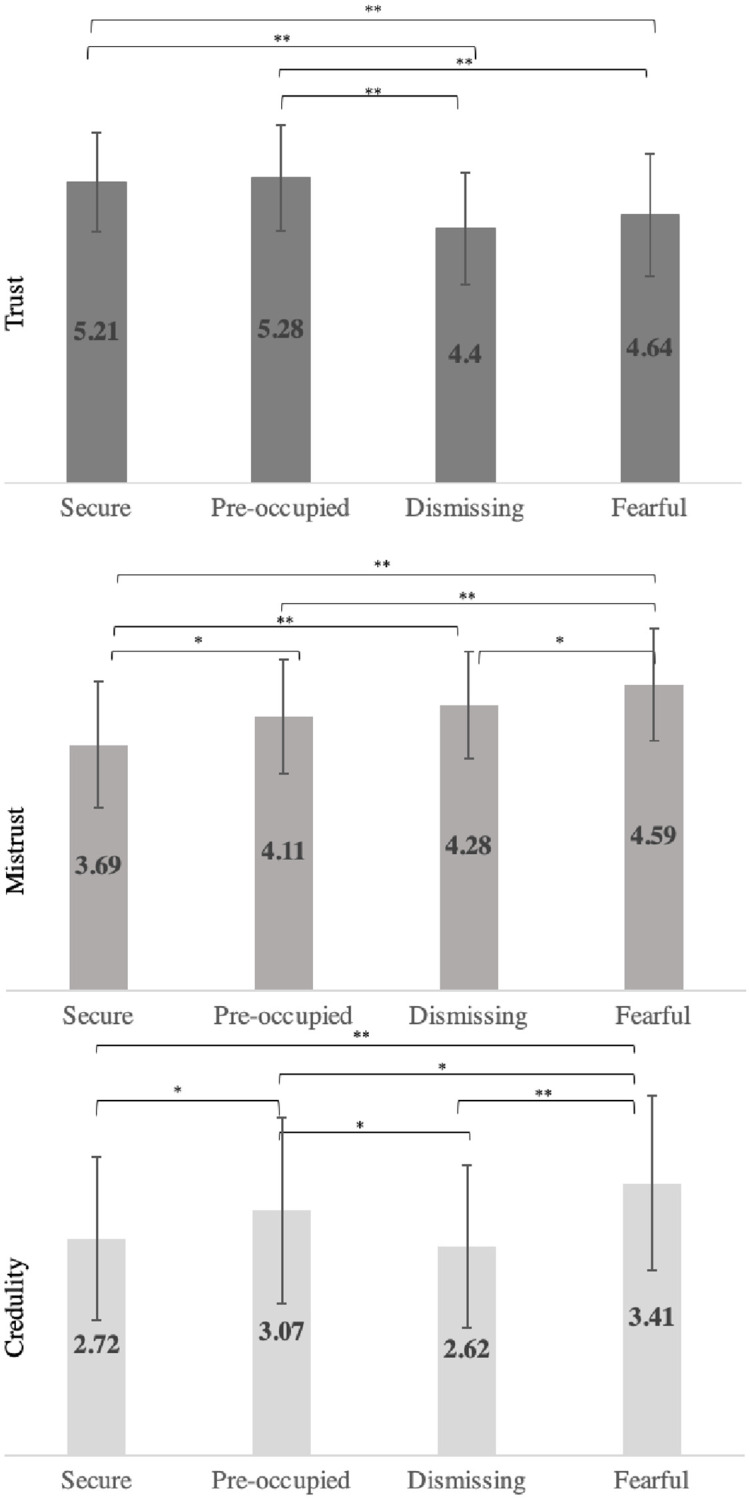
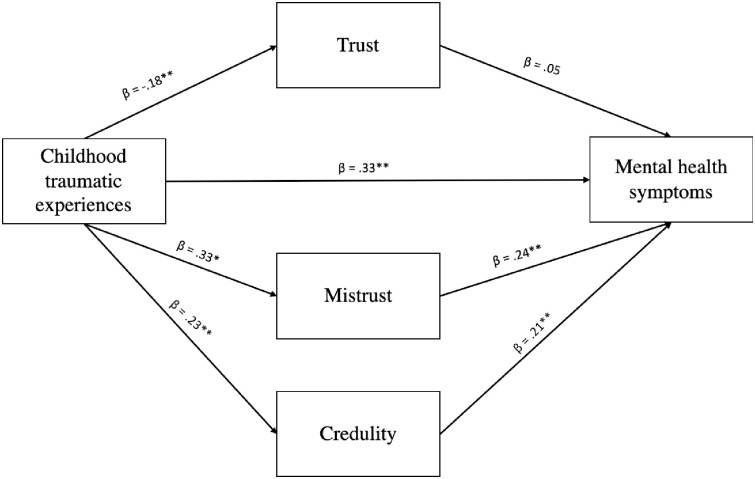
Epistemic trust (ET) refers to trust in communicated knowledge. This paper describes the development and validation of a new self-report questionnaire, the Epistemic Trust, Mistrust and Credulity Questionnaire (ETMCQ). We report on two studies (Study 1, n = 500; Study 2, n = 705) examining the psychometric properties of the ETMCQ and the relationship between EMTCQ scores (i.e., an individual's epistemic stance) and exposure to adverse childhood experiences, mental health symptoms, attachment, mentalizing and general self-efficacy. The factor structure of the ETMCQ was examined using Exploratory and Confirmatory Factor Analyses, and its reliability and test-retest reliability were tested. Both studies yielded three correlated yet distinct factors-Trust, Mistrust and Credulity-and confirmed the reliability and validity of the ETMCQ. Preregistered hypotheses were confirmed and replicated across both studies. Main findings suggest intriguing links between the ETMCQ and developmental psychopathology constructs and are consistent with thinking on the role of epistemic stance in undermining adaptation and increasing the developmental risk of mental health problems. Mistrust and Credulity scores were associated with childhood adversity and higher scores on the global psychopathology severity index and both factors partially mediated the link between early adversity and mental health symptoms. Mistrust and Credulity were positively associated with difficulties in understanding mental states and insecure attachment styles. Post-hoc analysis identified that different attachment styles were associated with differences in epistemic stance. In addition, Trust was not associated with reduced levels of mental health symptoms and did not moderate the impact of childhood adversity-findings are congruent with the suggestion that the reduction of mistrust and credulity may be crucial common factors in promoting resilience and the effectiveness of psychotherapeutic interventions. This investigation and the ETMCQ provide an empirical measure of what until now has been largely a theoretical concept and open new avenues for future research.
认知信任(ET)是指对所传达知识的信任。本文描述了一种新的自我报告问卷——认知信任、不信任和轻信问卷(ETMCQ)的开发与验证。我们报告了两项研究(研究1,n = 500;研究2,n = 705),考察了ETMCQ的心理测量特性以及ETMCQ得分(即个体的认知立场)与童年不良经历、心理健康症状、依恋、心理化和一般自我效能感之间的关系。使用探索性和验证性因素分析检验了ETMCQ的因素结构,并测试了其信度和重测信度。两项研究均得出了三个相关但不同的因素——信任、不信任和轻信——并证实了ETMCQ的信度和效度。预先注册的假设在两项研究中均得到了证实和重复。主要研究结果表明,ETMCQ与发展性心理病理学结构之间存在有趣联系,并且与关于认知立场在破坏适应和增加心理健康问题发展风险方面作用的思考一致。不信任和轻信得分与童年逆境以及全球心理病理学严重程度指数上的高分相关,并且这两个因素部分介导了早期逆境与心理健康症状之间的联系。不信任和轻信与理解心理状态的困难和不安全的依恋风格呈正相关。事后分析发现,不同的依恋风格与认知立场的差异相关。此外,信任与心理健康症状水平的降低无关,也没有调节童年逆境的影响——这些发现与以下观点一致,即减少不信任和轻信可能是促进复原力和心理治疗干预效果的关键共同因素。这项调查和ETMCQ为迄今为止很大程度上属于理论概念的内容提供了一种实证测量方法,并为未来研究开辟了新途径。