Iljina Marija, Mazal Hisham, Dayananda Ashan, Zhang Zhaocheng, Stan George, Riven Inbal, Haran Gilad
Department of Chemical and Biological Physics, Weizmann Institute of Science, Rehovot, Israel.
Department of Chemistry, University of Cincinnati, Cincinnati, Ohio.
Biophys J. 2024 Feb 6;123(3):374-388. doi: 10.1016/j.bpj.2024.01.002. Epub 2024 Jan 9.
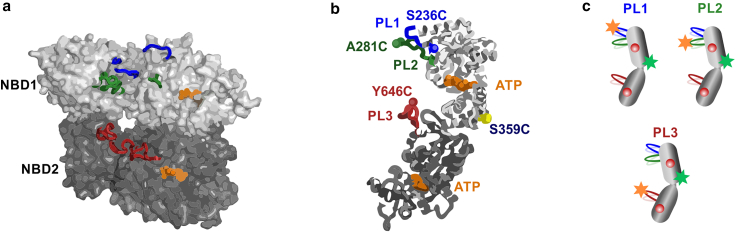
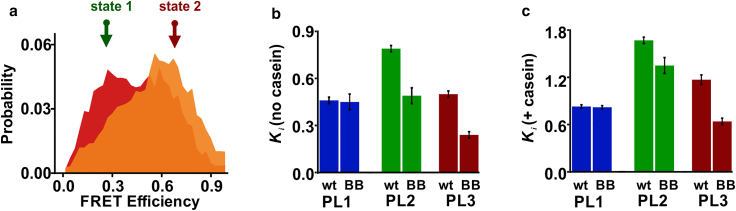
AAA+ proteins (ATPases associated with various cellular activities) comprise a family of powerful ring-shaped ATP-dependent translocases that carry out numerous vital substrate-remodeling functions. ClpB is a AAA+ protein disaggregation machine that forms a two-tiered hexameric ring, with flexible pore loops protruding into its center and binding to substrate proteins. It remains unknown whether these pore loops contribute only passively to substrate-protein threading or have a more active role. Recently, we have applied single-molecule FRET spectroscopy to directly measure the dynamics of substrate-binding pore loops in ClpB. We have reported that the three pore loops of ClpB (PL1-3) undergo large-scale fluctuations on the microsecond timescale that are likely to be mechanistically important for disaggregation. Here, using single-molecule FRET, we study the allosteric coupling between the pore loops and the two nucleotide-binding domains of ClpB (NBD1-2). By mutating the conserved Walker B motifs within the NBDs to abolish ATP hydrolysis, we demonstrate how the nucleotide state of each NBD tunes pore-loop dynamics. This effect is surprisingly long-ranged; in particular, PL2 and PL3 respond differentially to a Walker B mutation in either NBD1 or NBD2, as well as to mutations in both. We characterize the conformational dynamics of pore loops and the allosteric paths connecting NBDs to pore loops by molecular dynamics simulations and find that both principal motions and allosteric paths can be altered by changing the ATPase state of ClpB. Remarkably, PL3, which is highly conserved in AAA+ machines, is found to favor an upward conformation when only NBD1 undergoes ATP hydrolysis but a downward conformation when NBD2 is active. These results explicitly demonstrate a significant long-range allosteric effect of ATP hydrolysis sites on pore-loop dynamics. Pore loops are therefore established as active participants that undergo ATP-dependent conformational changes to translocate substrate proteins through the central pores of AAA+ machines.
AAA+蛋白(与各种细胞活动相关的ATP酶)构成了一个强大的环状ATP依赖转位酶家族,它们执行许多重要的底物重塑功能。ClpB是一种AAA+蛋白解聚机器,形成一个两层的六聚体环,其中心有灵活的孔环伸出并与底物蛋白结合。这些孔环是仅被动地有助于底物蛋白穿入,还是具有更积极的作用,目前尚不清楚。最近,我们应用单分子荧光共振能量转移光谱法直接测量ClpB中底物结合孔环的动力学。我们报道,ClpB的三个孔环(PL1-3)在微秒时间尺度上经历大规模波动,这可能在解聚机制上具有重要意义。在这里,我们使用单分子荧光共振能量转移技术研究孔环与ClpB的两个核苷酸结合结构域(NBD1-2)之间的变构偶联。通过将NBDs内保守的沃克B基序突变以消除ATP水解,我们证明了每个NBD的核苷酸状态如何调节孔环动力学。这种效应具有惊人的长程性;特别是,PL2和PL3对NBD1或NBD2中的沃克B突变以及两者中的突变有不同的反应。我们通过分子动力学模拟表征了孔环的构象动力学以及连接NBDs与孔环的变构途径,发现通过改变ClpB的ATP酶状态,主要运动和变构途径都可以改变。值得注意的是,在AAA+机器中高度保守的PL3,当只有NBD1进行ATP水解时,倾向于向上构象,而当NBD2活跃时,则倾向于向下构象。这些结果明确证明了ATP水解位点对孔环动力学有显著的长程变构效应。因此,孔环被确定为通过AAA+机器的中心孔进行ATP依赖的构象变化以转运底物蛋白的积极参与者。