Graduate Program in Public Health, Faculty of Health Sciences, University of Brasília, Brasilia, Distrito Federal, Brazil.
Department of Nutrition and Health, Graduate Program in Nutrition Science, Federal University of Viçosa (UFV), Viçosa, Brazil.
Matern Child Nutr. 2024 Apr;20(2):e13609. doi: 10.1111/mcn.13609. Epub 2024 Jan 9.
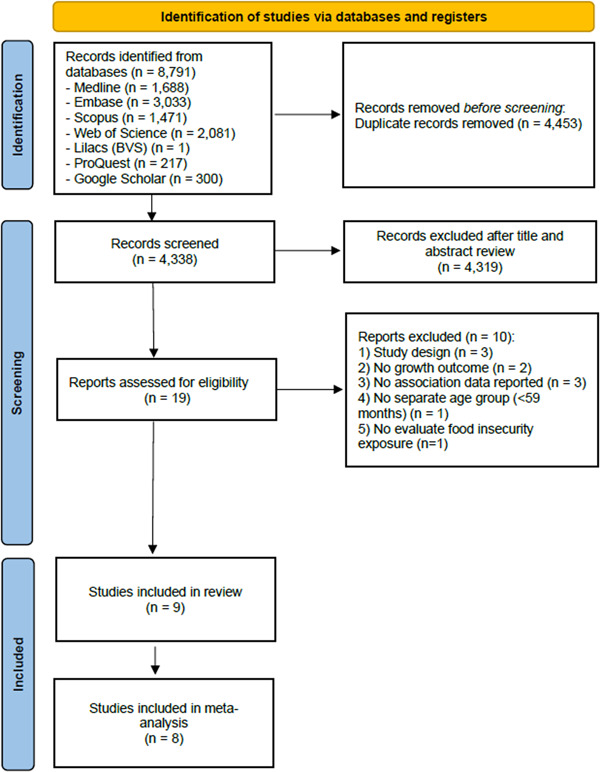
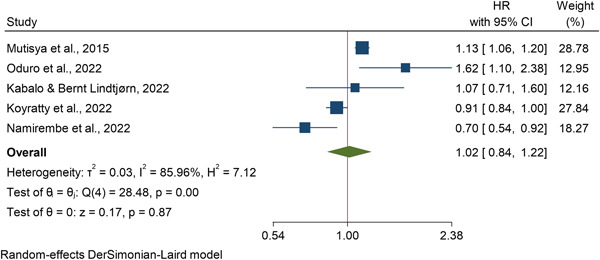
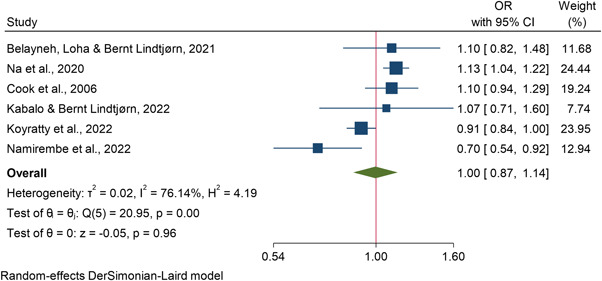
Household food insecurity (HFI) during childhood is associated with poor dietary diversity and malnutrition, placing children's growth at risk. Children with growth disorders, such as stunting, are more likely to have poor cognition and educational performance, lower economic status, and an increased risk of nutrition-related chronic diseases in adulthood. Our study aimed to systematically review and conduct a meta-analysis of cohort studies investigating the association between HFI and stunting in children aged 0-59 months. Peer-reviewed and grey literature were systematically searched in electronic databases with no language or date restrictions. Two reviewers independently assessed the studies for pre-established eligibility criteria. Data were extracted using a standard protocol. Random-effects meta-analysis models were used, and I > 40% indicated high heterogeneity across studies. We used the Grading of Recommendations Assessment, Development, and Evaluation system to assess the quality of the evidence. Nine cohort studies comprising 46,300 children were included. Approximately 80% (n = 7) of the studies found a positive association between HFI and stunting. Pooled odds ratio was 1.00 (95% confidence interval [CI]: 0.87-1.14; I: 76.14%). The pooled hazard ratio between moderate and severe HFI and stunting was 1.02 (95% CI: 0.84-1.22; I: 85.96%). Due to high heterogeneity, the quality of evidence was very low. Individual studies showed an association between HFI and stunting in children aged 0-59 months; however, this association was not sustained in the pooled analysis, possibly because of high heterogeneity across studies.
儿童期家庭食物不安全与膳食多样性差和营养不良有关,使儿童的生长发育面临风险。生长障碍儿童,如发育迟缓,更有可能认知和教育表现不佳、经济地位较低,以及成年后患与营养相关的慢性疾病的风险增加。我们的研究旨在系统地回顾和进行荟萃分析队列研究,调查 0-59 个月儿童家庭食物不安全与发育迟缓之间的关系。系统地在电子数据库中搜索同行评审和灰色文献,没有语言或日期限制。两名审查员独立评估研究是否符合预先设定的纳入标准。使用标准协议提取数据。使用随机效应荟萃分析模型,I > 40%表示研究之间存在高度异质性。我们使用推荐评估、制定和评估系统(Grading of Recommendations Assessment, Development, and Evaluation system)评估证据质量。纳入了 9 项队列研究,共涉及 46300 名儿童。约 80%(n = 7)的研究发现家庭食物不安全与发育迟缓之间存在正相关。汇总的优势比为 1.00(95%置信区间[CI]:0.87-1.14;I:76.14%)。中重度家庭食物不安全与发育迟缓之间的汇总危险比为 1.02(95%CI:0.84-1.22;I:85.96%)。由于高度异质性,证据质量非常低。个别研究表明家庭食物不安全与 0-59 个月儿童发育迟缓之间存在关联;然而,汇总分析中并未持续存在这种关联,这可能是由于研究之间存在高度异质性。