Massey University, Palmerston North 4474, New Zealand.
University of Auckland, Auckland 1010, New Zealand.
J R Soc Interface. 2024 Jan;21(210):20230425. doi: 10.1098/rsif.2023.0425. Epub 2024 Jan 10.
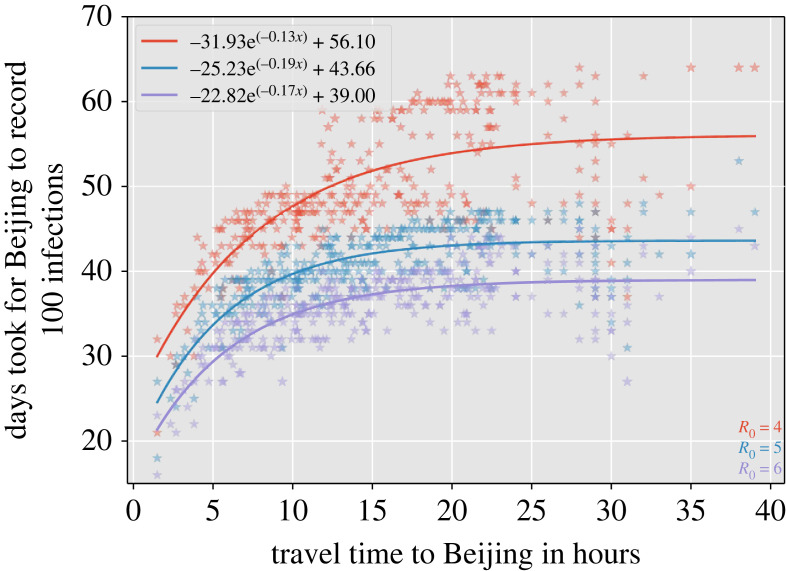
The speed of spread of severe acute respiratory syndrome coronavirus 2 (SARS-CoV-2) during the coronavirus disease 2019 (COVID-19) pandemic highlights the importance of understanding how infections are transmitted in a highly connected world. Prior to vaccination, changes in human mobility patterns were used as non-pharmaceutical interventions to eliminate or suppress viral transmission. The rapid spread of respiratory viruses, various intervention approaches, and the global dissemination of SARS-CoV-2 underscore the necessity for epidemiological models that incorporate mobility to comprehend the spread of the virus. Here, we introduce a metapopulation susceptible-exposed-infectious-recovered model parametrized with human movement data from 340 cities in China. Our model replicates the early-case trajectory in the COVID-19 pandemic. We then use machine learning algorithms to determine which network properties best predict spread between cities and find travel time to be most important, followed by the human movement-weighted personalized PageRank. However, we show that travel time is most influential locally, after which the high connectivity between cities reduces the impact of travel time between individual cities on transmission speed. Additionally, we demonstrate that only significantly reduced movement substantially impacts infection spread times throughout the network.
严重急性呼吸综合征冠状病毒 2(SARS-CoV-2)在 2019 年冠状病毒病(COVID-19)大流行期间的传播速度突显了了解在高度互联的世界中感染如何传播的重要性。在接种疫苗之前,人类流动模式的变化被用作非药物干预措施,以消除或抑制病毒传播。呼吸道病毒的迅速传播、各种干预措施以及 SARS-CoV-2 的全球传播,突出表明需要采用包含流动性的流行病学模型来理解病毒的传播。在这里,我们引入了一个元种群易感性-暴露性-感染性-恢复性模型,该模型使用来自中国 340 个城市的人类流动数据进行参数化。我们的模型复制了 COVID-19 大流行中的早期病例轨迹。然后,我们使用机器学习算法来确定哪些网络属性最能预测城市之间的传播,并发现旅行时间最重要,其次是人类流动加权个性化 PageRank。然而,我们表明旅行时间在本地最具影响力,之后城市之间的高连接性降低了个别城市之间旅行时间对传播速度的影响。此外,我们还证明,只有显著减少的活动才能实质性地影响整个网络的感染传播时间。