Department of Psychiatry and Psychotherapy, Faculty of Medicine, LVR-University-Hospital Essen, University of Duisburg-Essen, Virchowstr. 174, 45147, Essen, Germany.
Center for Translational Neuro- and Behavioral Sciences, University Duisburg-Essen, Hufelandstrasse 55, 45147, Essen, Germany.
Mol Autism. 2024 Jan 10;15(1):2. doi: 10.1186/s13229-024-00582-9.
Autistic and non-autistic individuals often differ in how they perceive and show emotions, especially in their ability and inclination to infer other people's feelings from subtle cues like facial expressions. Prominent theories of autism have suggested that these differences stem from alterations in amygdala functioning and that amygdala hypoactivation causes problems with emotion recognition. Thus far, however, empirical investigations of this hypothesis have yielded mixed results and largely relied on relatively small samples.
In a sample of 72 autistic and 79 non-autistic participants, we conducted a study in which we used the Hariri paradigm to test whether amygdala activation during emotional face processing is altered in autism spectrum disorder, and whether common mental disorders like depression, ADHD or anxiety disorders influence any potential alterations in activation patterns.
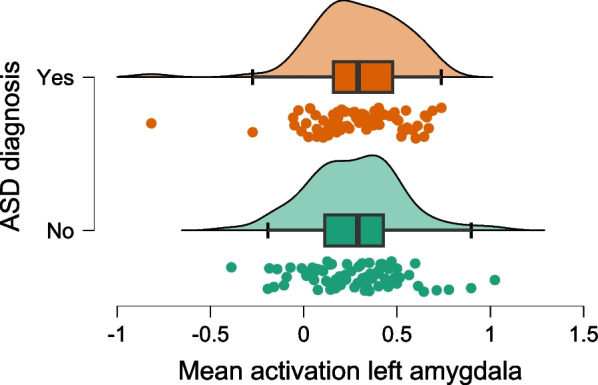
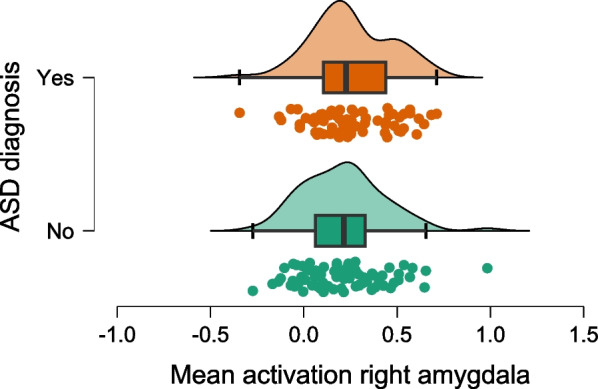
We found no evidence for differences in amygdala activation, neither when comparing autistic and non-autistic participants, nor when taking into account mental disorders or the overall level of functional impairment.
Because we used one basic emotion processing task in a Dutch sample, results might not generalise to other tasks and other populations.
Our results challenge the view that autistic and non-autistic processing of emotional faces in the amygdala is vastly different and call for a more nuanced view of differences between non-autistic and autistic emotion processing.
自闭症患者和非自闭症患者在感知和表现情绪方面常常存在差异,尤其是在从面部表情等细微线索推断他人感受的能力和倾向方面。自闭症的主流理论表明,这些差异源于杏仁核功能的改变,而杏仁核活动不足会导致情绪识别问题。然而,到目前为止,对这一假设的实证研究结果喜忧参半,且主要依赖于相对较小的样本。
在 72 名自闭症患者和 79 名非自闭症患者的样本中,我们进行了一项研究,使用哈里里范式来测试自闭症谱系障碍患者在处理情绪面孔时杏仁核的激活是否发生改变,以及抑郁症、ADHD 或焦虑症等常见精神障碍是否会影响任何潜在的激活模式改变。
我们没有发现杏仁核激活存在差异的证据,无论是在比较自闭症患者和非自闭症患者时,还是在考虑精神障碍或整体功能障碍水平时,都没有发现差异。
由于我们在荷兰样本中使用了一项基本的情绪处理任务,因此结果可能不适用于其他任务和其他人群。
我们的结果挑战了自闭症患者和非自闭症患者在杏仁核中处理情绪面孔的方式存在巨大差异的观点,并呼吁对非自闭症患者和自闭症患者的情绪处理之间的差异有更细致入微的看法。