Li Junwei, Li Juncheng, Wang Shuaibiao, Ju Huiming, Chen Shufang, Basioura Athina, Ferreira-Dias Graça, Liu Zongping, Zhu Jiaqiao
College of Veterinary Medicine, Yangzhou University, Yangzhou 225009, China.
Jiangsu Co-Innovation Center for Prevention and Control of Important Animal Infectious Diseases and Zoonoses, Yangzhou University, Yangzhou 225009, China.
Animals (Basel). 2023 Dec 26;14(1):87. doi: 10.3390/ani14010087.
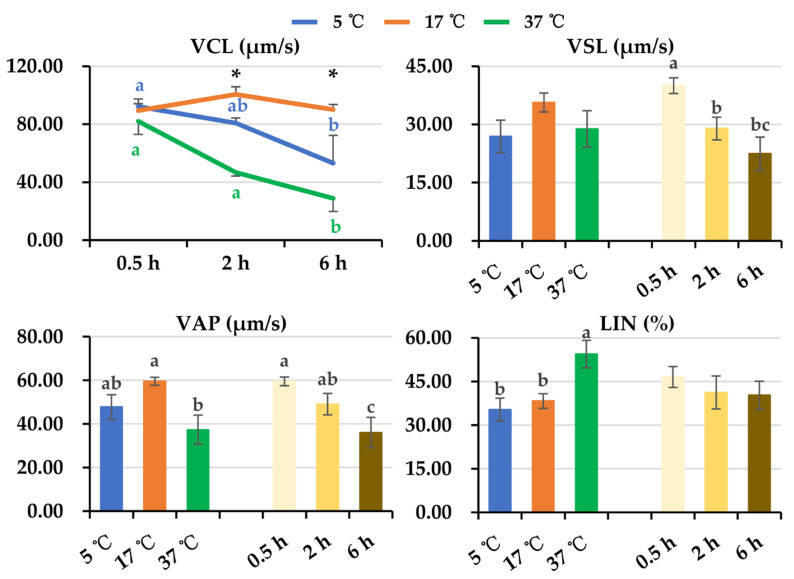
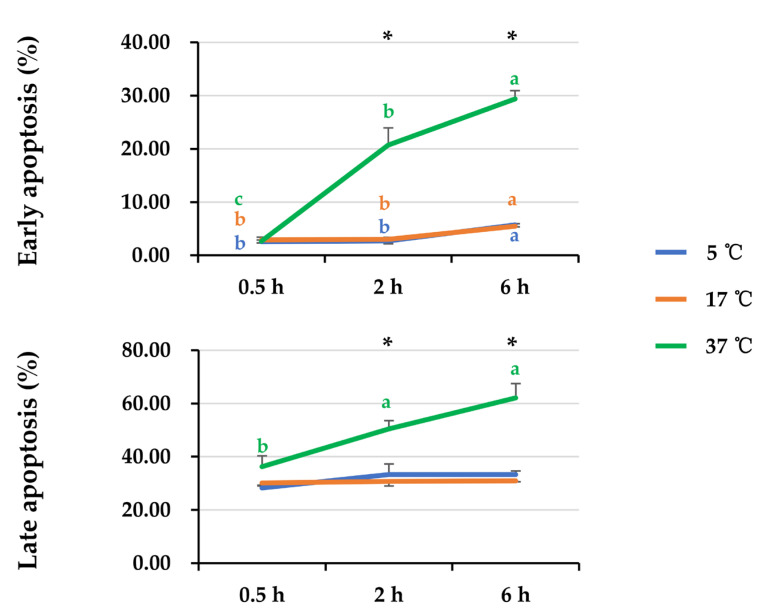
Cryopreservation deteriorates boar sperm quality and lifespan, which restricts the use of artificial insemination with frozen-thawed boar semen in field conditions. The objective of this study was to test the effects of post-thaw storage time and temperature on boar sperm survival. Semen ejaculates from five Landrace boars (one ejaculate per boar) were collected and frozen following a 0.5 mL-straw protocol. Straws from the five boars were thawed and diluted 1:1 (v:v) in BTS. The frozen-thawed semen samples were aliquoted into three parts and respectively stored at 5 °C, 17 °C, and 37 °C for up to 6 h. At 0.5, 2, and 6 h of storage, sperm motility, viability, mitochondrial membrane potential, and intracellular reactive oxygen species (ROS) levels and apoptotic changes were measured. Antioxidant and oxidant levels were tested in boar sperm (SPZ) and their surrounding environment (SN) at each timepoint. The results showed significant effects of post-thaw storage time and temperature and an impact on boar sperm quality (total and progressive motility, VCL, viability, acrosome integrity), early and late sperm apoptotic changes, and changes in MDA levels in SPZ and SN. Compared to storage at 5 °C and 37 °C, frozen-thawed semen samples stored at 17 °C displayed better sperm quality, less apoptotic levels, and lower levels of SPZ MDA and SN MDA. Notably, post-thaw storage at 17 °C extended boar sperm lifespan up to 6 h without obvious reduction in sperm quality. In conclusion, storage of frozen-thawed boar semen at 17 °C preserves sperm quality for up to 6 h, which facilitates the use of cryopreserved boar semen for field artificial insemination.
冷冻保存会使公猪精子质量和寿命下降,这限制了在野外条件下使用冻融公猪精液进行人工授精。本研究的目的是测试解冻后储存时间和温度对公猪精子存活的影响。采集了5头长白公猪的精液射精样本(每头公猪一份射精样本),并按照0.5 mL细管方案进行冷冻。将来自这5头公猪的细管解冻,并在BTS中按1:1(v:v)进行稀释。将冻融后的精液样本分成三份,分别在5℃、17℃和37℃下储存长达6小时。在储存0.5小时、2小时和6小时时,测量精子活力、存活率、线粒体膜电位、细胞内活性氧(ROS)水平以及凋亡变化。在每个时间点对公猪精子(SPZ)及其周围环境(SN)中的抗氧化剂和氧化剂水平进行测试。结果表明,解冻后储存时间和温度有显著影响,并对公猪精子质量(总活力和渐进活力、曲线速度(VCL)、存活率、顶体完整性)、精子早期和晚期凋亡变化以及SPZ和SN中丙二醛(MDA)水平变化有影响。与在5℃和37℃下储存相比,在17℃下储存的冻融精液样本显示出更好的精子质量、更低的凋亡水平以及更低的SPZ MDA和SN MDA水平。值得注意的是,在17℃下解冻后储存可将公猪精子寿命延长至6小时,而精子质量无明显下降。总之,在17℃下储存冻融公猪精液可使精子质量在长达6小时内得以保存,这有利于将冷冻保存的公猪精液用于野外人工授精。