Osman Rana, Lee Seongju, Almubarak Areeg, Han Jae-Ik, Yu Il-Jeoung, Jeon Yubyeol
Department of Theriogenology and Reproductive Biotechnology, College of Veterinary Medicine, Jeonbuk National University, Iksan 54596, Republic of Korea.
Department of Veterinary Medicine and Surgery, College of Veterinary Medicine, Sudan University of Science and Technology, P.O. Box 204, Hilat Kuku, Khartoum North 11111, Sudan.
Antioxidants (Basel). 2023 Aug 26;12(9):1673. doi: 10.3390/antiox12091673.
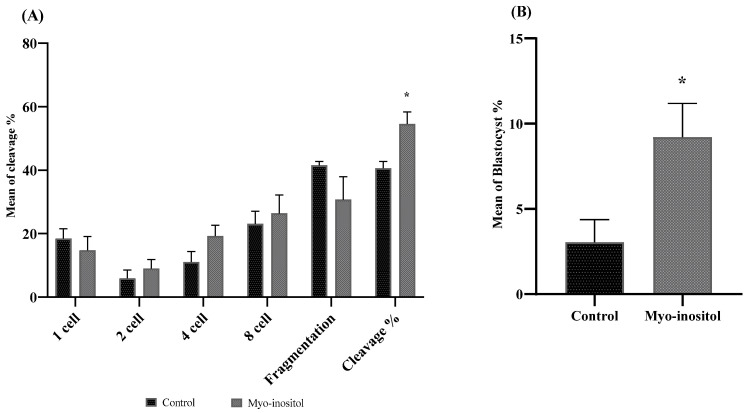
During cryopreservation, sperm undergoes structural and molecular changes such as ice crystal formation, DNA fragmentation, and reactive oxygen species (ROS) production, leading to decreased sperm quality after thawing. Antioxidants play a crucial role in preventing these damages, both in vivo and in vitro. One potent antioxidant is myo-inositol, known for its protective effects on sperm against ROS. This study aimed to investigate the protective effect of myo-inositol on cryopreserved boar semen. The semen was diluted, cooled, and cryopreserved using a BF5 extender. It was then divided into five groups: control and different concentrations of myo-inositol (0.5, 1, 1.5, and 2 mg/mL). The post-thaw evaluation included assessments of motility, viability, acrosome integrity, mitochondrial membrane potential (MMP), caspase activity, gene expression, ROS levels, apoptosis, and IVF with treated semen. Results showed that myo-inositol at 0.5 mg/mL improved motility, acrosome integrity, and fertilization ability. It also reduced the expression of pro-apoptotic genes and increased expression. Lower concentrations also demonstrated improved viability and reduced apoptosis and ROS levels. In conclusion, myo-inositol treatment during cryopreservation improved sperm quality, reduced apoptosis and ROS levels, and enhanced fertility rates in boar semen.
在冷冻保存过程中,精子会发生结构和分子变化,如冰晶形成、DNA碎片化和活性氧(ROS)产生,导致解冻后精子质量下降。抗氧化剂在体内和体外预防这些损伤方面都起着至关重要的作用。一种有效的抗氧化剂是肌醇,它以对精子抵抗ROS的保护作用而闻名。本研究旨在探讨肌醇对冷冻保存的公猪精液的保护作用。精液用BF5稀释液稀释、冷却并冷冻保存。然后将其分为五组:对照组和不同浓度的肌醇(0.5、1、1.5和2mg/mL)。解冻后的评估包括对活力、存活率、顶体完整性、线粒体膜电位(MMP)、半胱天冬酶活性、基因表达、ROS水平、凋亡以及用处理过的精液进行体外受精的评估。结果表明,0.5mg/mL的肌醇可提高活力、顶体完整性和受精能力。它还降低了促凋亡基因的表达并增加了[此处原文可能有误,推测应为某种基因表达增加]表达。较低浓度也显示出存活率提高,凋亡和ROS水平降低。总之,冷冻保存期间用肌醇处理可提高公猪精液的精子质量,降低凋亡和ROS水平,并提高受精率。