Rojas-Nossa Sandra V, Mato Salustiano, Feijoo Pilar, Lagoa Aarón, Garrido Josefina
Department of Ecology and Animal Biology, University of Vigo, 36310 Vigo, Pontevedra, Spain.
Animals (Basel). 2023 Dec 29;14(1):129. doi: 10.3390/ani14010129.
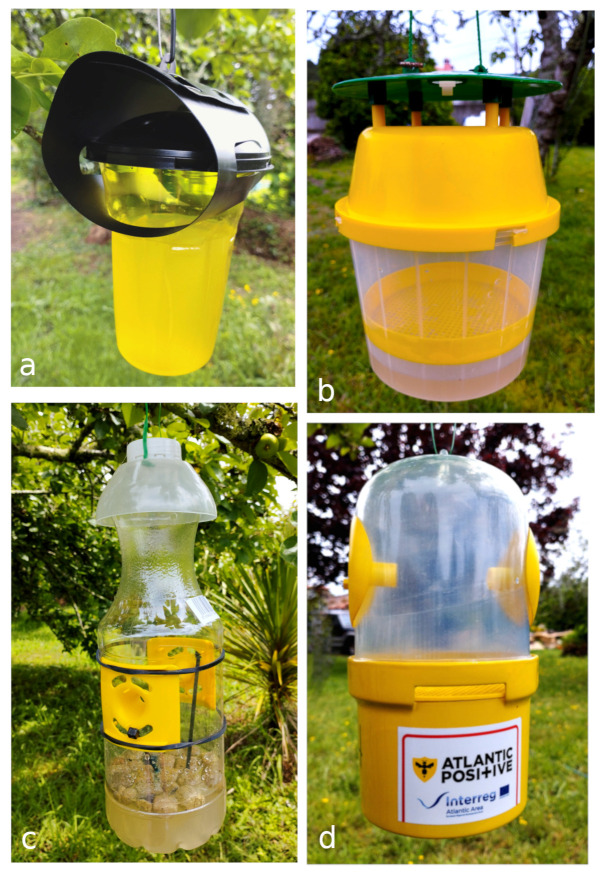
The invasive hornet affects apiculture, biodiversity, and human health. The use of baited traps with the aim of reducing the population and mitigating its impacts is a common practice. However, the lack of impact on the number of colonies and the high capture rate of non-target insects make it controversial. Our objective was to compare the effectiveness and selectiveness of four trap models. We measured effectiveness as the capture rate of per day per trap, and selectiveness as the capture rate of /capture rate of non-target species. The E trap had better performance with a higher selectiveness and effectiveness. Traps V and X had a higher effectiveness but the lowest selectiveness, with high capture rates of native insects, including threatened species. The R trap had the lowest effectiveness and selectiveness. Results show that small changes in the design can contribute to achieving more sustainable tools. Otherwise, with the current tools, bait trapping continues to be non-sustainable from an environmental perspective due to the impacts on native biodiversity.
入侵性黄蜂会影响养蜂业、生物多样性和人类健康。使用诱饵陷阱以减少其数量并减轻其影响是一种常见做法。然而,对蜂群数量缺乏影响以及非目标昆虫的高捕获率使其存在争议。我们的目标是比较四种陷阱模型的有效性和选择性。我们将有效性衡量为每个陷阱每天的捕获率,将选择性衡量为目标物种捕获率/非目标物种捕获率。E型陷阱表现更佳,具有更高的选择性和有效性。V型和X型陷阱有效性较高,但选择性最低,对包括受威胁物种在内的本地昆虫捕获率很高。R型陷阱的有效性和选择性最低。结果表明,设计上的微小变化有助于实现更具可持续性的工具。否则,就目前的工具而言,从环境角度来看,诱饵诱捕由于对本地生物多样性的影响仍然不可持续。