Zhang Weihua, Zheng Jiaqiang, Li Yufeng
College of Economics and Management, Shanghai Ocean University, Shanghai 201306, China.
Foods. 2023 Dec 26;13(1):88. doi: 10.3390/foods13010088.
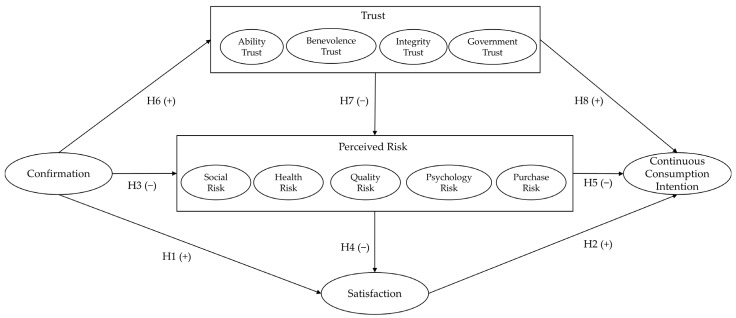
With the rapid development and the increasing importance of the consumer market of prepared dishes in China, it is imperative to study the formation mechanism of Chinese consumers' continuous consumption intention (CCI) toward prepared dishes for promoting the sustainable development of Chinese prepared dishes industry. The aim of this study is to study the formation mechanism and the role of perceived risk and trust in it. Based on the Expectation Confirmation Model, this study constructed a model of continuous consumption intention of prepared dishes by introducing perceived risk and trust. 381 adult consumers were surveyed and the data was analyzed by an Exploratory Factor Analysis and the Partial Least Squares Structure Equation Model. The results showed that: (1) The confirmation of expectation had a significant positive impact on trust and satisfaction, a significant negative impact on the perceived risk (PR). Trust and satisfaction had a significant positive, while PR had a significant negative, impact on CCI. (2) The dimensions of PR included social, health, quality, psychological and purchasing risk, among which quality risk had a significant negative impact on CCI. (3) All dimensions of trust (ability, integrity, benevolence and government trust) had a significant positive impact on CCI, among which integrity trust played the most important role. (4) Overall, trust had a significant negative impact on PR. Benevolence trust could mitigate all dimensions of PR, integrity trust could mitigate all dimensions of PR except health risk, and ability trust, government trust could only mitigate quality risk. Therefore, the enterprises should pay high attention to the quality of their products and the establishment and maintenance of consumer trust, and the government should establish an authoritative image.
随着中国预制菜消费市场的快速发展及其重要性的日益凸显,为推动中国预制菜产业可持续发展,研究中国消费者对预制菜的持续消费意愿(CCI)形成机制势在必行。本研究旨在探究其形成机制以及感知风险和信任在其中所起的作用。基于期望确认模型,本研究通过引入感知风险和信任构建了预制菜持续消费意愿模型。对381名成年消费者进行了调查,并运用探索性因子分析和偏最小二乘结构方程模型对数据进行分析。结果表明:(1)期望确认对信任和满意度有显著正向影响,对感知风险(PR)有显著负向影响。信任和满意度对CCI有显著正向影响,而PR对CCI有显著负向影响。(2)PR的维度包括社会、健康、质量、心理和购买风险,其中质量风险对CCI有显著负向影响。(3)信任的所有维度(能力、诚信、善意和政府信任)对CCI均有显著正向影响,其中诚信信任发挥的作用最为重要。(4)总体而言,信任对PR有显著负向影响。善意信任可减轻PR的所有维度,诚信信任可减轻除健康风险外的PR所有维度,能力信任、政府信任仅能减轻质量风险。因此,企业应高度重视产品质量以及消费者信任的建立与维护,政府应树立权威形象。