• 文献检索
  • 文档翻译
  • 深度研究
  • 学术资讯
  • Suppr Zotero 插件Zotero 插件
  • 邀请有礼
  • 套餐&价格
  • 历史记录
应用&插件
Suppr Zotero 插件Zotero 插件浏览器插件Mac 客户端Windows 客户端微信小程序
定价
高级版会员购买积分包购买API积分包
服务
文献检索文档翻译深度研究API 文档MCP 服务
关于我们
关于 Suppr公司介绍联系我们用户协议隐私条款
关注我们

Suppr 超能文献

核心技术专利:CN118964589B侵权必究
粤ICP备2023148730 号-1Suppr @ 2026

文献检索

告别复杂PubMed语法,用中文像聊天一样搜索,搜遍4000万医学文献。AI智能推荐,让科研检索更轻松。

立即免费搜索

文件翻译

保留排版,准确专业,支持PDF/Word/PPT等文件格式,支持 12+语言互译。

免费翻译文档

深度研究

AI帮你快速写综述,25分钟生成高质量综述,智能提取关键信息,辅助科研写作。

立即免费体验

使用机器学习模型估计和预测聚合物的物理特性

Estimation and Prediction of the Polymers' Physical Characteristics Using the Machine Learning Models.

作者信息

Malashin Ivan Pavlovich, Tynchenko Vadim Sergeevich, Nelyub Vladimir Aleksandrovich, Borodulin Aleksei Sergeevich, Gantimurov Andrei Pavlovich

机构信息

Artificial Intelligence Technology Scientific and Education Center, Bauman Moscow State Technical University, 105005 Moscow, Russia.

Information-Control Systems Department, Institute of Computer Science and Telecommunications, Reshetnev Siberian State University of Science and Technology, 660037 Krasnoyarsk, Russia.

出版信息

Polymers (Basel). 2023 Dec 29;16(1):115. doi: 10.3390/polym16010115.

DOI:10.3390/polym16010115
PMID:38201778
原文链接:https://pmc.ncbi.nlm.nih.gov/articles/PMC10780762/
Abstract

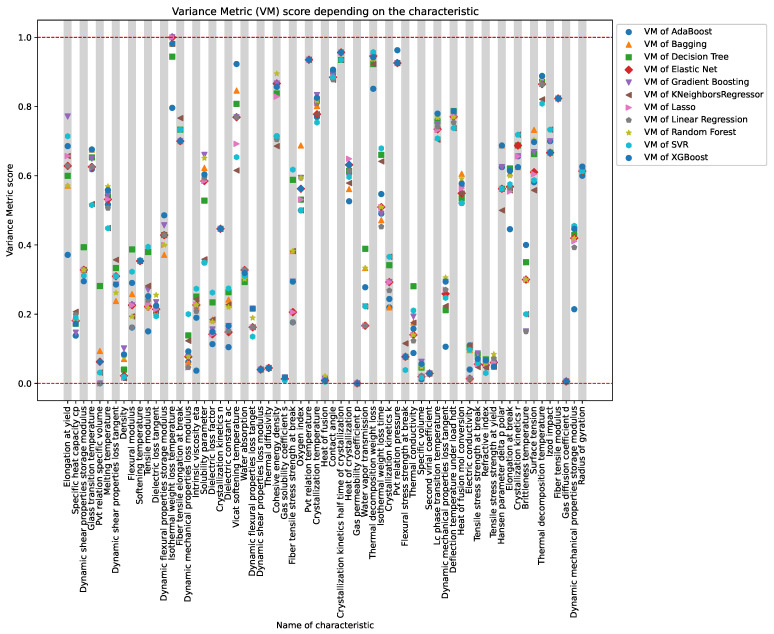
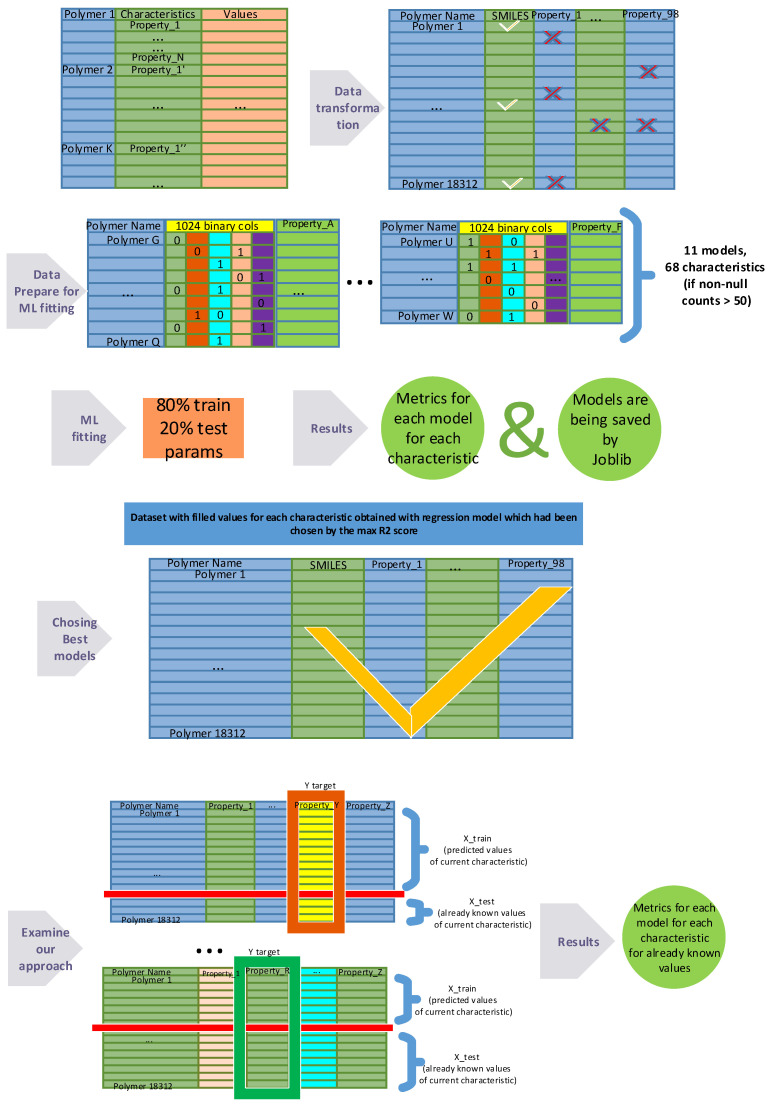
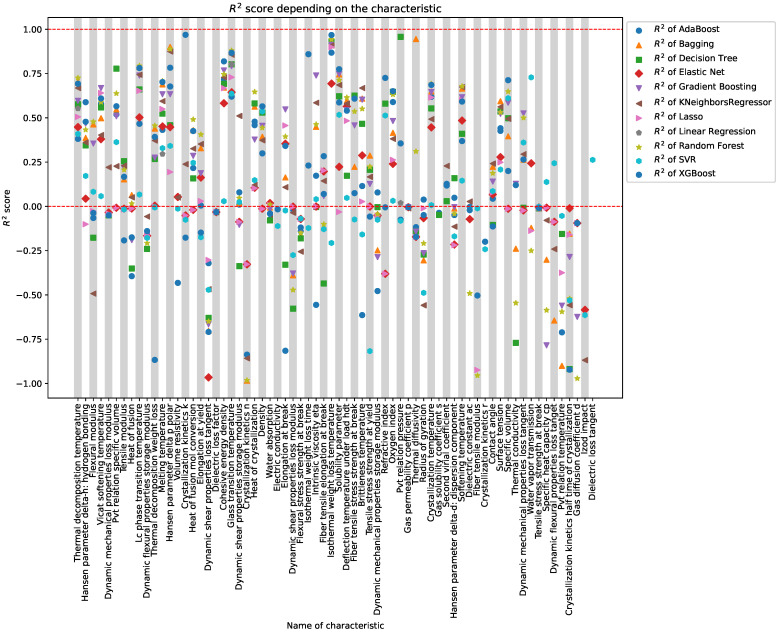
This article investigates the utility of machine learning (ML) methods for predicting and analyzing the diverse physical characteristics of polymers. Leveraging a rich dataset of polymers' characteristics, the study encompasses an extensive range of polymer properties, spanning compressive and tensile strength to thermal and electrical behaviors. Using various regression methods like Ensemble, Tree-based, Regularization, and Distance-based, the research undergoes thorough evaluation using the most common quality metrics. As a result of a series of experimental studies on the selection of effective model parameters, those that provide a high-quality solution to the stated problem were found. The best results were achieved by Random Forest with the highest R2 scores of 0.71, 0.73, and 0.88 for glass transition, thermal decomposition, and melting temperatures, respectively. The outcomes are intricately compared, providing valuable insights into the efficiency of distinct ML approaches in predicting polymer properties. Unknown values for each characteristic were predicted, and a method validation was performed by training on the predicted values, comparing the results with the specified variance values of each characteristic. The research not only advances our comprehension of polymer physics but also contributes to informed model selection and optimization for materials science applications.

摘要

本文研究了机器学习(ML)方法在预测和分析聚合物各种物理特性方面的效用。该研究利用丰富的聚合物特性数据集,涵盖了广泛的聚合物属性,从压缩强度和拉伸强度到热行为和电行为。使用诸如集成、基于树、正则化和基于距离等各种回归方法,该研究使用最常见的质量指标进行了全面评估。通过一系列关于有效模型参数选择的实验研究,找到了能够为所述问题提供高质量解决方案的参数。随机森林取得了最佳结果,对于玻璃化转变温度、热分解温度和熔点温度,其R2分数分别高达0.71、0.73和0.88。对结果进行了复杂的比较,为不同ML方法在预测聚合物特性方面的效率提供了有价值的见解。预测了每个特性的未知值,并通过对预测值进行训练、将结果与每个特性的指定方差值进行比较来进行方法验证。该研究不仅增进了我们对聚合物物理的理解,还为材料科学应用中的明智模型选择和优化做出了贡献。
https://cdn.ncbi.nlm.nih.gov/pmc/blobs/f02c/10780762/d7ba8b82b8c8/polymers-16-00115-g006.jpg
https://cdn.ncbi.nlm.nih.gov/pmc/blobs/f02c/10780762/4bd3a162ff66/polymers-16-00115-g001.jpg
https://cdn.ncbi.nlm.nih.gov/pmc/blobs/f02c/10780762/71a415dc3143/polymers-16-00115-g002.jpg
https://cdn.ncbi.nlm.nih.gov/pmc/blobs/f02c/10780762/a41115944d05/polymers-16-00115-g003.jpg
https://cdn.ncbi.nlm.nih.gov/pmc/blobs/f02c/10780762/5f9adb7f7e3d/polymers-16-00115-g004.jpg
https://cdn.ncbi.nlm.nih.gov/pmc/blobs/f02c/10780762/4c11108f7779/polymers-16-00115-g005.jpg
https://cdn.ncbi.nlm.nih.gov/pmc/blobs/f02c/10780762/d7ba8b82b8c8/polymers-16-00115-g006.jpg
https://cdn.ncbi.nlm.nih.gov/pmc/blobs/f02c/10780762/4bd3a162ff66/polymers-16-00115-g001.jpg
https://cdn.ncbi.nlm.nih.gov/pmc/blobs/f02c/10780762/71a415dc3143/polymers-16-00115-g002.jpg
https://cdn.ncbi.nlm.nih.gov/pmc/blobs/f02c/10780762/a41115944d05/polymers-16-00115-g003.jpg
https://cdn.ncbi.nlm.nih.gov/pmc/blobs/f02c/10780762/5f9adb7f7e3d/polymers-16-00115-g004.jpg
https://cdn.ncbi.nlm.nih.gov/pmc/blobs/f02c/10780762/4c11108f7779/polymers-16-00115-g005.jpg
https://cdn.ncbi.nlm.nih.gov/pmc/blobs/f02c/10780762/d7ba8b82b8c8/polymers-16-00115-g006.jpg

相似文献

1
Estimation and Prediction of the Polymers' Physical Characteristics Using the Machine Learning Models.使用机器学习模型估计和预测聚合物的物理特性
Polymers (Basel). 2023 Dec 29;16(1):115. doi: 10.3390/polym16010115.
2
Prediction of Neurological Outcomes in Out-of-hospital Cardiac Arrest Survivors Immediately after Return of Spontaneous Circulation: Ensemble Technique with Four Machine Learning Models.院外心脏骤停幸存者自主循环恢复后即刻的神经功能结局预测:四种机器学习模型的集成技术。
J Korean Med Sci. 2021 Jul 19;36(28):e187. doi: 10.3346/jkms.2021.36.e187.
3
Can Predictive Modeling Tools Identify Patients at High Risk of Prolonged Opioid Use After ACL Reconstruction?预测模型工具能否识别 ACL 重建术后阿片类药物使用时间延长的高风险患者?
Clin Orthop Relat Res. 2020 Jul;478(7):0-1618. doi: 10.1097/CORR.0000000000001251.
4
Representing Polymers as Periodic Graphs with Learned Descriptors for Accurate Polymer Property Predictions.将聚合物表示为具有学习描述符的周期性图,以实现准确的聚合物性质预测。
J Chem Inf Model. 2022 Nov 28;62(22):5435-5445. doi: 10.1021/acs.jcim.2c00875. Epub 2022 Oct 31.
5
Evaluating the performance of machine learning methods and variable selection methods for predicting difficult-to-measure traits in Holstein dairy cattle using milk infrared spectral data.利用牛奶近红外光谱数据评估机器学习方法和变量选择方法在荷斯坦奶牛中预测难以测量性状的性能。
J Dairy Sci. 2021 Jul;104(7):8107-8121. doi: 10.3168/jds.2020-19861. Epub 2021 Apr 15.
6
Computation of High-Performance Concrete Compressive Strength Using Standalone and Ensembled Machine Learning Techniques.使用独立和集成机器学习技术计算高性能混凝土抗压强度
Materials (Basel). 2021 Nov 19;14(22):7034. doi: 10.3390/ma14227034.
7
Prediction of diabetes disease using an ensemble of machine learning multi-classifier models.使用机器学习多分类器集成模型预测糖尿病疾病。
BMC Bioinformatics. 2023 Sep 12;24(1):337. doi: 10.1186/s12859-023-05465-z.
8
Machine learning glass transition temperature of polymers.机器学习预测聚合物的玻璃化转变温度。
Heliyon. 2020 Oct 6;6(10):e05055. doi: 10.1016/j.heliyon.2020.e05055. eCollection 2020 Oct.
9
Forecasting the Mechanical Properties of Plastic Concrete Employing Experimental Data Using Machine Learning Algorithms: DT, MLPNN, SVM, and RF.利用机器学习算法(决策树、多层感知器神经网络、支持向量机和随机森林)及实验数据预测塑性混凝土的力学性能
Polymers (Basel). 2022 Apr 13;14(8):1583. doi: 10.3390/polym14081583.
10
High Glass Transition Temperature Fluorinated Polymers Based on Transfer Learning with Small Experimental Data.基于小实验数据的迁移学习的高玻璃化转变温度含氟聚合物。
Macromol Rapid Commun. 2024 Aug;45(15):e2400161. doi: 10.1002/marc.202400161. Epub 2024 Jun 18.

引用本文的文献

1
Scientific Machine Learning for Polymeric Materials.用于聚合物材料的科学机器学习
Polymers (Basel). 2025 Aug 14;17(16):2222. doi: 10.3390/polym17162222.
2
Data-Driven Tailoring Optimization of Thermoset Polymers Using Ultrasonics and Machine Learning.基于超声和机器学习的数据驱动热固性聚合物定制优化
Polymers (Basel). 2025 Mar 27;17(7):895. doi: 10.3390/polym17070895.
3
Prediction of Dielectric Constant in Series of Polymers by Quantitative Structure-Property Relationship (QSPR).基于定量结构-性质关系(QSPR)对一系列聚合物介电常数的预测

本文引用的文献

1
Hybrid BO-XGBoost and BO-RF Models for the Strength Prediction of Self-Compacting Mortars with Parametric Analysis.用于自密实砂浆强度预测的混合BO-XGBoost和BO-RF模型及参数分析
Materials (Basel). 2023 Jun 13;16(12):4366. doi: 10.3390/ma16124366.
2
Representing Polymers as Periodic Graphs with Learned Descriptors for Accurate Polymer Property Predictions.将聚合物表示为具有学习描述符的周期性图,以实现准确的聚合物性质预测。
J Chem Inf Model. 2022 Nov 28;62(22):5435-5445. doi: 10.1021/acs.jcim.2c00875. Epub 2022 Oct 31.
3
Detection of outliers in high-dimensional data using -support vector regression.
Polymers (Basel). 2024 Sep 26;16(19):2731. doi: 10.3390/polym16192731.
4
Predicting Diffusion Coefficients in Nafion Membranes during the Soaking Process Using a Machine Learning Approach.使用机器学习方法预测浸泡过程中Nafion膜的扩散系数
Polymers (Basel). 2024 Apr 25;16(9):1204. doi: 10.3390/polym16091204.
使用 - 支持向量回归检测高维数据中的异常值。
J Appl Stat. 2021 Apr 8;49(10):2550-2569. doi: 10.1080/02664763.2021.1911965. eCollection 2022.
4
Predicting Energetics Materials' Crystalline Density from Chemical Structure by Machine Learning.通过机器学习从化学结构预测能质材料的结晶密度。
J Chem Inf Model. 2021 May 24;61(5):2147-2158. doi: 10.1021/acs.jcim.0c01318. Epub 2021 Apr 26.
5
Predicting Missing Values in Medical Data via XGBoost Regression.通过XGBoost回归预测医学数据中的缺失值。
J Healthc Inform Res. 2020 Dec;4(4):383-394. doi: 10.1007/s41666-020-00077-1. Epub 2020 Aug 3.
6
iStable 2.0: Predicting protein thermal stability changes by integrating various characteristic modules.iStable 2.0:通过整合各种特征模块预测蛋白质热稳定性变化。
Comput Struct Biotechnol J. 2020 Mar 6;18:622-630. doi: 10.1016/j.csbj.2020.02.021. eCollection 2020.
7
Mechanical Properties of Carbon Fiber-Reinforced Polymer Concrete with Different Polymer-Cement Ratios.不同聚合物-水泥比例的碳纤维增强聚合物混凝土的力学性能
Materials (Basel). 2019 Oct 28;12(21):3530. doi: 10.3390/ma12213530.
8
Analyzing Learned Molecular Representations for Property Prediction.分析用于性质预测的学习分子表示。
J Chem Inf Model. 2019 Aug 26;59(8):3370-3388. doi: 10.1021/acs.jcim.9b00237. Epub 2019 Aug 13.
9
Crystal Graph Convolutional Neural Networks for an Accurate and Interpretable Prediction of Material Properties.晶体图卷积神经网络实现材料属性的精确和可解释预测。
Phys Rev Lett. 2018 Apr 6;120(14):145301. doi: 10.1103/PhysRevLett.120.145301.
10
Polymers for 3D Printing and Customized Additive Manufacturing.用于3D打印和定制增材制造的聚合物。
Chem Rev. 2017 Aug 9;117(15):10212-10290. doi: 10.1021/acs.chemrev.7b00074. Epub 2017 Jul 30.