Mahmoud Osama, Krafft Ulrich, Al-Nader Mulham, Heß Jochen, Kesch Claudia, AbdelRazek Mostafa, Abolyosr Ahmad, Alsagheer Gamal A, Mohamed Omar, Fathi Atef, Hadaschik Boris A, Tschirdewahn Stephan
Department of Urology, University Hospital Essen, Essen, Germany.
Department of Urology, Qena Faculty of Medicine, South Valley University, Qena, Egypt.
Arab J Urol. 2023 Jul 23;22(1):61-69. doi: 10.1080/2090598X.2023.2239107. eCollection 2024.
Ureteroenteric stricture (UES) is the leading cause of renal function deterioration after radical cystectomy (RC) and urinary diversion (UD). The aim of the present review is to summarize studies that discussed the risk factors associated with UES development. Identifying the responsible factors is of importance to help surgeons to modify their treatment or follow-up strategies to reduce this serious complication.
A comprehensive search of the literature using the PubMed database was conducted. The target of the search was only studies that primarily aimed to identify risk factors of UES after RC and UD. References of searched papers were also checked for potential inclusion.
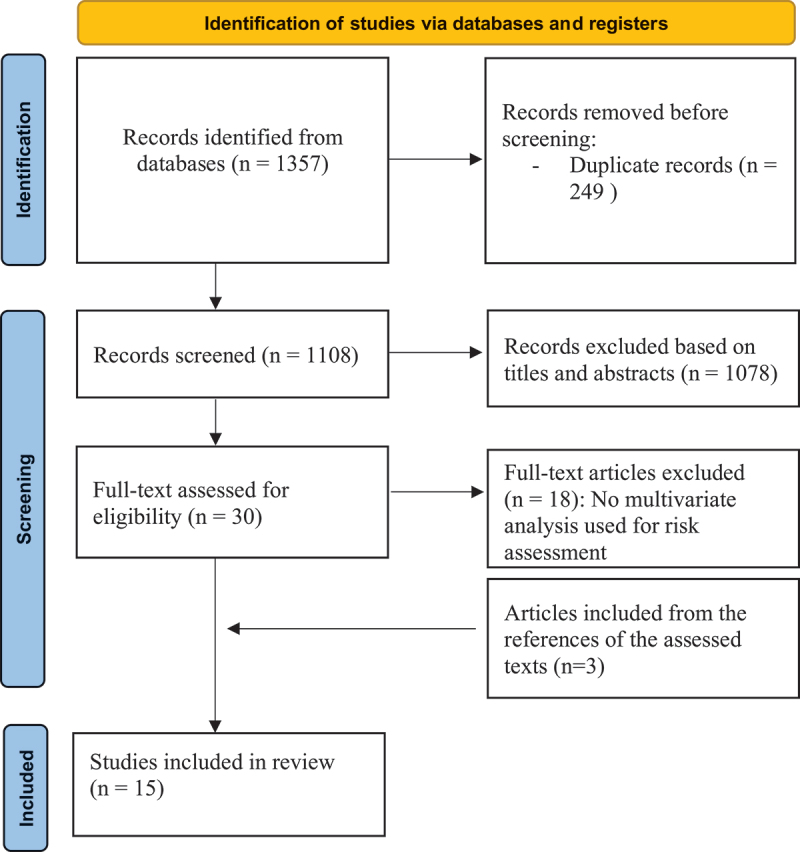
The search originally yielded a total of 1357 articles, of which only 15 met our inclusion criteria, comprising 13, 481 patients. All the studies were observational, and retrospective published between 2013 and 2022. The natural history of UES and the reported risk factors varied widely across the studies. In 13 studies, a significant association between some risk factors and UES development was demonstrated. High body mass index (BMI) was the most frequently reported stricture risk factor, followed by perioperative urinary tract infection (UTI), robotic-assisted radical cystectomy (RARC), occurrence of post-operative Clavian grade ≥ 3 complications and urinary leakage. Otherwise, many other risk factors were reported only once.
The literature is still lacking well-designed prospective studies investigating predisposing factors of UES. The available data suggest that the high BMI, RARC and complicated postoperative course are the main risk factors for stricture formation.
输尿管肠吻合口狭窄(UES)是根治性膀胱切除术(RC)及尿流改道(UD)后肾功能恶化的主要原因。本综述的目的是总结探讨与UES发生相关危险因素的研究。识别相关因素对于帮助外科医生调整治疗或随访策略以减少这一严重并发症至关重要。
使用PubMed数据库对文献进行全面检索。检索目标仅为主要旨在识别RC和UD后UES危险因素的研究。还检查了检索论文的参考文献以确定是否可能纳入。
最初检索共得到1357篇文章,其中仅15篇符合我们的纳入标准,涉及13481例患者。所有研究均为观察性研究,且为2013年至2022年发表的回顾性研究。不同研究中UES的自然史和报告的危险因素差异很大。13项研究表明某些危险因素与UES发生之间存在显著关联。高体重指数(BMI)是最常报告的狭窄危险因素,其次是围手术期尿路感染(UTI)、机器人辅助根治性膀胱切除术(RARC)、术后锁骨下≥3级并发症的发生以及尿漏。此外,许多其他危险因素仅被报告过一次。
目前仍缺乏设计良好的前瞻性研究来调查UES的易感因素。现有数据表明,高BMI、RARC和复杂的术后病程是狭窄形成的主要危险因素。