Wandall-Holm Malthe Faurschou, Holm Rolf Pringler, Heick Alex, Langkilde Annika Reynberg, Magyari Melinda
Department of Neurology, Danish Multiple Sclerosis Registry, Copenhagen University Hospital-Rigshospitalet, Glostrup DK-2600, Denmark.
Department of Neurology, Danish Multiple Sclerosis Center, Copenhagen University Hospital-Rigshospitalet, Glostrup DK-2600, Denmark.
Brain Commun. 2024 Jan 2;6(1):fcad358. doi: 10.1093/braincomms/fcad358. eCollection 2024.
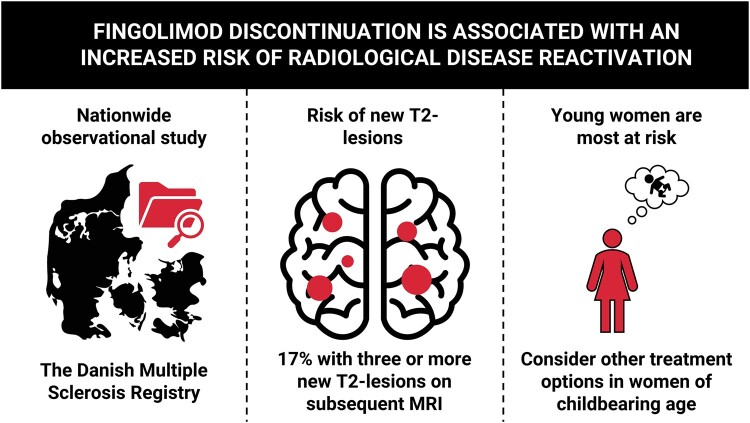
Fingolimod is a frequently used disease-modifying therapy in relapsing-remitting multiple sclerosis. However, case reports and small observational studies indicate a highly increased risk of disease reactivation after discontinuation. We aimed to investigate the risk of radiological disease reactivation in patients discontinuing fingolimod. We performed a nationwide cohort study in Denmark, including patients who discontinued fingolimod between January 2014 and January 2023. Eligibility was a diagnosis with relapsing-remitting multiple sclerosis and two MRIs performed respectively within 1 year before and after discontinuing fingolimod. The included patients were compared with those discontinuing dimethyl fumarate with the same eligibility criteria in an unadjusted and matched propensity score analysis. Matching was done on age, sex, Expanded Disability Status Scale, MRI data, cause for treatment discontinuation, treatment duration and relapse rate. The main outcome was the presence of new T lesions on the first MRI after treatment discontinuation. To identify high-risk patients among those discontinuing fingolimod, we made a predictive model assessing risk factors for obtaining new T lesions. Of 1324 patients discontinuing fingolimod in the study period, 752 were eligible for inclusion [mean age (standard deviation), years, 41 (10); 552 females (73%); median Expanded Disability Status Scale (Q1-Q3), 2.5 (2.0-3.5); mean disease duration (standard deviation), years, 12 (8)]. Of 2044 patients discontinuing dimethyl fumarate in the study period, 957 were eligible for inclusion, presenting similar baseline characteristics. Among patients discontinuing fingolimod, 127 (17%) had 1-2 new T lesions, and 124 (17%) had ≥3 new T lesions compared with 114 (12%) and 45 (5%), respectively, for those discontinuing dimethyl fumarate, corresponding to odds ratios (95% confidence interval) of 1.8 (1.3-2.3) and 4.4 (3.1-6.3). The predictive model, including 509 of the 752 patients discontinuing fingolimod, showed a highly increased risk of new T lesions among those with disease activity during fingolimod treatment and among females under 40 years. This nationwide study suggests that discontinuing fingolimod in some cases carries a risk of developing new T lesions, emphasizing the importance of clinical awareness. If feasible, clinicians should prioritize the prompt initiation of new disease-modifying therapies, particularly among young females.
芬戈莫德是复发缓解型多发性硬化症中常用的疾病修饰疗法。然而,病例报告和小型观察性研究表明,停药后疾病重新激活的风险大幅增加。我们旨在调查停用芬戈莫德的患者中放射学疾病重新激活的风险。我们在丹麦进行了一项全国性队列研究,纳入了2014年1月至2023年1月期间停用芬戈莫德的患者。入选标准为复发缓解型多发性硬化症诊断,且在停用芬戈莫德前后1年内分别进行了两次磁共振成像(MRI)检查。在未调整和匹配倾向评分分析中,将纳入的患者与符合相同入选标准的停用富马酸二甲酯的患者进行比较。匹配因素包括年龄、性别、扩展残疾状态量表、MRI数据、停药原因、治疗持续时间和复发率。主要结局是停药后首次MRI上出现新的T2加权高信号病变。为了在停用芬戈莫德的患者中识别高危患者,我们建立了一个预测模型,评估出现新的T2加权高信号病变的危险因素。在研究期间停用芬戈莫德的1324例患者中,752例符合纳入标准[平均年龄(标准差),岁,41(10);女性552例(73%);扩展残疾状态量表中位数(第1四分位数 - 第3四分位数),2.5(2.0 - 3.5);平均病程(标准差),年,12(8)]。在研究期间停用富马酸二甲酯的2044例患者中,957例符合纳入标准,其基线特征相似。在停用芬戈莫德的患者中,127例(17%)有1 - 2个新的T2加权高信号病变,124例(17%)有≥3个新的T2加权高信号病变,而停用富马酸二甲酯患者中相应比例分别为114例(12%)和45例(5%),对应优势比(95%置信区间)为1.8(1.3 - 2.3)和4.