Nofer Institute of Occupational Medicine, Łódź, Poland (Department of Environmental and Occupational Health Hazards).
Medical University of Lodz, Łódź, Poland (Department of Toxicology).
Int J Occup Med Environ Health. 2024 Mar 5;37(1):34-44. doi: 10.13075/ijomeh.1896.02320. Epub 2024 Jan 12.
The circadian system is the main regulator of almost all human physiological processes. The aim of this study was to assess sleep in the working population, in relation to the share of remote working.
An online survey was conducted among students and staff representing 3 universities in Łódź, Poland (N = 1209). The participants were divided into 3 groups according to the percentage of time they worked remotely. Group I consisted of respondents performing tasks remotely for ≤45% of their working time; group II included respondents performing their duties remotely for >45-75% of their working time, and group III included those working >75% of their time remotely.
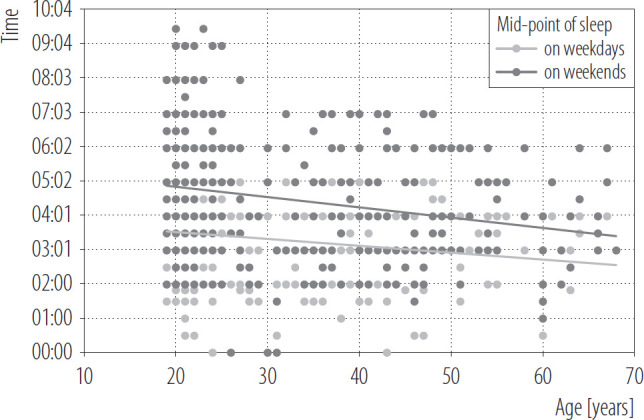
performing their duties remotely for >45-75% of their working time, and group III included those working >75% of their time remotely. Results: In the study, the authors found the association between the length of time spent on a computer, the percentage of time working remotely, and the occurrence of physical symptoms and the prevalence of sleep disorders. The most significant difference between working days and days off in terms of the mid-point of sleep (1.5 h) was observed in group I, where there was the greatest variability in the form of work performance. The participants who worked most of their time remotely (group III) shifted their bedtime to midnight, both on working days and on days off.
The study highlights that increased remote computer use leads to a shift in sleeping patterns towards midnight. The participants with later midpoint of sleep hours were found to have a higher incidence of sleep disorders. The prevalence of sleep disorders was significantly impacted by prolonged mobile phone use before bedtime and long hours of computer use. Thus, limiting both the time spent in front of a computer and the use of mobile phones before bedtime is recommended. Int J Occup Med Environ Health. 2024;37(1):34-44.
生物钟系统是几乎所有人体生理过程的主要调节者。本研究旨在评估与远程工作比例相关的工作人群的睡眠情况。
对波兰罗兹 3 所大学的学生和工作人员进行了一项在线调查(N=1209)。根据远程工作时间的比例,参与者被分为 3 组。第 1 组的远程工作时间不超过 45%;第 2 组的远程工作时间为 45%-75%;第 3 组的远程工作时间超过 75%。
在该研究中,作者发现了在计算机使用时间、远程工作时间比例与身体症状发生和睡眠障碍患病率之间存在关联。第 1 组的工作时间和休息时间的中点睡眠时间(1.5 小时)差异最大,工作方式的变化最大。在远程工作时间最长的第 3 组中,工作日和休息日的就寝时间都推迟到午夜。
该研究强调,增加远程计算机使用会导致睡眠模式向午夜转移。研究发现,睡眠中点时间较晚的参与者睡眠障碍发生率更高。睡眠障碍的患病率受到睡前长时间使用手机和长时间使用电脑的显著影响。因此,建议限制使用电脑和手机的时间,以减少睡前使用手机和长时间使用电脑的时间。国际职业医学与环境卫生杂志。2024;37(1):34-44.