Department of Molecular Genetics, Erasmus MC Cancer Institute, Erasmus University Medical Centre Rotterdam, 3015 GD Rotterdam, The Netherlands.
Centre for Health Protection, National Institute for Public Health and the Environment (RIVM), 3721 MA Bilthoven, The Netherlands.
Nutrients. 2021 Dec 18;13(12):4543. doi: 10.3390/nu13124543.
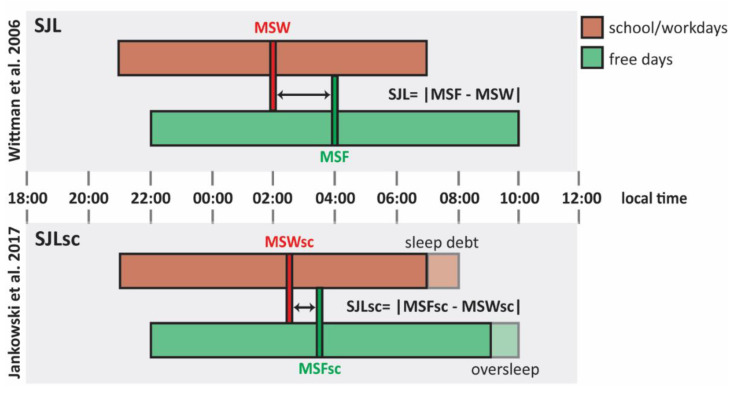
The term social jetlag is used to describe the discrepancy between biological time, determined by our internal body clock, and social times, mainly dictated by social obligations such as school or work. In industrialized countries, two-thirds of the studying/working population experiences social jetlag, often for several years. Described for the first time in 2006, a considerable effort has been put into understanding the effects of social jetlag on human physiopathology, yet our understanding of this phenomenon is still very limited. Due to its high prevalence, social jetlag is becoming a primary concern for public health. This review summarizes current knowledge regarding social jetlag, social jetlag associated behavior (e.g., unhealthy eating patterns) and related risks for human health.
社会时差这个术语用来描述生物时间(由我们的内部生物钟决定)和社会时间(主要由学校或工作等社会义务决定)之间的差异。在工业化国家,三分之二的学习/工作人口经历社会时差,这种情况通常会持续数年。社会时差于 2006 年首次被描述,人们已经做出了相当大的努力来理解社会时差对人类病理生理学的影响,但我们对这一现象的理解仍然非常有限。由于其高患病率,社会时差正成为公共卫生的主要关注点。本综述总结了目前关于社会时差、与社会时差相关的行为(例如,不健康的饮食模式)以及对人类健康相关风险的认识。