Department of Otolaryngology-Head and Neck Surgery, The Ohio State Wexner Medical Center, Columbus, OH, USA.
The Ohio State University College of Medicine, Columbus, OH, USA.
Respir Res. 2024 Jan 12;25(1):28. doi: 10.1186/s12931-024-02667-8.
Tissue-engineered tracheal grafts (TETG) can be recellularized by the host or pre-seeded with host-derived cells. However, the impact of airway disease on the recellularization process is unknown.
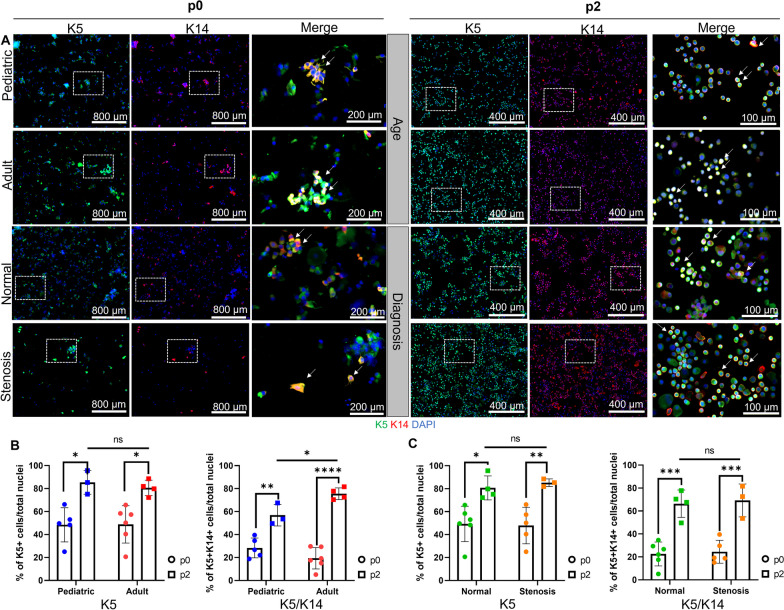
In this study, we determined if airway disease alters the regenerative potential of the human tracheobronchial epithelium (hTBE) obtained by brushing the tracheal mucosa during clinically-indicated bronchoscopy from 48 pediatric and six adult patients.
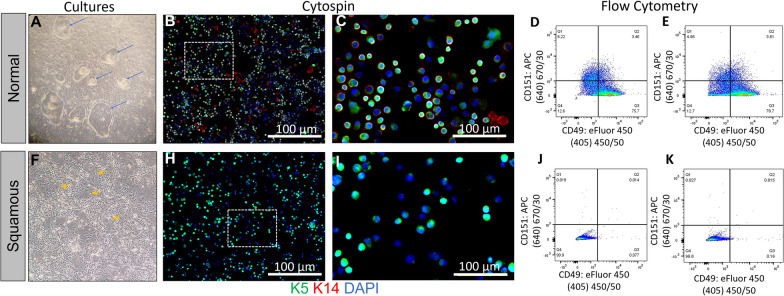
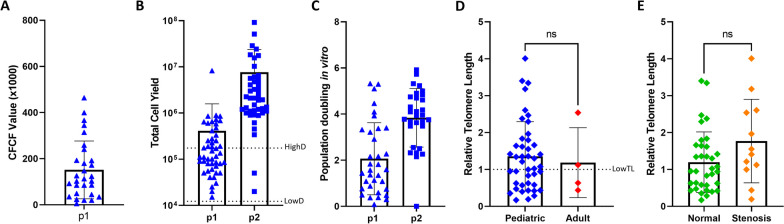
Our findings revealed that basal cell recovery and frequency did not vary by age or region. At passage 1, all samples produced enough cells to cellularize a 3.5 by 0.5 cm graft scaffold at low cell density (~ 7000 cells/cm), and 43.75% could cellularize a scaffold at high cell density (~ 100,000 cells/cm). At passage 2, all samples produced the number of cells required for both recellularization models. Further evaluation revealed that six pediatric samples (11%) and three (50%) adult samples contained basal cells with a squamous basal phenotype. These cells did not form a polarized epithelium or produce differentiated secretory or ciliated cells. In the pediatric population, the squamous basal cell phenotype was associated with degree of prematurity (< 28 weeks, 64% vs. 13%, p = 0.02), significant pulmonary history (83% vs. 34%, p = 0.02), specifically with bronchopulmonary dysplasia (67% vs. 19%, p = 0.01), and patients who underwent previous tracheostomy (67% vs. 23%, p = 0.03).
In summary, screening high-risk pediatric or adult population based on clinical risk factors and laboratory findings could define appropriate candidates for airway reconstruction with tracheal scaffolds.
Level III Cohort study.
组织工程气管移植物(TETG)可以通过宿主再细胞化或预先接种宿主来源的细胞。然而,气道疾病对再细胞化过程的影响尚不清楚。
在这项研究中,我们确定了气道疾病是否改变了通过临床指示支气管镜从 48 名儿科和 6 名成年患者的气管黏膜刷取获得的人气管支气管上皮(hTBE)的再生潜能。
我们的发现表明,基底细胞的恢复和频率与年龄或部位无关。在第 1 代时,所有样本在低细胞密度(7000 个细胞/cm)下都产生了足够的细胞来使 3.5×0.5cm 移植物支架再细胞化,而 43.75%的细胞可以在高细胞密度(100000 个细胞/cm)下使支架再细胞化。在第 2 代时,所有样本都产生了两种再细胞化模型所需的细胞数量。进一步评估显示,6 名儿科样本(11%)和 3 名(50%)成年样本中含有鳞状基底表型的基底细胞。这些细胞没有形成极化上皮,也没有产生分化的分泌细胞或纤毛细胞。在儿科人群中,鳞状基底细胞表型与早产程度(<28 周,64%与 13%,p=0.02)、显著的肺部病史(83%与 34%,p=0.02)、特别是支气管肺发育不良(67%与 19%,p=0.01)和先前接受过气管造口术的患者(67%与 23%,p=0.03)有关。
总之,基于临床危险因素和实验室发现,对高危儿科或成年人群进行筛查,可以确定适合使用气管支架进行气道重建的合适候选者。
III 级队列研究。