Medical Device Solutions, Battelle Memorial Institute, 505 King Ave, Columbus, OH, 43201, USA.
Health Analytics, Battelle Memorial Institute, 505 King Ave, Columbus, OH, 43201, USA.
J Neuroeng Rehabil. 2024 Jan 13;21(1):7. doi: 10.1186/s12984-023-01301-w.
Seventy-five percent of stroke survivors, caregivers, and health care professionals (HCP) believe current therapy practices are insufficient, specifically calling out the upper extremity as an area where innovation is needed to develop highly usable prosthetics/orthotics for the stroke population. A promising method for controlling upper extremity technologies is to infer movement intention non-invasively from surface electromyography (EMG). However, existing technologies are often limited to research settings and struggle to meet user needs.
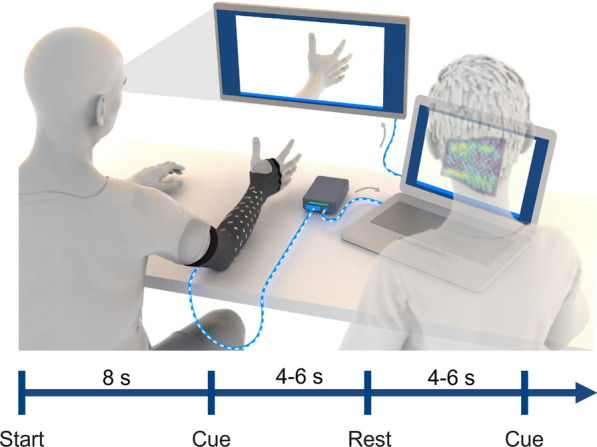
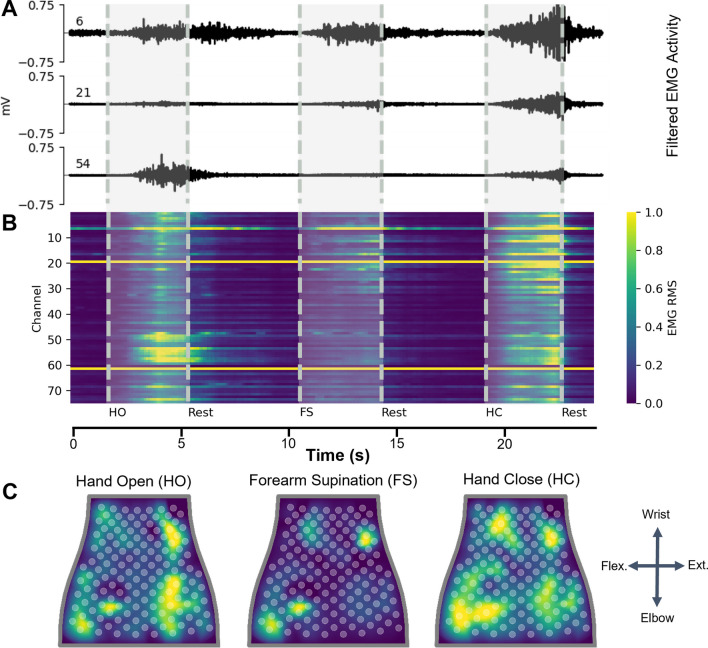
To address these limitations, we have developed the NeuroLife EMG System, an investigational device which consists of a wearable forearm sleeve with 150 embedded electrodes and associated hardware and software to record and decode surface EMG. Here, we demonstrate accurate decoding of 12 functional hand, wrist, and forearm movements in chronic stroke survivors, including multiple types of grasps from participants with varying levels of impairment. We also collected usability data to assess how the system meets user needs to inform future design considerations.
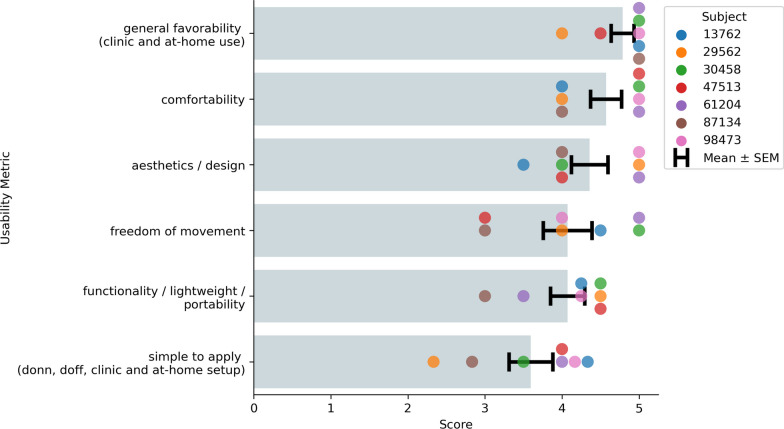
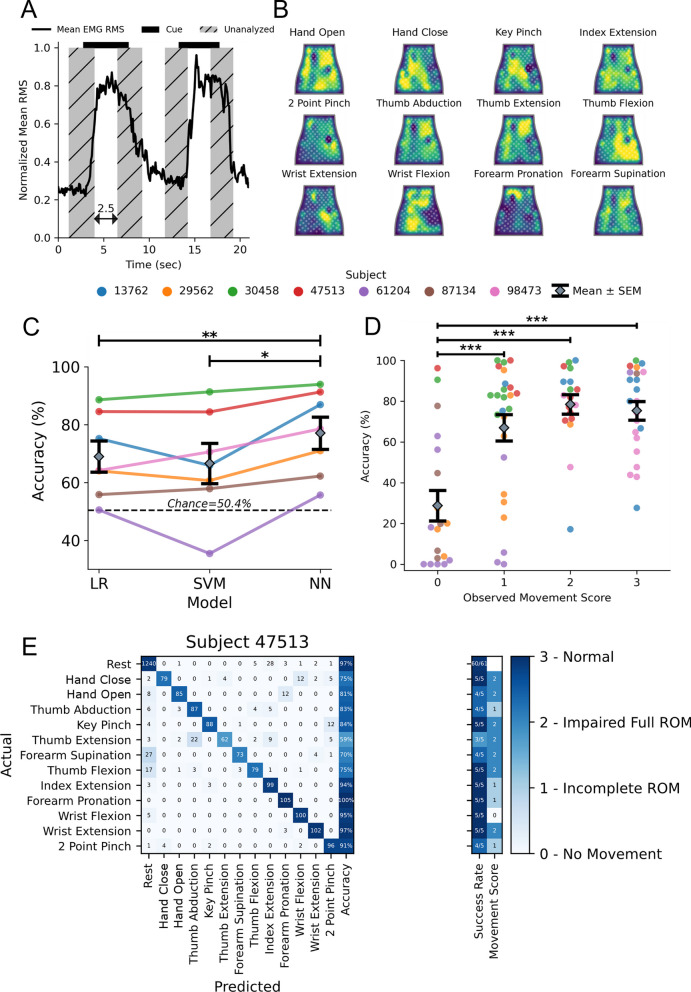
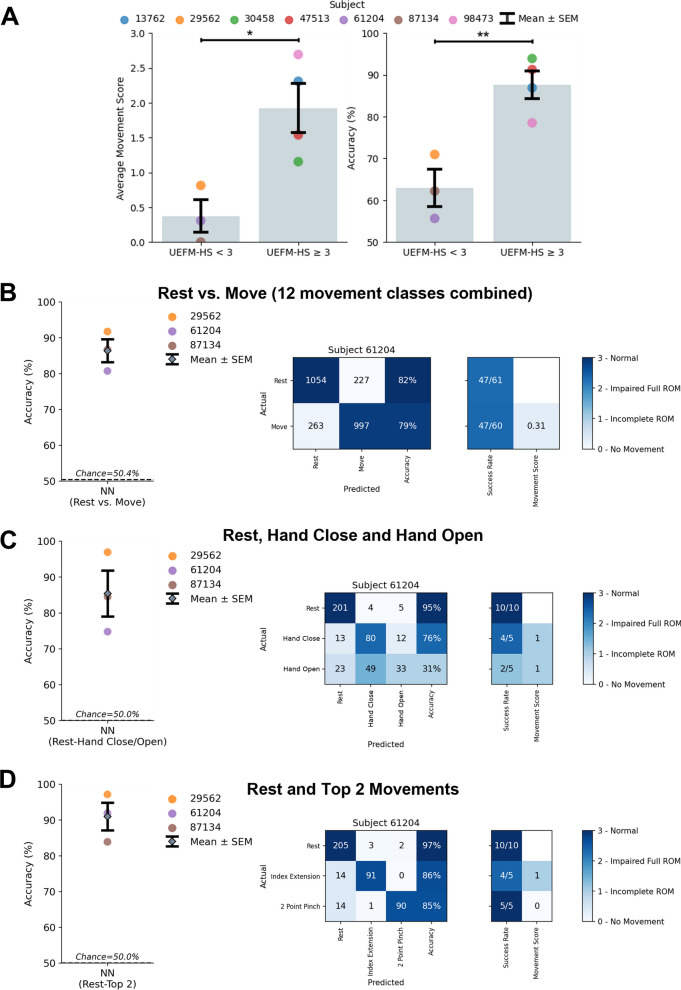
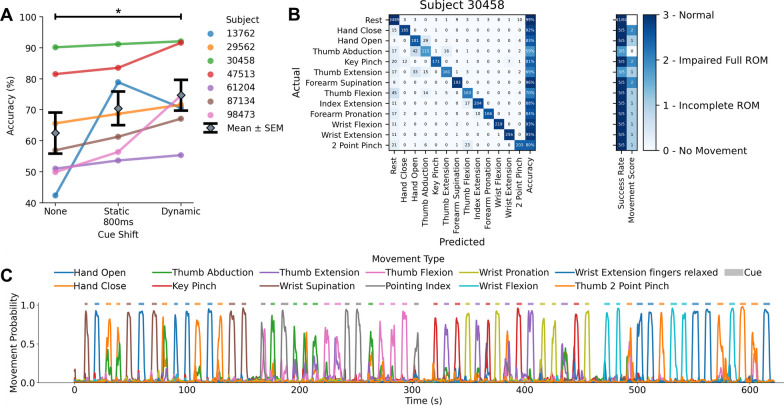
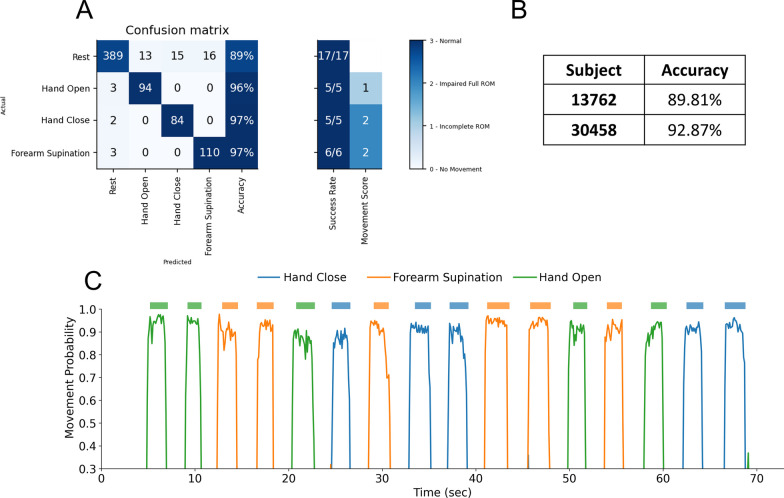
Our decoding algorithm trained on historical- and within-session data produced an overall accuracy of 77.1 ± 5.6% across 12 movements and rest in stroke participants. For individuals with severe hand impairment, we demonstrate the ability to decode a subset of two fundamental movements and rest at 85.4 ± 6.4% accuracy. In online scenarios, two stroke survivors achieved 91.34 ± 1.53% across three movements and rest, highlighting the potential as a control mechanism for assistive technologies. Feedback from stroke survivors who tested the system indicates that the sleeve's design meets various user needs, including being comfortable, portable, and lightweight. The sleeve is in a form factor such that it can be used at home without an expert technician and can be worn for multiple hours without discomfort.
The NeuroLife EMG System represents a platform technology to record and decode high-resolution EMG for the real-time control of assistive devices in a form factor designed to meet user needs. The NeuroLife EMG System is currently limited by U.S. federal law to investigational use.
75%的中风幸存者、照顾者和医疗保健专业人员(HCP)认为当前的治疗实践不足,特别是上肢作为需要创新的领域,以开发出高度可用的中风人群假肢/矫形器。一种有前途的控制上肢技术的方法是通过表面肌电图(EMG)无创地推断运动意图。然而,现有的技术往往限于研究环境,难以满足用户的需求。
为了解决这些限制,我们开发了 NeuroLife EMG 系统,这是一种由可穿戴的前臂袖套和 150 个嵌入式电极以及相关的硬件和软件组成的研究设备,用于记录和解码表面 EMG。在这里,我们展示了对慢性中风幸存者的 12 种功能性手部、手腕和前臂运动的准确解码,包括参与者不同程度损伤的多种抓握类型。我们还收集了可用性数据,以评估系统如何满足用户的需求,为未来的设计考虑提供信息。
我们的解码算法在历史和会话数据上进行训练,在中风参与者中产生了 12 种运动和休息的总体准确率为 77.1±5.6%。对于手部严重受损的个体,我们证明了能够以 85.4±6.4%的准确率解码两个基本运动和休息的子集。在在线场景中,两名中风幸存者在三个运动和休息中实现了 91.34±1.53%的准确率,突出了作为辅助技术控制机制的潜力。测试系统的中风幸存者的反馈表明,袖套的设计满足了各种用户需求,包括舒适、便携和轻便。袖套的外形尺寸使得它可以在家中使用,无需专家技术人员,并且可以在不引起不适的情况下佩戴数小时。
NeuroLife EMG 系统代表了一种记录和解码高分辨率 EMG 的平台技术,用于以满足用户需求的外形尺寸实时控制辅助设备。NeuroLife EMG 系统目前受到美国联邦法律的限制,只能用于研究用途。