Xu Hong-Miao, Shen Xuan-Jiang, Liu Jia
Department of Stomatology, The First People's Hospital of Wenling, Taizhou 317500, Zhejiang Province, China.
Department of Stomatology, Taizhou Central Hospital (Taizhou University Hospital), Taizhou 318000, Zhejiang Province, China.
World J Diabetes. 2023 Dec 15;14(12):1793-1802. doi: 10.4239/wjd.v14.i12.1793.
Type 2 diabetes mellitus (T2DM) is associated with periodontitis. Currently, there are few studies proposing predictive models for periodontitis in patients with T2DM.
To determine the factors influencing periodontitis in patients with T2DM by constructing logistic regression and random forest models.
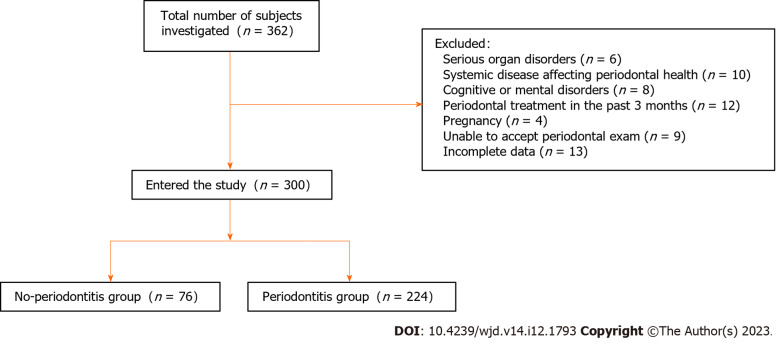
In this a retrospective study, 300 patients with T2DM who were hospitalized at the First People's Hospital of Wenling from January 2022 to June 2022 were selected for inclusion, and their data were collected from hospital records. We used logistic regression to analyze factors associated with periodontitis in patients with T2DM, and random forest and logistic regression prediction models were established. The prediction efficiency of the models was compared using the area under the receiver operating characteristic curve (AUC).
Of 300 patients with T2DM, 224 had periodontitis, with an incidence of 74.67%. Logistic regression analysis showed that age [odds ratio (OR) = 1.047, 95% confidence interval (CI): 1.017-1.078], teeth brushing frequency (OR = 4.303, 95%CI: 2.154-8.599), education level (OR = 0.528, 95%CI: 0.348-0.800), glycosylated hemoglobin (HbA1c) (OR = 2.545, 95%CI: 1.770-3.661), total cholesterol (TC) (OR = 2.872, 95%CI: 1.725-4.781), and triglyceride (TG) (OR = 3.306, 95%CI: 1.019-10.723) influenced the occurrence of periodontitis ( < 0.05). The random forest model showed that the most influential variable was HbA1c followed by age, TC, TG, education level, brushing frequency, and sex. Comparison of the prediction effects of the two models showed that in the training dataset, the AUC of the random forest model was higher than that of the logistic regression model (AUC = 1.000 AUC = 0.851; < 0.05). In the validation dataset, there was no significant difference in AUC between the random forest and logistic regression models (AUC = 0.946 AUC = 0.915; > 0.05).
Both random forest and logistic regression models have good predictive value and can accurately predict the risk of periodontitis in patients with T2DM.
2型糖尿病(T2DM)与牙周炎相关。目前,很少有研究提出T2DM患者牙周炎的预测模型。
通过构建逻辑回归和随机森林模型来确定影响T2DM患者牙周炎的因素。
在这项回顾性研究中,选取了2022年1月至2022年6月在温岭市第一人民医院住院的300例T2DM患者纳入研究,并从医院记录中收集他们的数据。我们使用逻辑回归分析T2DM患者牙周炎的相关因素,并建立随机森林和逻辑回归预测模型。使用受试者工作特征曲线下面积(AUC)比较模型的预测效率。
300例T2DM患者中,224例患有牙周炎,发病率为74.67%。逻辑回归分析显示,年龄[比值比(OR)=1.047,95%置信区间(CI):1.017 - 1.078]、刷牙频率(OR = 4.303,95%CI:2.154 - 8.599)、教育水平(OR = 0.528,95%CI:0.348 - 0.800)、糖化血红蛋白(HbA1c)(OR = 2.545,95%CI:1.770 - 3.661)、总胆固醇(TC)(OR = 2.872,95%CI:1.725 - 4.781)和甘油三酯(TG)(OR = 3.306,95%CI:1.019 - 10.723)影响牙周炎的发生(P < 0.05)。随机森林模型显示,最具影响力的变量是HbA1c,其次是年龄、TC、TG、教育水平、刷牙频率和性别。两种模型预测效果的比较表明,在训练数据集中,随机森林模型的AUC高于逻辑回归模型(AUC = 1.000 vs AUC = 0.851;P < 0.05)。在验证数据集中,随机森林模型和逻辑回归模型的AUC无显著差异(AUC = 0.946 vs AUC = 0.915;P > 0.05)。
随机森林模型和逻辑回归模型均具有良好的预测价值,能够准确预测T2DM患者牙周炎的风险。