Cong Peng, Wang Xue-Mei, Zhang Yun-Fei
Department of Ultrasound, The First Hospital of China Medical University, Shenyang, China.
Quant Imaging Med Surg. 2024 Jan 3;14(1):711-721. doi: 10.21037/qims-23-788. Epub 2024 Jan 2.
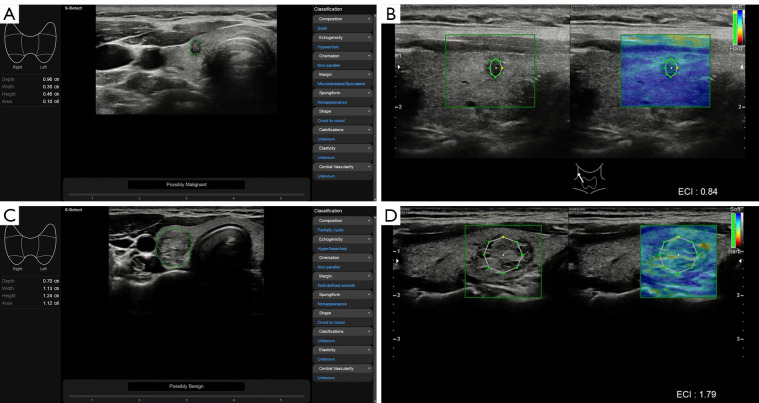
Ultrasound is widely used for detecting thyroid nodules in clinical practice. This retrospective study aimed to assess the diagnostic efficacy of the American College of Radiology Thyroid Imaging Reporting and Data System (ACR-TIRADS), S-Detect, and elastography of the carotid artery for suspicious thyroid nodules and to determine the complementary value of artificial intelligence and elastography.
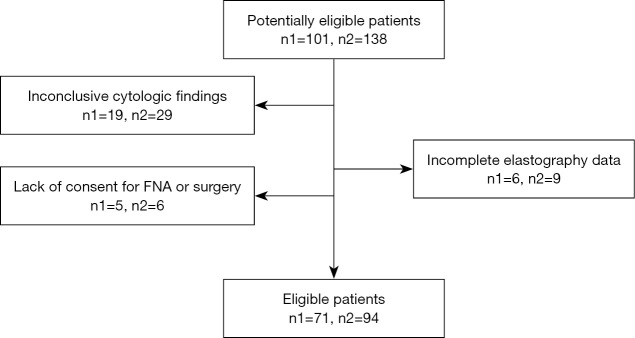
Between January 2021 and November 2021, 101 consecutive patients with 138 thyroid nodules were enrolled in The First Hospital of China Medical University. All nodules were evaluated using ACR-TIRADS categories (TR), S-Detect, and elastography, and then the diagnostic performance of the different methods and the combined assessment were compared. The inclusion criteria were the following: (I) TR3, TR4, and TR5 nodules, which were defined as "suspicious nodules"; (II) patients who had surgical or cytopathological results after ultrasound examination; and (III) voluntary enrollment in this study. Meanwhile, the exclusion criteria were the following: (I) TR1 and TR2 nodules, (II) patients who had undergone fine-needle aspiration before ultrasound examination, and (III) inconclusive cytologic findings.
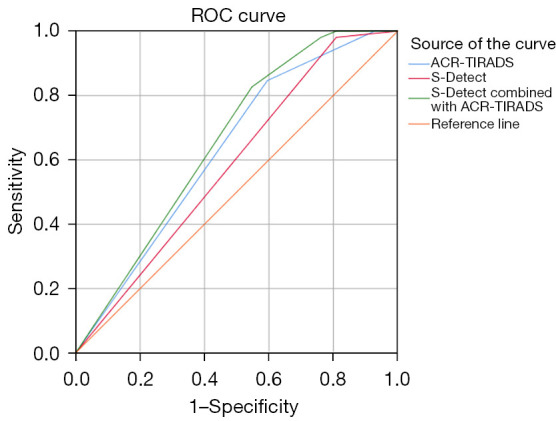
A total of 71 patients (12 men and 59 women) with 94 suspicious thyroid nodules (42 benign nodules and 52 malignant nodules) were finally included in this study. S-Detect had a significantly better sensitivity than did ACR-TIRADS [S-Detect: 98.1%, 95% confidence interval (CI): 89.7-100.0%; ACR-TIRADS: 84.6%, 95% CI: 71.9-93.1%; P=0.036], but its specificity was much lower (S-Detect: 19.0%; 95% CI: 8.6-34.1%; ACR-TIRADS: 40.5%, 95% CI: 25.6-56.7%; P=0.032). The accuracy was not significantly different between S-Detect (62.8%; 95% CI: 52.2-72.5%) and ACR-TIRADS (64.9%; 95% CI: 54.4-74.5%) (P=0.761). The elasticity contrast index (ECI) was not definitively useful in identifying suspicious thyroid nodules (P=0.592). Compared with the use of ACR-TIRADS and S-Detect alone, the specificity (45.2%; 95% CI: 29.8-61.3%), positive predictive value (65.2%; 95% CI: 52.4-76.5%), accuracy (66.0%; 95% CI: 55.5-75.4%), and the area under the receiver operating characteristic curve (0.640; 95% CI: 0.534-0.736) of their combination were higher but not significantly so.
At present, S-Detect cannot replace manual diagnosis, and the value of elastography of the carotid artery in diagnosing suspected thyroid nodules remains unclear.
超声在临床实践中广泛用于检测甲状腺结节。本回顾性研究旨在评估美国放射学会甲状腺影像报告和数据系统(ACR-TIRADS)、S-Detect以及颈动脉弹性成像对可疑甲状腺结节的诊断效能,并确定人工智能与弹性成像的互补价值。
2021年1月至2021年11月,中国医科大学附属第一医院连续纳入101例患者,共138个甲状腺结节。所有结节均采用ACR-TIRADS分类(TR)、S-Detect和弹性成像进行评估,然后比较不同方法及联合评估的诊断性能。纳入标准如下:(I)TR3、TR4和TR5类结节,定义为“可疑结节”;(II)超声检查后有手术或细胞病理学结果的患者;(III)自愿参加本研究。同时,排除标准如下:(I)TR1和TR2类结节;(II)超声检查前已接受细针穿刺的患者;(III)细胞学检查结果不明确。
本研究最终纳入71例患者(12例男性和59例女性),共94个可疑甲状腺结节(42个良性结节和52个恶性结节)。S-Detect的灵敏度显著高于ACR-TIRADS [S-Detect:98.1%,95%置信区间(CI):89.7-100.0%;ACR-TIRADS:84.6%,95% CI:71.9-93.1%;P=0.036],但其特异度低得多(S-Detect:19.0%;95% CI:8.6-34.1%;ACR-TIRADS:40.5%,95% CI:25.6-56.7%;P=0.032)。S-Detect(62.8%;95% CI:52.2-72.5%)与ACR-TIRADS(64.9%;95% CI:54.4-74.5%)的准确度差异无统计学意义(P=0.761)。弹性对比指数(ECI)在识别可疑甲状腺结节方面并无确切作用(P=0.592)。与单独使用ACR-TIRADS和S-Detect相比,其联合评估的特异度(45.2%;95% CI:29.8-61.3%)、阳性预测值(65.2%;95% CI:52.4-76.5%)、准确度(66.0%;95% CI:55.5-75.4%)及受试者工作特征曲线下面积(0.640;95% CI:0.534-0.736)更高,但差异无统计学意义。
目前,S-Detect不能取代人工诊断,颈动脉弹性成像在诊断可疑甲状腺结节中的价值仍不明确。