
棉鼠丝虫的基因组揭示了丝虫线虫Y染色体的起源。
The genome of Litomosoides sigmodontis illuminates the origins of Y chromosomes in filarial nematodes.
作者信息
Stevens Lewis, Kieninger Manuela, Chan Brian, Wood Jonathan M D, Gonzalez de la Rosa Pablo, Allen Judith, Blaxter Mark
机构信息
Tree of Life, Wellcome Sanger Institute, Cambridge, United Kingdom.
Lydia Becker Institute of Immunology and Inflammation, Wellcome Centre for Cell-Matrix Research, Faculty of Biology, Medicine & Health, University of Manchester, Manchester, United Kingdom.
出版信息
PLoS Genet. 2024 Jan 16;20(1):e1011116. doi: 10.1371/journal.pgen.1011116. eCollection 2024 Jan.
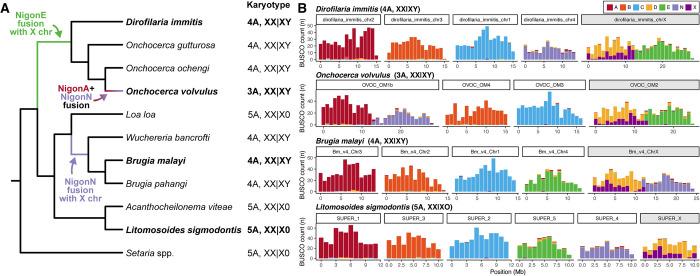
Heteromorphic sex chromosomes are usually thought to have originated from a pair of autosomes that acquired a sex-determining locus and subsequently stopped recombining, leading to degeneration of the sex-limited chromosome. The majority of nematode species lack heteromorphic sex chromosomes and determine sex using an X-chromosome counting mechanism, with males being hemizygous for one or more X chromosomes (XX/X0). Some filarial nematode species, including important parasites of humans, have heteromorphic XX/XY karyotypes. It has been assumed that sex is determined by a Y-linked locus in these species. However, karyotypic analyses suggested that filarial Y chromosomes are derived from the unfused homologue of an autosome involved in an X-autosome fusion event. Here, we generated a chromosome-level reference genome for Litomosoides sigmodontis, a filarial nematode with the ancestral filarial karyotype and sex determination mechanism (XX/X0). By mapping the assembled chromosomes to the rhabditid nematode ancestral linkage (or Nigon) elements, we infer that the ancestral filarial X chromosome was the product of a fusion between NigonX (the ancestrally X-linked element) and NigonD (ancestrally autosomal). In the two filarial lineages with XY systems, there have been two independent X-autosome chromosome fusion events involving different autosomal Nigon elements. In both lineages, the region shared by the neo-X and neo-Y chromosomes is within the ancestrally autosomal portion of the X, confirming that the filarial Y chromosomes are derived from the unfused homologue of the autosome. Sex determination in XY filarial nematodes therefore likely continues to operate via the ancestral X-chromosome counting mechanism, rather than via a Y-linked sex-determining locus.
异形性染色体通常被认为起源于一对常染色体,这对常染色体获得了一个性别决定位点,随后停止重组,导致性限制染色体退化。大多数线虫物种缺乏异形性染色体,而是使用X染色体计数机制来决定性别的,雄性为一个或多个X染色体半合子(XX/X0)。一些丝虫线虫物种,包括人类的重要寄生虫,具有异形的XX/XY核型。据推测,这些物种的性别由Y连锁位点决定。然而,核型分析表明,丝虫Y染色体源自参与X-常染色体融合事件的常染色体未融合同源物。在这里,我们为巴西日圆线虫(Litomosoides sigmodontis)生成了一个染色体水平的参考基因组,它是一种具有丝状线虫祖先核型和性别决定机制(XX/X0)的丝状线虫。通过将组装好的染色体映射到杆形线虫祖先连锁(或尼贡)元件上,我们推断丝状线虫祖先X染色体是尼贡X(祖先X连锁元件)和尼贡D(祖先常染色体)之间融合的产物。在具有XY系统的两个丝状线虫谱系中,发生了两次独立的X-常染色体融合事件,涉及不同的常染色体尼贡元件。在这两个谱系中,新X染色体和新Y染色体共有的区域在X染色体的祖先常染色体部分内,证实了丝状线虫Y染色体源自常染色体的未融合同源物。因此,XY丝状线虫的性别决定可能继续通过祖先的X染色体计数机制起作用,而不是通过Y连锁的性别决定位点。


 Zotero 插件