
活体生物的晚期功能化:重新思考生物学中的选择性。
Late-Stage Functionalization of Living Organisms: Rethinking Selectivity in Biology.
机构信息
The Rosalind Franklin Institute, Oxfordshire OX11 0FA, U.K.
Department of Pharmacology, University of Oxford, Oxford OX1 3QT, U.K.
出版信息
Chem Rev. 2024 Feb 14;124(3):889-928. doi: 10.1021/acs.chemrev.3c00579. Epub 2024 Jan 17.
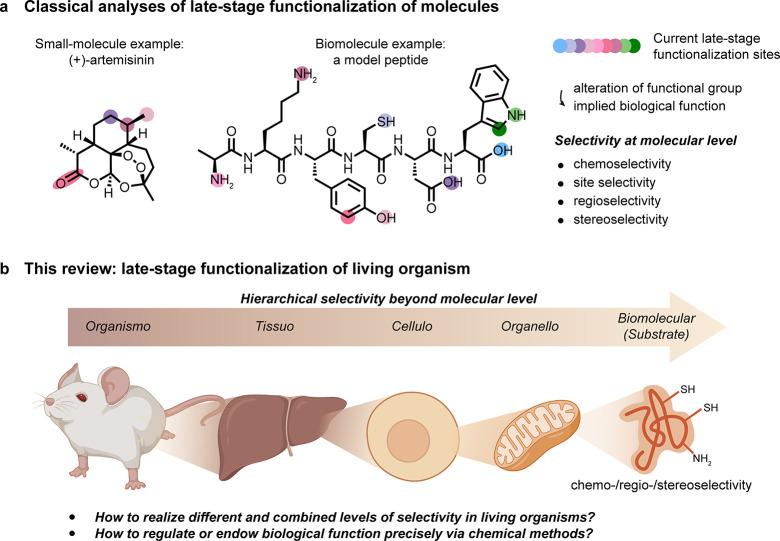
With unlimited selectivity, full post-translational chemical control of biology would circumvent the dogma of genetic control. The resulting direct manipulation of organisms would enable atomic-level precision in "editing" of function. We argue that a key aspect that is still missing in our ability to do this (at least with a high degree of control) is the selectivity of a given chemical reaction in a living organism. In this Review, we systematize existing illustrative examples of chemical selectivity, as well as identify needed chemical selectivities set in a hierarchy of anatomical complexity: organismo- (selectivity for a given organism over another), tissuo- (selectivity for a given tissue type in a living organism), cellulo- (selectivity for a given cell type in an organism or tissue), and organelloselectivity (selectivity for a given organelle or discrete body within a cell). Finally, we analyze more traditional concepts such as regio-, chemo-, and stereoselective reactions where additionally appropriate. This survey of late-stage biomolecule methods emphasizes, where possible, functional consequences (, biological function). In this way, we explore a concept of late-stage functionalization of living organisms (where "late" is taken to mean at a given state of an organism in time) in which programmed and selective chemical reactions take place in life. By building on precisely analyzed notions (, mechanism and selectivity) we believe that the logic of chemical methodology might ultimately be applied to increasingly complex molecular constructs in biology. This could allow principles developed at the simple, small-molecule level to progress hierarchically even to manipulation of physiology.
具有无限选择性,可完全进行翻译后生物学的化学控制,将绕过遗传控制的教条。这种对生物体的直接操作将使“编辑”功能达到原子级精度。我们认为,在我们有能力做到这一点(至少具有高度控制能力)方面,仍然缺少一个关键方面,即给定化学反应在活生物体中的选择性。在这篇综述中,我们系统地总结了现有化学选择性的说明性示例,并确定了在解剖复杂性层次结构中所需的化学选择性:生物种间选择性(一种给定生物体相对于另一种生物体的选择性)、组织选择性(一种给定组织类型在活生物体中的选择性)、细胞选择性(一种给定细胞类型在生物体或组织中的选择性)和细胞器选择性(一种给定细胞器或细胞内离散体的选择性)。最后,我们分析了更传统的概念,如区域选择性、化学选择性和立体选择性反应,在适当的情况下也会涉及到这些反应。对晚期生物分子方法的这种调查强调了(如果可能的话)功能后果(,生物学功能)。通过这种方式,我们探索了对活生物体进行晚期功能化的概念(其中“晚期”是指在生物体时间的给定状态),在这种功能化中,程序化和选择性化学反应在生命中发生。通过构建经过精确分析的概念(,机制和选择性),我们相信化学方法学的逻辑最终可能会应用于生物学中越来越复杂的分子结构。这可以使在简单小分子水平上开发的原理甚至可以按层次结构推进到生理学的操作。











 Zotero 插件