
埃塞俄比亚西南部阿尔巴明奇镇蚊虫的高人体血液指数:对城市蚊媒疾病传播的影响。
High human blood meal index of mosquitoes in Arba Minch town, southwest Ethiopia: an implication for urban mosquito-borne disease transmission.
机构信息
Department of Biology, Arba Minch University, Arba Minch, Ethiopia.
Centre for International Health, University of Bergen, Bergen, Norway.
出版信息
Parasitol Res. 2024 Jan 18;123(1):102. doi: 10.1007/s00436-024-08121-4.
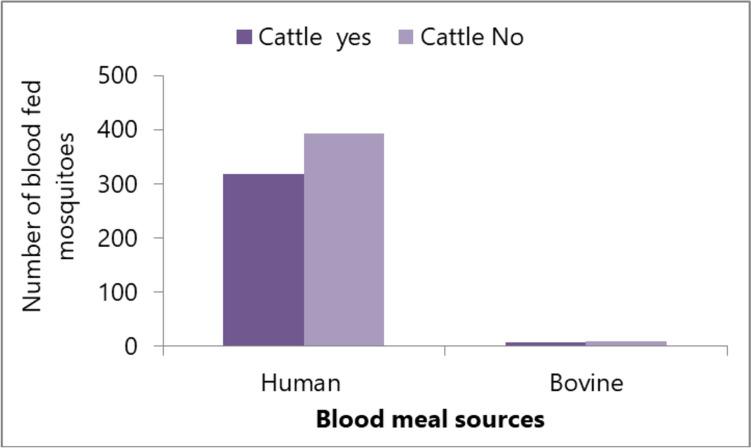
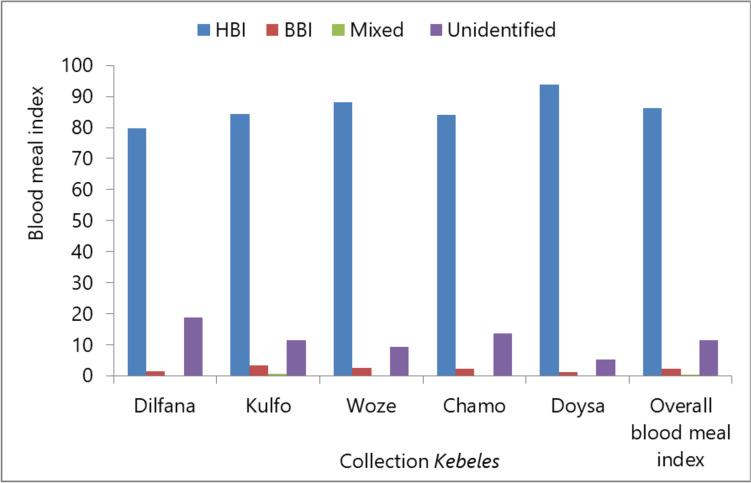
Unplanned human population shifts in urban areas are expected to increase the prevalence of vector-borne diseases. This study aimed to investigate mosquito species composition, blood meal sources, and malaria vectors in an urban area. Indoor-resting adult mosquitoes were collected using Prokopack and host-seeking mosquitoes using Centers for Disease Control and Prevention light traps in Arba Minch town. Larval collection from artificial containers was done in those houses selected for adult mosquito collection. Anopheles adults collected and emerged from larvae were identified morphologically using a taxonomic key. ELISA was used to identify blood meal sources in freshly fed Anopheles and Culex mosquitoes, and CSP of Anopheles mosquitoes. A total of 16,756 female mosquitoes were collected. Of these, 93% (15,571) were Culex, 6% (1016) were Anopheles, and 1% (169) were Aedes mosquitoes. Out of the 130 adult mosquitoes that were raised from larvae collected from the containers, 20% were An. rhodesiensis, while the remaining 80% were Aedes mosquitoes. Out of 823 mosquitoes tested for blood meal origins, 86.3% (710/823) tested positive for human blood, 2.2% (18/823) tested positive for bovine blood, and 11.5% (95/823) were negative for human and bovine antibodies. Anopheles gambiae complex had a human blood meal index (HBI) of 50% (90/180; CI 42.3-57.5%) and a bovine blood meal index (BBI) of only 0.5% (95% CI 0.01-3.1%). Culex HBI was 96.7% (620/641), and its BBI index was 2.4% (15/641). While it was low (0.8%) in Culex, the proportion of An. gambiae complex with unidentified blood meal sources was 49.5% (95 CI% 41.9-56.9%). Among the 1016 Anopheles mosquitoes tested, a single An. gambiae complex (0.1%; 1/1016) was positive for P. vivax CSP. The high HBI indicates frequent contact between humans and vectors. To reduce human exposure, personal protection tools should be implemented.
预计城市地区的非计划性人口迁移将增加媒介传播疾病的流行。本研究旨在调查城市地区的蚊子物种组成、血液来源和疟疾媒介。使用 Prokopack 收集室内休息的成年蚊子,使用疾病控制和预防中心的诱蚊灯收集户外寻找宿主的蚊子。在选择收集成年蚊子的房屋中,从人工容器中收集幼虫。收集的幼虫中出现的成年按蚊通过分类学关键特征进行形态鉴定。使用 ELISA 鉴定新吸血的按蚊和库蚊的血液来源,并鉴定按蚊的 CSP。共收集了 16756 只雌性蚊子。其中,93%(15571 只)为库蚊,6%(1016 只)为按蚊,1%(169 只)为伊蚊。从容器中收集的幼虫中饲养的 130 只成年蚊子中,20%为罗得西亚按蚊,其余 80%为伊蚊。在 823 只检测血液来源的蚊子中,86.3%(710/823)检测到人血阳性,2.2%(18/823)检测到牛血阳性,11.5%(95/823)人血和牛血抗体均为阴性。冈比亚按蚊复合体的人血指数(HBI)为 50%(90/180;95%CI 42.3-57.5%),牛血指数(BBI)仅为 0.5%(95%CI 0.01-3.1%)。库蚊的 HBI 为 96.7%(620/641),BBI 指数为 2.4%(15/641)。虽然库蚊的 BBI 指数较低(0.8%),但冈比亚按蚊复合体中无法确定血液来源的比例为 49.5%(95%CI 41.9-56.9%)。在检测的 1016 只按蚊中,仅有 1 只(0.1%;1/1016)冈比亚按蚊复合体对间日疟原虫 CSP 呈阳性。高 HBI 表明人类与媒介之间经常接触。为了减少人类接触,应实施个人保护工具。



 Zotero 插件