Pocevičiūtė Milda, Eilertsen Gabriel, Lundström Claes
Linköping University, Center for Medical Image Science and Visualization, Linköping, Sweden.
Linköping University, Department of Science and Technology, Linköping, Sweden.
J Med Imaging (Bellingham). 2024 Jan;11(1):017501. doi: 10.1117/1.JMI.11.1.017501. Epub 2024 Jan 16.
Uncertainty estimation has gained significant attention in recent years for its potential to enhance the performance of deep learning (DL) algorithms in medical applications and even potentially address domain shift challenges. However, it is not straightforward to incorporate uncertainty estimation with a DL system to achieve a tangible positive effect. The objective of our work is to evaluate if the proposed spatial uncertainty aggregation (SUA) framework may improve the effectiveness of uncertainty estimation in segmentation tasks. We evaluate if SUA boosts the observed correlation between the uncertainty estimates and false negative (FN) predictions. We also investigate if the observed benefits can translate to tangible improvements in segmentation performance.
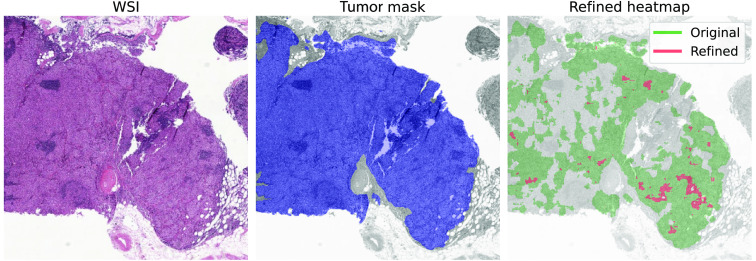
Our SUA framework processes negative prediction regions from a segmentation algorithm and detects FNs based on an aggregated uncertainty score. It can be utilized with many existing uncertainty estimation methods to boost their performance. We compare the SUA framework with a baseline of processing individual pixel's uncertainty independently.
The results demonstrate that SUA is able to detect FN regions. It achieved of 0.92 on the in-domain and 0.85 on the domain-shift test data compared with 0.81 and 0.48 achieved by the baseline uncertainty, respectively. We also demonstrate that SUA yields improved general segmentation performance compared with utilizing the baseline uncertainty.
We propose the SUA framework for incorporating and utilizing uncertainty estimates for FN detection in DL segmentation algorithms for histopathology. The evaluation confirms the benefits of our approach compared with assessing pixel uncertainty independently.
近年来,不确定性估计因其在医学应用中提升深度学习(DL)算法性能甚至可能应对域转移挑战的潜力而备受关注。然而,将不确定性估计与DL系统相结合以实现切实的积极效果并非易事。我们工作的目标是评估所提出的空间不确定性聚合(SUA)框架是否能提高分割任务中不确定性估计的有效性。我们评估SUA是否能增强不确定性估计与假阴性(FN)预测之间的观测相关性。我们还研究观测到的益处是否能转化为分割性能的切实提升。
我们的SUA框架处理来自分割算法的负预测区域,并基于聚合的不确定性分数检测FN。它可与许多现有的不确定性估计方法一起使用以提升其性能。我们将SUA框架与独立处理单个像素不确定性的基线进行比较。
结果表明SUA能够检测FN区域。在域内测试数据上,它的得分为0.92,在域转移测试数据上为0.85,而基线不确定性分别为0.81和0.48。我们还证明,与使用基线不确定性相比,SUA产生了更好的总体分割性能。
我们提出了SUA框架,用于在组织病理学的DL分割算法中纳入和利用不确定性估计以进行FN检测。评估证实了我们的方法相对于独立评估像素不确定性所具有的优势。