Nischang Vivien, Witt Finja M, Börner Friedemann, Gomez Mario, Jordan Paul M, Werz Oliver
Department of Pharmaceutical/Medicinal Chemistry, Institute of Pharmacy, Friedrich Schiller University Jena, Jena, Germany.
Evonik Operations GmbH, Darmstadt, Germany.
Front Pharmacol. 2024 Jan 4;14:1332628. doi: 10.3389/fphar.2023.1332628. eCollection 2023.
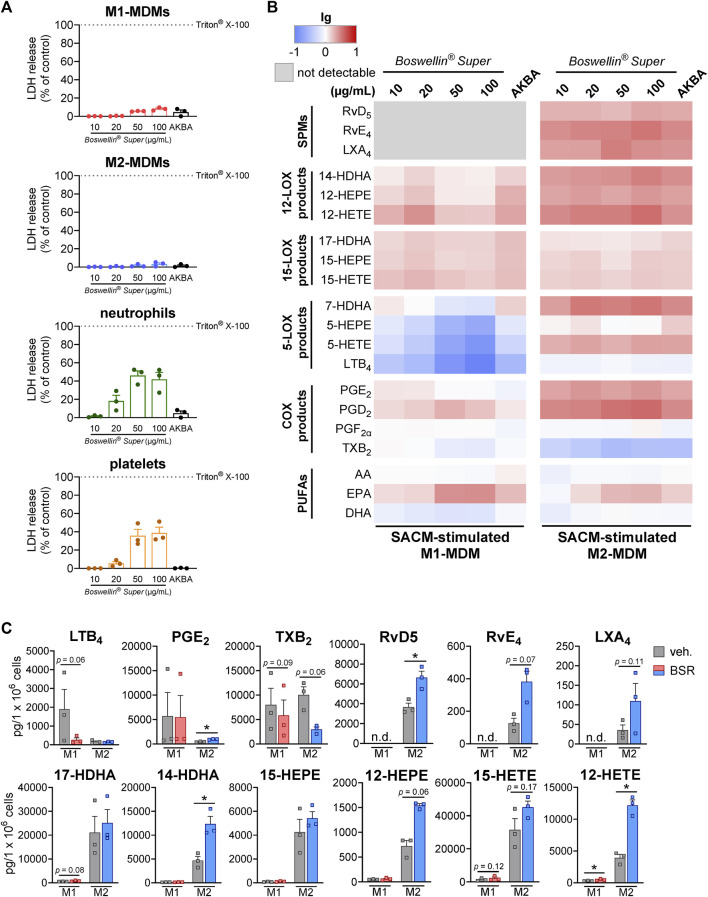
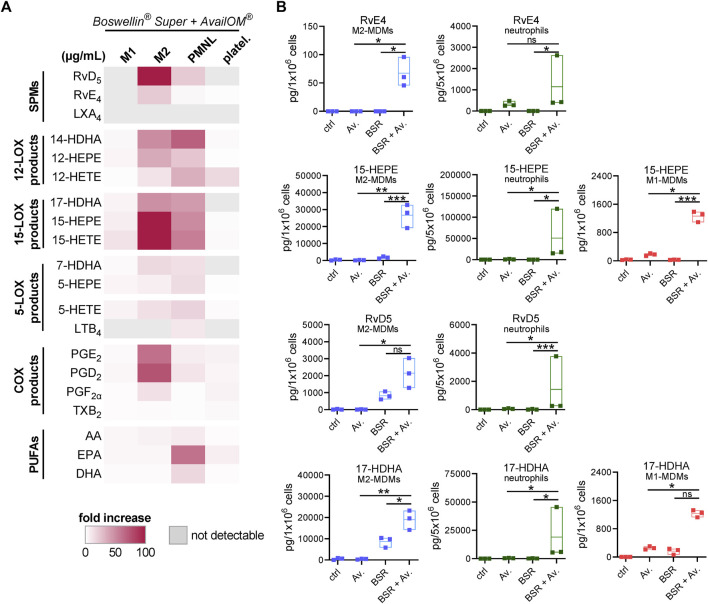
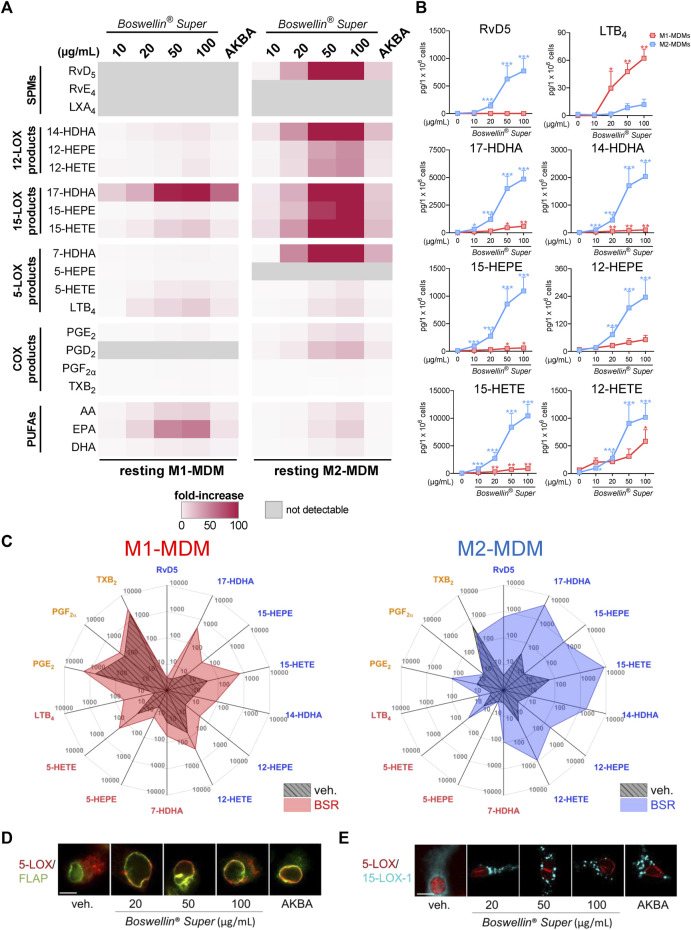
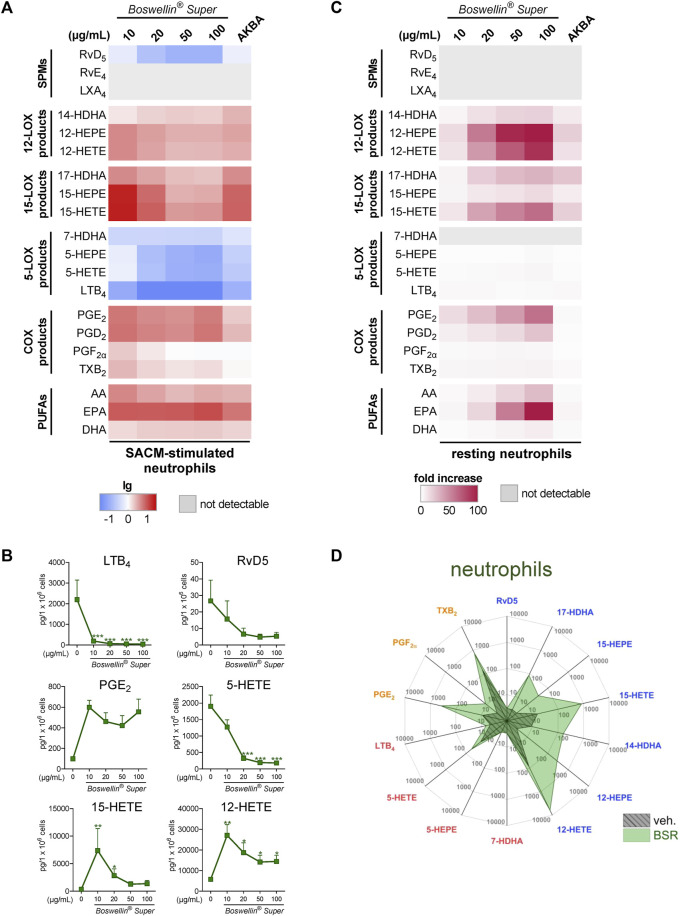
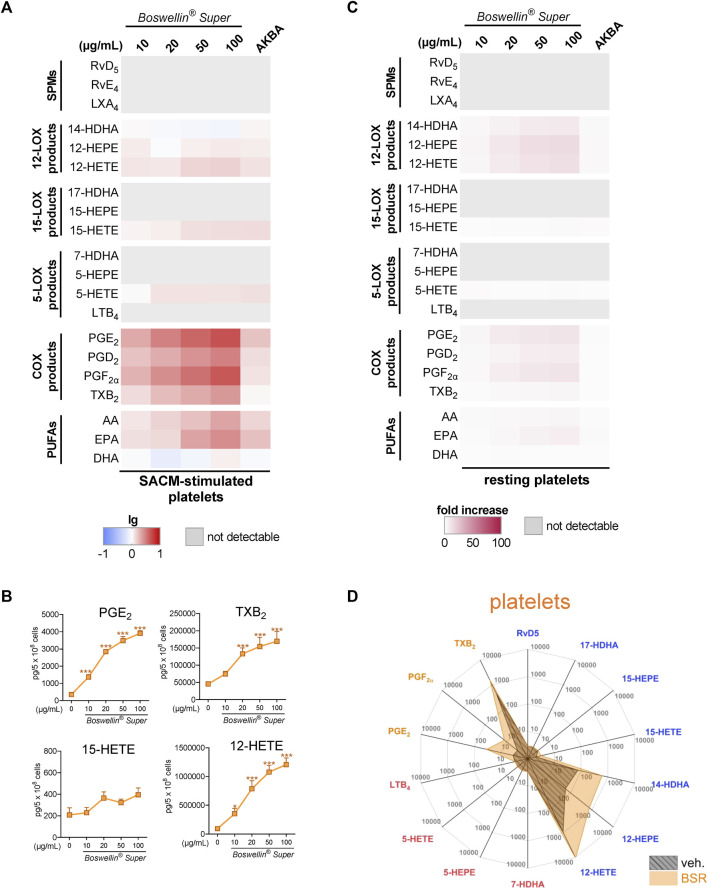
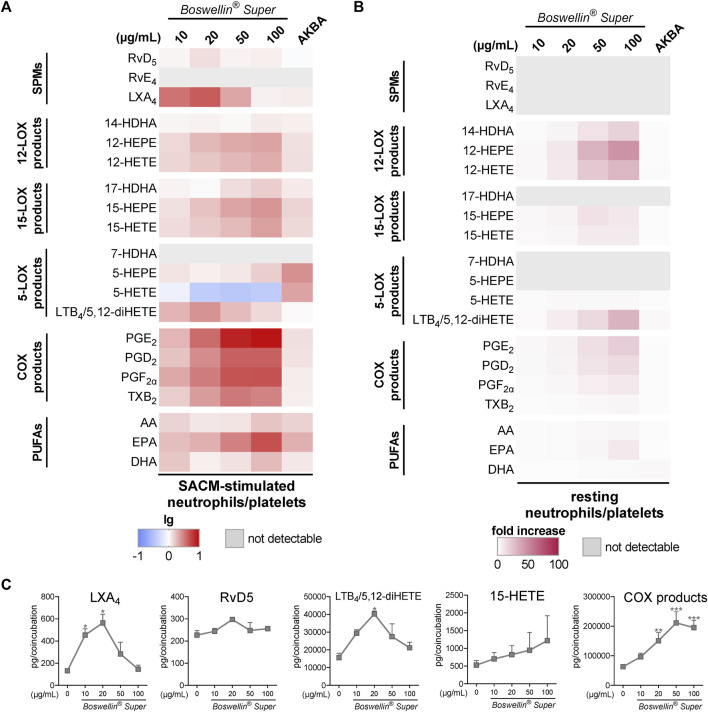
Frankincense preparations are frequently used as traditional anti-inflammatory remedies in folk medicine with increasing popularity. Boswellic acids (BAs), especially 3-O-acetyl-11-keto-βBA (AKBA), are unique anti-inflammatory principles of frankincense, with multiple pharmacological actions and target proteins. We recently showed that AKBA favorably impacts lipid mediator (LM) networks in innate immune cells, by modulation of lipoxygenase (LOX) activities. Thus, AKBA binds to allosteric sites in 5-LOX, shifting the regiospecificity to a 12/15-lipoxygnating enzyme, and to an analogous site in 15-LOX-1, leading to enzyme activation, which favors specialized pro-resolving mediator (SPM) formation at the expense of leukotriene production. Here, we investigated Boswellin super® (BSR), a commercially available frankincense extract with ≥30% AKBA, used as remedy that approved efficacy in osteoarthritis trials, for its ability to modulate LM pathways in human monocyte-derived macrophage (MDM) phenotypes, neutrophils, and neutrophil/platelet co-incubations. LM profiling was performed by using targeted ultraperformance liquid chromatography-tandem mass spectrometry (UPLC-MS-MS). BSR concentration-dependently (10-100 μg/ml) suppressed formation of pro-inflammatory 5-LOX products including LTB4 in exotoxin-stimulated M1-MDM and neutrophils, and strongly elevated 12/15-LOX products and SPM in activated M2-MDM and neutrophil/platelet cocultures, starting at 10 μg/mL. Also, BSR (≥10 μg/mL) induced robust 12/15-LOX product and SPM generation in resting M2-MDM, which was further markedly elevated when exogenous docosahexaenoic acid (DHA) and eicosahexaenoic acid (EPA) were supplied, and induced translocation of 15-LOX from a soluble to a particulate locale in M2 MDM. We conclude that BSR especially when co-added with DHA and EPA, promotes the LM class switch in innate immune cells from pro-inflammatory to pro-resolving mediators, which might be a plausible mechanism underlying the anti-inflammatory actions of BSR.
乳香制剂在民间医学中常被用作传统抗炎药物,且越来越受欢迎。乳香酸(BAs),尤其是3 - O - 乙酰 - 11 - 酮 - βBA(AKBA),是乳香独特的抗炎成分,具有多种药理作用和靶蛋白。我们最近发现,AKBA通过调节脂氧合酶(LOX)活性,对先天免疫细胞中的脂质介质(LM)网络产生有利影响。因此,AKBA与5 - LOX的变构位点结合,将区域特异性转变为12/15 - 脂氧合酶,同时与15 - LOX - 1中的类似位点结合,导致酶激活,这有利于以白三烯产生为代价形成特异性促消退介质(SPM)。在此,我们研究了Boswellin super®(BSR),一种市售的乳香提取物,其AKBA含量≥30%,在骨关节炎试验中被批准具有疗效,研究其调节人单核细胞衍生巨噬细胞(MDM)表型、中性粒细胞以及中性粒细胞/血小板共培养物中LM途径的能力。通过使用靶向超高效液相色谱 - 串联质谱(UPLC - MS - MS)进行LM分析。BSR以浓度依赖性方式(10 - 100μg/ml)抑制外毒素刺激的M1 - MDM和中性粒细胞中促炎5 - LOX产物(包括LTB4)的形成,并在活化的M2 - MDM和中性粒细胞/血小板共培养物中强烈提高12/15 - LOX产物和SPM的水平,起始浓度为10μg/mL。此外,BSR(≥10μg/mL)在静息的M2 - MDM中诱导强大的12/15 - LOX产物和SPM生成,当供应外源性二十二碳六烯酸(DHA)和二十碳五烯酸(EPA)时,其生成进一步显著增加,并且在M2 MDM中诱导15 - LOX从可溶性部位向颗粒部位的转位。我们得出结论,BSR,尤其是与DHA和EPA共同添加时,可促进先天免疫细胞中LM类别从促炎介质向促消退介质的转变,这可能是BSR抗炎作用的一个合理机制。