
智能机器人的多模态融合与人机交互控制
Multimodal fusion and human-robot interaction control of an intelligent robot.
作者信息
Gong Tao, Chen Dan, Wang Guangping, Zhang Weicai, Zhang Junqi, Ouyang Zhongchuan, Zhang Fan, Sun Ruifeng, Ji Jiancheng Charles, Chen Wei
机构信息
Institute of Intelligent Manufacturing, Shenzhen Polytechnic University, Shenzhen, China.
AVIC Changhe Aircraft Industry (Group) Corporation Ltd., Jingdezhen, China.
出版信息
Front Bioeng Biotechnol. 2024 Jan 4;11:1310247. doi: 10.3389/fbioe.2023.1310247. eCollection 2023.
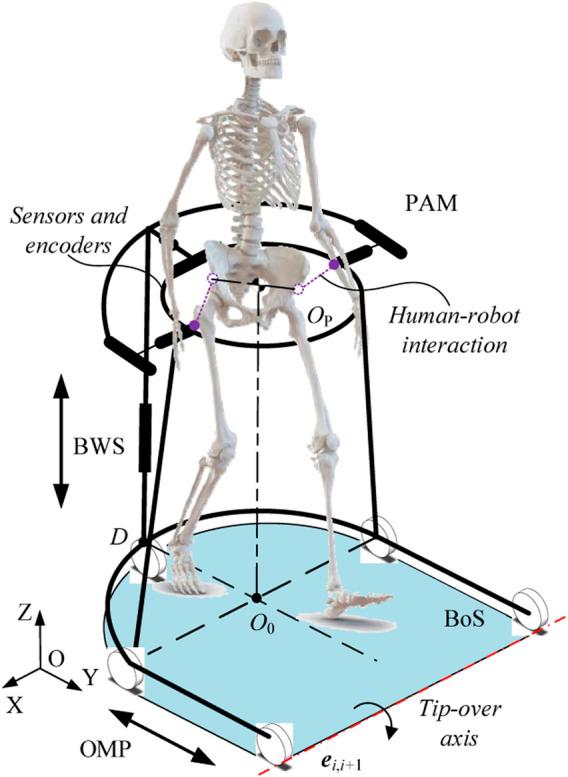
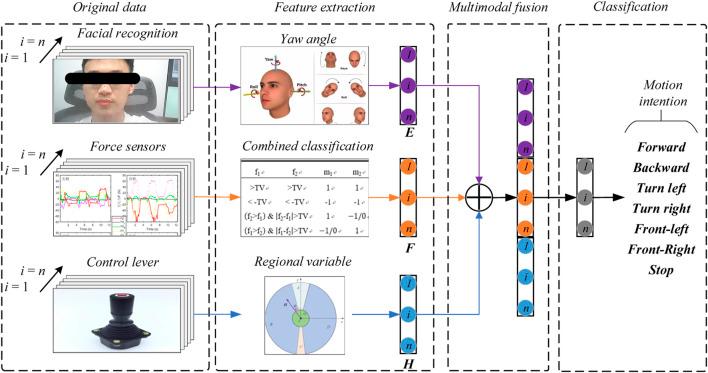
Small-scaled robotic walkers play an increasingly important role in Activity of Daily Living (ADL) assistance in the face of ever-increasing rehab requirements and existing equipment drawbacks. This paper proposes a Rehabilitation Robotic Walker (RRW) for walking assistance and body weight support (BWS) during gait rehabilitation. The walker provides the patients with weight offloading and guiding force to mimic a series of the physiotherapist's (PT's) movements, and creates a natural, comfortable, and safe environment. This system consists of an omnidirectional mobile platform, a BWS mechanism, and a pelvic brace to smooth the motions of the pelvis. To recognize the human intentions, four force sensors, two joysticks, and one depth-sensing camera were used to monitor the human-machine information, and a multimodal fusion algorithm for intention recognition was proposed to improve the accuracy. Then the system obtained the heading angle E, the pelvic pose F, and the motion vector H via the camera, the force sensors, and the joysticks respectively, classified the intentions with feature extraction and information fusion, and finally outputted the motor speed control through the robot's kinematics. To validate the validity of the algorithm above, a preliminary test with three volunteers was conducted to study the motion control. The results showed that the average error of the integral square error (ISE) was 2.90 and the minimum error was 1.96. The results demonstrated the efficiency of the proposed method, and that the system is capable of providing walking assistance.
面对日益增长的康复需求和现有设备的缺点,小型机器人助行器在日常生活活动(ADL)辅助中发挥着越来越重要的作用。本文提出了一种用于步态康复期间行走辅助和体重支持(BWS)的康复机器人助行器(RRW)。该助行器为患者提供卸载体重和引导力,以模仿物理治疗师(PT)的一系列动作,并营造一个自然、舒适和安全的环境。该系统由一个全向移动平台、一个体重支持机构和一个用于平滑骨盆运动的骨盆支架组成。为了识别人类意图,使用四个力传感器、两个操纵杆和一个深度感应摄像头来监测人机信息,并提出了一种用于意图识别的多模态融合算法以提高准确性。然后,系统分别通过摄像头、力传感器和操纵杆获得航向角E、骨盆姿态F和运动矢量H,通过特征提取和信息融合对意图进行分类,最后通过机器人运动学输出电机速度控制。为了验证上述算法的有效性,对三名志愿者进行了初步测试以研究运动控制。结果表明,积分平方误差(ISE)的平均误差为2.90,最小误差为1.96。结果证明了所提方法的有效性,并且该系统能够提供行走辅助。





 Zotero 插件