Institute of Analytical Chemistry, Chemo- and Biosensors, University of Regensburg, Universitätsstraße 31, 93053, Regensburg, Germany.
Anal Bioanal Chem. 2024 Jun;416(15):3487-3500. doi: 10.1007/s00216-024-05145-8. Epub 2024 Jan 19.
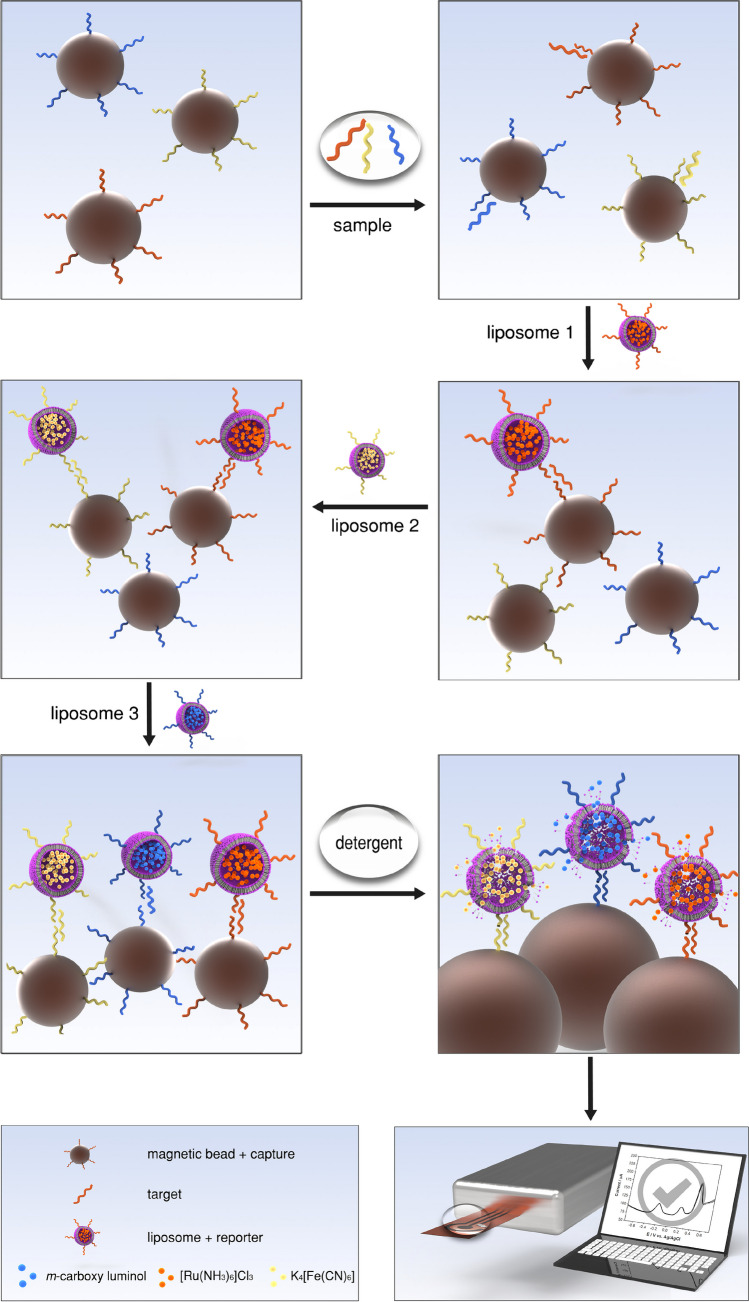
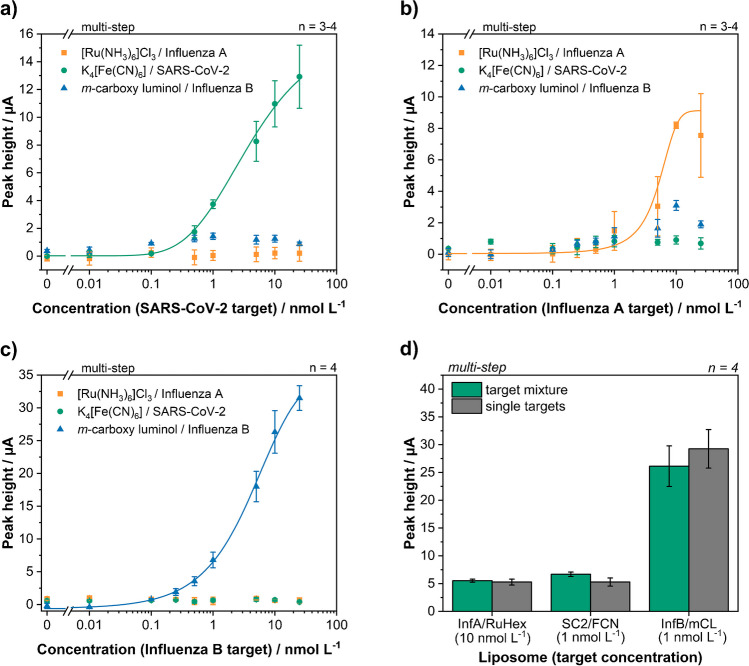
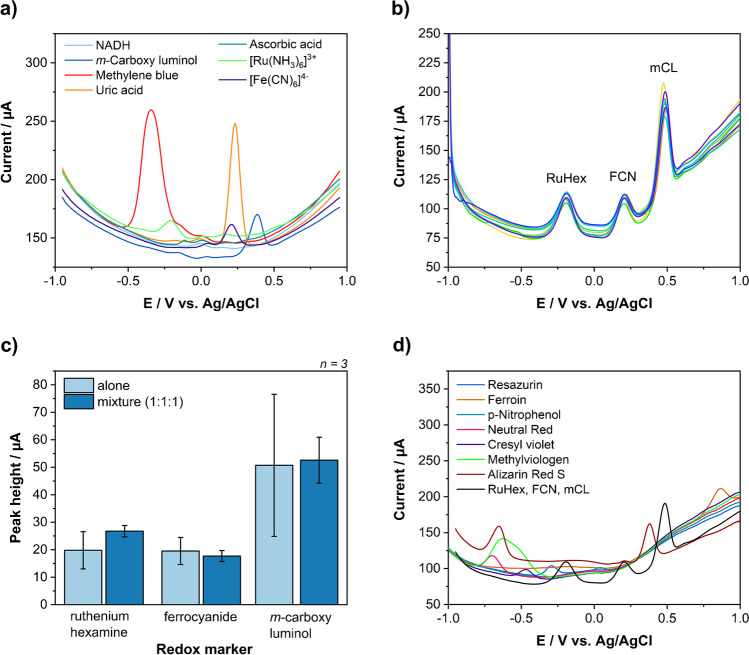
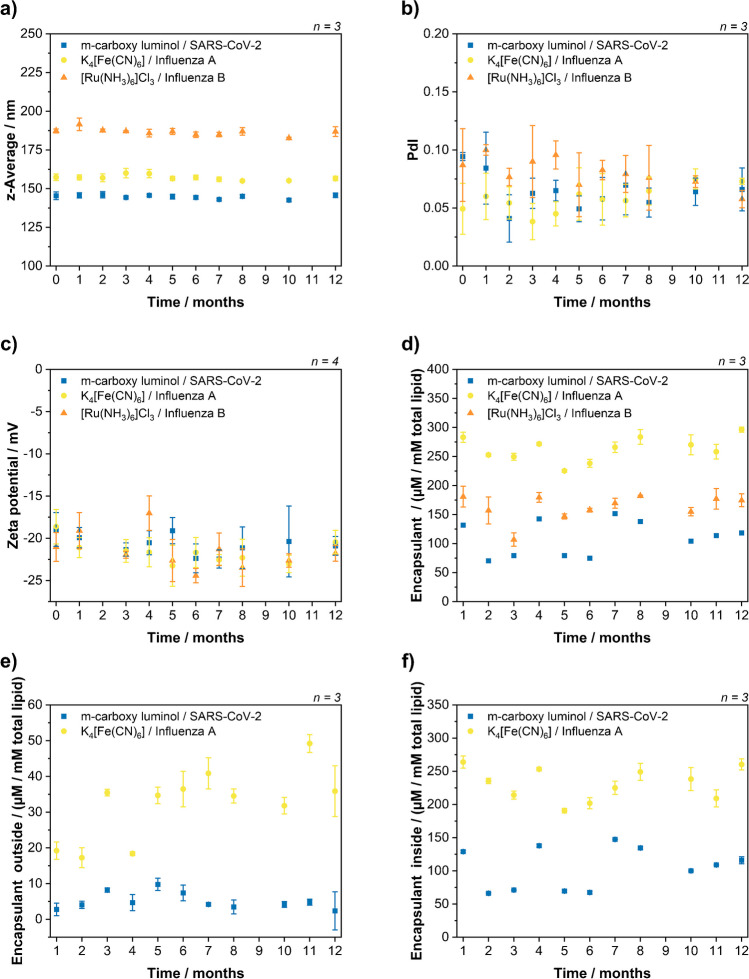
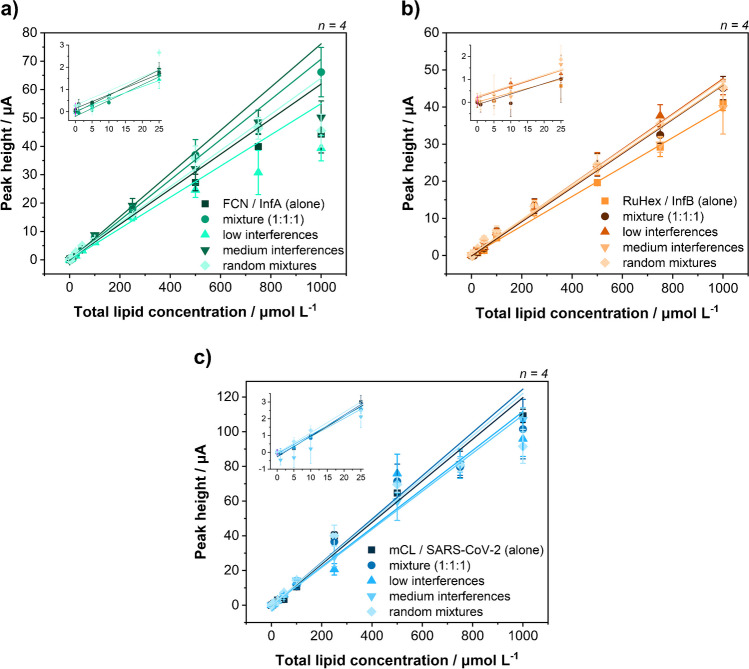
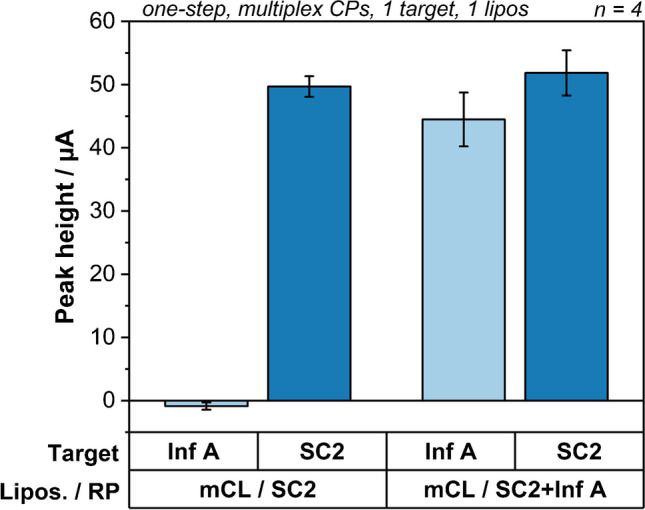
Multiplexing is a relevant strategy for biosensors to improve accuracy and decision-making due to the increased amount of simultaneously obtained information. Liposomes offer unique benefits for label-based multiplexing since a variety of different marker molecules can be encapsulated, leading to intrinsic signal amplification and enabling a variety of detection formats. We successfully developed an electrochemical (EC) liposome-based platform technology for the simultaneous detection of at least three analytes by studying parameters to ensure specific and sensitive bioassay performance. Influenza A and B and SARS-CoV-2 sequences served as model system in a standard sandwich hybridization assay. Studies included encapsulants, probe distribution on liposomes and capture beads, assay setup and interferences between liposomes to also ensure a generalization of the platform. Ruthenium hexamine(III), potassium hexacyanoferrate(II) and m-carboxy luminol, when encapsulated separately into a liposome, provided desirable long-term stability of at least 12 months and no cross-signals between liposomes. Through the optimization process, low limits of detections of 1.6 nmol L, 125 pmol L and 130 pmol L, respectively, were achieved in a multiplexed assay setup, which were similar to singleplex assays. Non-specific interactions were limited to 25.1%, 7.6% and 7.5%, respectively, through sequential liposome incubations and singleplex capture bead designs. Here, ruthenium hexamine liposomes had only mediocre performance so that low overall signal strength translated into higher LODs and worse specificity. A different marker such as ferroin may be an option in the future. The identification of further electrochemical markers will provide new opportunities for liposomes to function as multiplex, orthogonal or internal standard labels in electrochemical bioassays.
多重检测是生物传感器提高准确性和决策能力的一种相关策略,因为它可以同时获得更多的信息量。脂质体为基于标记的多重检测提供了独特的优势,因为可以封装各种不同的标记分子,从而实现固有信号放大,并支持各种检测形式。我们通过研究确保特定和敏感生物测定性能的参数,成功开发了一种基于电化学(EC)脂质体的平台技术,用于同时检测至少三种分析物。流感 A 和 B 以及 SARS-CoV-2 序列作为标准夹心杂交测定中的模型系统。研究包括包封剂、脂质体和捕获珠上探针的分布、测定设置以及脂质体之间的干扰,以确保平台的通用性。六氨合钌(III)、六氰合铁(II)酸钾和间羧基鲁米诺分别封装在脂质体中,可提供至少 12 个月的理想长期稳定性,并且脂质体之间没有交叉信号。通过优化过程,在多重检测设置中,分别实现了 1.6 nmol L、125 pmol L 和 130 pmol L 的低检测限,与单重检测相当。通过顺序的脂质体孵育和单重捕获珠设计,非特异性相互作用分别限制在 25.1%、7.6%和 7.5%。在此,六氨合钌脂质体的性能仅中等,因此低整体信号强度转化为更高的检测限和更差的特异性。未来可能会选择其他标记物,如 ferroin。进一步鉴定电化学标记物将为脂质体在电化学生物测定中作为多重、正交或内参标签提供新的机会。