Division of Thoracic Oncology, Shizuoka Cancer Center, Shizuoka, Japan.
Division of Respiratory Medicine, Department of Internal Medicine, Nihon University School of Medicine, Tokyo, Japan.
Thorac Cancer. 2024 Feb;15(6):477-485. doi: 10.1111/1759-7714.15218. Epub 2024 Jan 19.
Which patients benefit from the addition of immune checkpoint inhibitors (ICIs) to chemotherapy for small cell lung cancer (SCLC) remains unclear. There have been few reports on the efficacy of ICIs based on conventional immunohistochemical neuroendocrine (NE) markers (synaptophysin, chromogranin A, and neural cell adhesion molecule [NCAM]). In the present study, we aimed to analyze the relationship between the expression of immunohistochemical NE markers and the efficacy of ICIs in patients with extensive disease (ED)-SCLC, to assess whether conventional NE markers are predictive of ICIs.
Patients with untreated ED-SCLC who received first-line therapy at the Shizuoka Cancer Center between November 2002 and July 2021 were retrospectively reviewed. We evaluated the efficacy of first-line chemotherapy according to the expression status of each immunohistochemical NE marker in patients treated with ICI plus chemotherapy (ICI-chemo group) and with chemotherapy alone (chemo group).
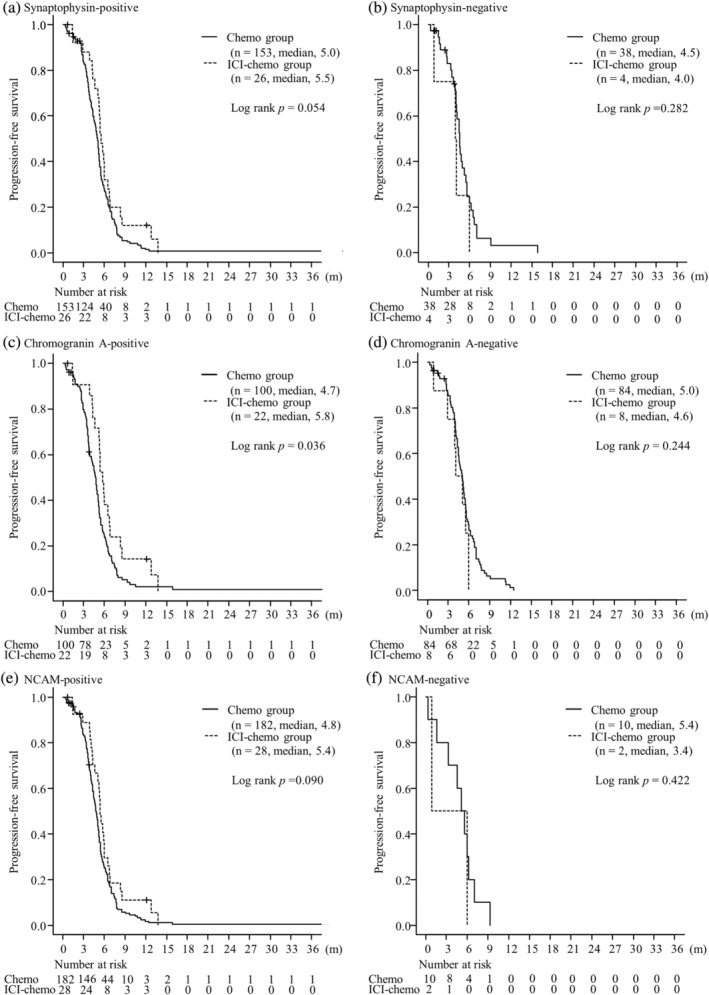
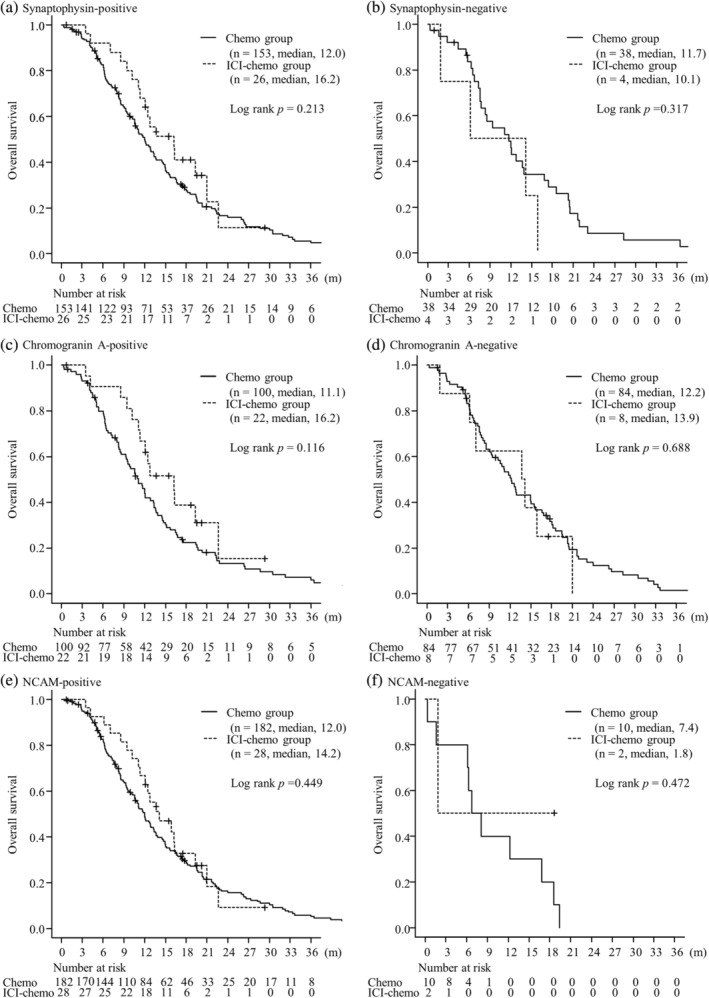
A total of 227 patients were included in the ICI-chemo and chemo groups, respectively. The progression-free survival (PFS) tended to be better in patients in the ICI-chemo group than those treated with chemotherapy alone in patients with NE marker-positive SCLC. In particular, it was statistically significant in patients with chromogranin A-positive SCLC (p = 0.036). In patients with NE marker-negative SCLC, no significant differences were observed in PFS between the two groups. There were no significant differences in overall survival (OS), regardless of the expression of any conventional NE marker.
Our study suggests that the efficacy of ICIs in addition to chemotherapy may be poor in patients with NE marker-negative SCLC.
对于小细胞肺癌(SCLC)患者,免疫检查点抑制剂(ICI)联合化疗的获益人群仍不明确。目前,基于常规免疫组织化学神经内分泌(NE)标志物(突触素、嗜铬粒蛋白 A 和神经细胞黏附分子 [NCAM])的ICI 疗效报告较少。本研究旨在分析广泛期 SCLC 患者中免疫组化 NE 标志物表达与 ICI 疗效之间的关系,评估常规 NE 标志物是否可预测 ICI。
回顾性分析 2002 年 11 月至 2021 年 7 月在静冈癌症中心接受一线治疗的未经治疗的广泛期 SCLC 患者。我们根据接受 ICI 联合化疗(ICI-化疗组)和单纯化疗(化疗组)患者的每个免疫组化 NE 标志物的表达状态评估一线化疗的疗效。
ICI-化疗组和化疗组分别纳入 227 例患者。与单纯化疗相比,ICI-化疗组中 NE 标志物阳性 SCLC 患者的无进展生存期(PFS)有改善趋势。尤其是在嗜铬粒蛋白 A 阳性 SCLC 患者中,差异具有统计学意义(p=0.036)。在 NE 标志物阴性 SCLC 患者中,两组间 PFS 无显著差异。无论任何常规 NE 标志物的表达情况如何,OS 均无显著差异。
本研究提示,对于 NE 标志物阴性 SCLC 患者,ICI 联合化疗的疗效可能较差。