Trofor Antigona Carmen, Robu Popa Daniela, Melinte Oana Elena, Trofor Letiția, Vicol Cristina, Grosu-Creangă Ionela Alina, Crișan Dabija Radu Adrian, Cernomaz Andrei Tudor
Discipline of Pneumology, III-rd Medical Department, Faculty of Medicine, University of Medicine and Pharmacy "Grigore T. Popa", 700115 Iasi, Romania.
Clinical Hospital of Pulmonary Diseases, 700116 Iasi, Romania.
J Pers Med. 2024 Jan 16;14(1):97. doi: 10.3390/jpm14010097.
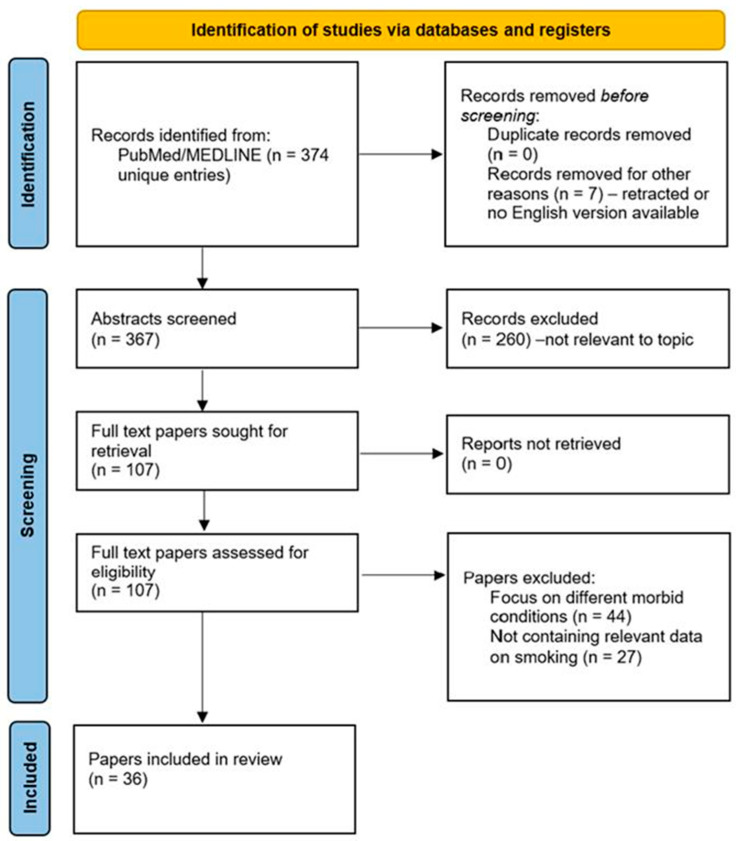
Long COVID is a recently described entity that is responsible for significant morbidity and that has consequences ranging from mild to life-threatening. The underlying mechanisms are not completely understood, and treatment options are currently limited, as existing data focus more on risk factors and predictors. Smoking has been reported as a risk factor for poor outcomes of acute SARS-CoV-2 infection and seems to also play a role in mediating post-COVID-19 symptoms. We aimed to review relevant work addressing the interaction between smoking and long COVID in order to characterize smoking's role as a risk factor and possibly identify new research directions. Methods: The PubMed/MEDLINE database was searched using the keywords 'smoking', 'long COVID', and 'post-acute COVID' to identify relevant English-language articles published up to October 2023. Results and conclusions: From the 374 initial hits, a total of 36 papers were deemed relevant to the aim of the review. There was significant variability concerning the ways in which tobacco usage was quantified and reported; still, there is compelling evidence linking smoking to an increased risk of developing manifestations of post-acute-COVID disease. Some clinical conditions, such as dyspnea, cardiovascular symptoms, and cognitive or mental-health impairment, seem to be relatively strongly associated with smoking, while the connection between smoking and upper-airway involvement seems less certain. The available data support recommending smoking cessation as a clinical tool for the prevention of long COVID.
长期新冠是一种最近被描述的疾病实体,它会导致严重的发病情况,其后果从轻微到危及生命不等。其潜在机制尚未完全了解,目前治疗选择有限,因为现有数据更多地集中在风险因素和预测指标上。据报道,吸烟是急性SARS-CoV-2感染不良预后的一个风险因素,并且似乎在介导新冠后症状方面也起作用。我们旨在综述关于吸烟与长期新冠之间相互作用的相关研究,以描述吸烟作为风险因素的作用,并可能确定新的研究方向。方法:使用关键词“吸烟”“长期新冠”和“急性新冠后”在PubMed/MEDLINE数据库中进行检索,以识别截至2023年10月发表的相关英文文章。结果与结论:从最初的374条检索结果中,共有36篇论文被认为与综述目的相关。在烟草使用的量化和报告方式上存在很大差异;尽管如此,有令人信服的证据表明吸烟与急性新冠后疾病表现风险增加有关。一些临床状况,如呼吸困难、心血管症状以及认知或心理健康损害,似乎与吸烟的关联相对较强,而吸烟与上呼吸道受累之间的联系似乎不太确定。现有数据支持将戒烟作为预防长期新冠的一种临床手段。