Sheng Liuji, Yang Chongtu, Chen Yidi, Song Bin
Department of Radiology, West China Hospital, Sichuan University, Chengdu 610041, China.
Functional and Molecular Imaging Key Laboratory of Sichuan Province, West China Hospital, Sichuan University, Chengdu 610041, China.
Biomedicines. 2023 Dec 26;12(1):58. doi: 10.3390/biomedicines12010058.
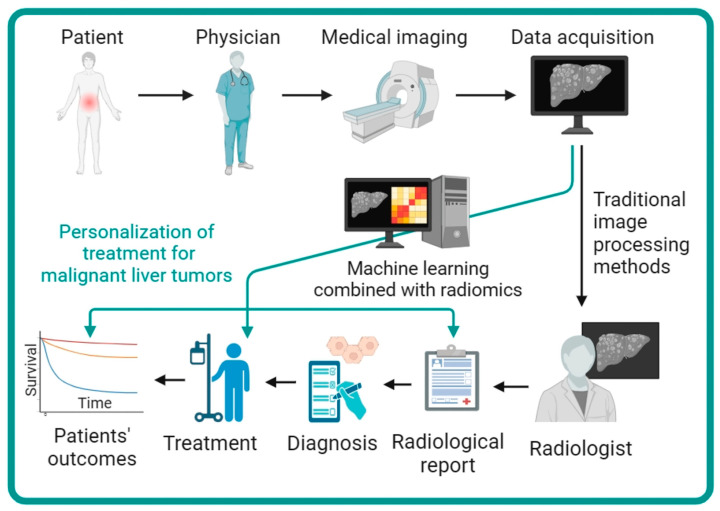
In the realm of managing malignant liver tumors, the convergence of radiomics and machine learning has redefined the landscape of medical practice. The field of radiomics employs advanced algorithms to extract thousands of quantitative features (including intensity, texture, and structure) from medical images. Machine learning, including its subset deep learning, aids in the comprehensive analysis and integration of these features from diverse image sources. This potent synergy enables the prediction of responses of malignant liver tumors to various treatments and outcomes. In this comprehensive review, we examine the evolution of the field of radiomics and its procedural framework. Furthermore, the applications of radiomics combined with machine learning in the context of personalized treatment for malignant liver tumors are outlined in aspects of surgical therapy and non-surgical treatments such as ablation, transarterial chemoembolization, radiotherapy, and systemic therapies. Finally, we discuss the current challenges in the amalgamation of radiomics and machine learning in the study of malignant liver tumors and explore future opportunities.
在恶性肝肿瘤的管理领域,放射组学与机器学习的融合重新定义了医学实践格局。放射组学领域运用先进算法从医学图像中提取数千个定量特征(包括强度、纹理和结构)。机器学习,包括其子领域深度学习,有助于对来自不同图像源的这些特征进行全面分析和整合。这种强大的协同作用能够预测恶性肝肿瘤对各种治疗的反应及预后。在这篇全面综述中,我们考察了放射组学领域的发展历程及其程序框架。此外,还从手术治疗以及诸如消融、经动脉化疗栓塞、放疗和全身治疗等非手术治疗方面,概述了放射组学与机器学习相结合在恶性肝肿瘤个性化治疗中的应用。最后,我们讨论了在恶性肝肿瘤研究中放射组学与机器学习融合目前面临的挑战,并探索未来的机遇。