Rago Vittoria, Bossio Sabrina, Lofaro Danilo, Perri Anna, Di Agostino Silvia
Department of Pharmacy, Health and Nutritional Sciences, University of Calabria, 87036 Rende, Italy.
Department of Experimental and Clinical Medicine, Magna Græcia University of Catanzaro, 88100 Catanzaro, Italy.
Life (Basel). 2023 Dec 28;14(1):52. doi: 10.3390/life14010052.
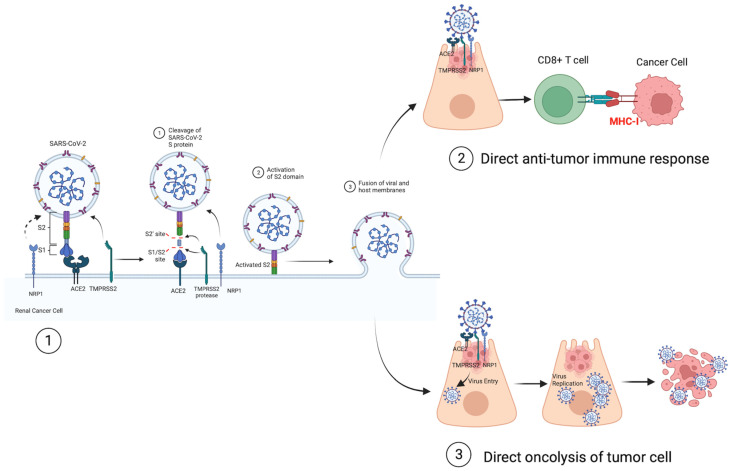
Cancer has been described as a risk factor for greater susceptibility to SARS-CoV-2 infection and severe COVID-19, mainly for patients with metastatic disease. Conversely, to that reported for most solid and hematological malignancies, the few available clinical studies reported that the infection did not increase the risk of death in renal cancer patients. The expression on proximal tubular renal cells of the key players in cellular viral uptake, ACE2, TMPRSS2, and NRP1, seems to be the mechanism for the direct kidney injury seen in patients with COVID-19. Interestingly, data from The Cancer Genome Atlas and experimental analyses on various renal cancer cell lines demonstrated that the above-reported receptors/cofactors are maintained by renal cancer cells. However, whether SARS-CoV-2 infection directly kills renal cancer cells or generates enhanced immunogenicity is a question worth investigating. In addition, some researchers have further addressed the topic by studying the expression and prognostic significance of gene signatures related to SARS-CoV-2 infection in renal cancer patients. The emerging data highlights the importance of better understanding the existence of a link between renal cancer and COVID-19 since it could lead to the identification of new prognostic factors and the development of new therapeutic targets in the management of renal cancer patients.
癌症已被描述为更易感染SARS-CoV-2和患重症新冠肺炎的一个风险因素,主要针对患有转移性疾病的患者。相反,与大多数实体和血液系统恶性肿瘤的报道情况不同,为数不多的现有临床研究报告称,感染并未增加肾癌患者的死亡风险。细胞病毒摄取关键因子ACE2、TMPRSS2和NRP1在近端肾小管细胞上的表达,似乎是新冠肺炎患者出现直接肾损伤的机制。有趣的是,癌症基因组图谱的数据以及对各种肾癌细胞系的实验分析表明,上述受体/辅助因子由肾癌细胞维持。然而,SARS-CoV-2感染是否直接杀死肾癌细胞或产生增强的免疫原性是一个值得研究的问题。此外,一些研究人员通过研究肾癌患者中与SARS-CoV-2感染相关的基因特征的表达及其预后意义,进一步探讨了这一话题。新出现的数据凸显了更好地理解肾癌与新冠肺炎之间联系的重要性,因为这可能有助于识别新的预后因素,并在肾癌患者的管理中开发新的治疗靶点。