Tsapalov Andrey, Kovler Konstantin
National Building Research Institute, Faculty of Civil and Environmental Engineering, Technion-Israel Institute of Technology, Haifa 3200003, Israel.
Sensors (Basel). 2024 Jan 13;24(2):504. doi: 10.3390/s24020504.
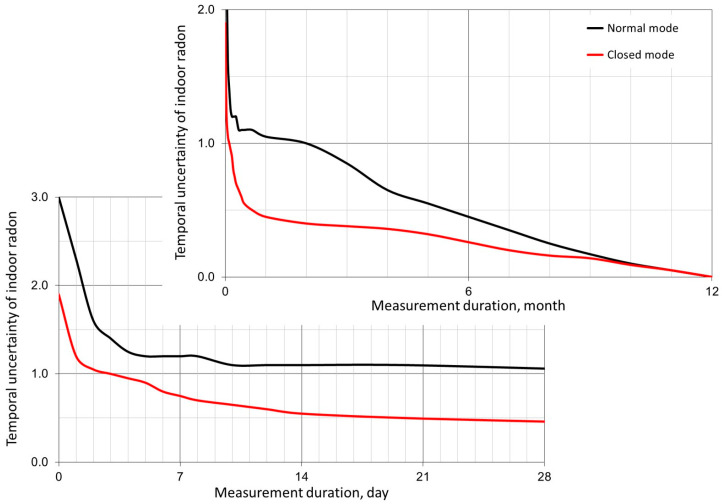
Indoor radon measurements have been conducted in many countries worldwide for several decades. However, to date, there is a lack of a globally harmonized measurement standard. Furthermore, measurement protocols in the US (short-term tests for 2-7 days) and European Union countries (long-term tests for at least 2 months) differ significantly, and their metrological support is underdeveloped, as clear mathematical algorithms (criteria) and QA/QC procedures considering fundamental ISO/IEC concepts such as "measurement uncertainty" and "conformity assessment" are still absent. In this context, for many years, the authors have been advancing and refining the theory of metrological support for standardizing indoor radon measurements based on a rational criterion for conformity assessment within the ISO/IEC concepts. The rational criterion takes into account the main uncertainties arising from temporal variations in indoor radon and instrumental errors, enabling the utilization of both short- and long-term measurements while ensuring specified reliability in decision making (typically no less than 95%). The paper presents improved mathematical algorithms for determining both temporal and instrumental uncertainties. Additionally, within the framework of the rational criterion, unified metrological requirements are formulated for various methods and devices employed in indoor radon measurements.
几十年来,全球许多国家都开展了室内氡测量工作。然而,迄今为止,缺乏全球统一的测量标准。此外,美国(2至7天的短期测试)和欧盟国家(至少2个月的长期测试)的测量方案差异显著,而且它们的计量支持不够完善,因为仍然缺乏考虑诸如“测量不确定度”和“合格评定”等基本ISO/IEC概念的清晰数学算法(标准)和质量保证/质量控制程序。在此背景下,多年来,作者们一直在推进和完善基于ISO/IEC概念内合理合格评定标准的室内氡测量标准化计量支持理论。该合理标准考虑了室内氡时间变化和仪器误差产生的主要不确定度,能够同时利用短期和长期测量结果,同时确保决策具有规定的可靠性(通常不低于95%)。本文提出了用于确定时间和仪器不确定度的改进数学算法。此外,在合理标准的框架内,针对室内氡测量中使用的各种方法和设备制定了统一的计量要求。