Desiderato Christian K, Müller Carolin, Schretzmeier Alexander, Hasenauer Katharina M, Gnannt Bruno, Süpple Bastian, Reiter Alexander, Steier Valentin, Oldiges Marco, Eikmanns Bernhard J, Riedel Christian U
Institute of Molecular Biology and Biotechnology of Prokaryotes, University of Ulm, Ulm, Germany.
Institute of Bio- and Geosciences, IBG-1: Biotechnology, Forschungszentrum Jülich GmbH, Jülich, Germany.
Front Microbiol. 2024 Jan 8;14:1254882. doi: 10.3389/fmicb.2023.1254882. eCollection 2023.
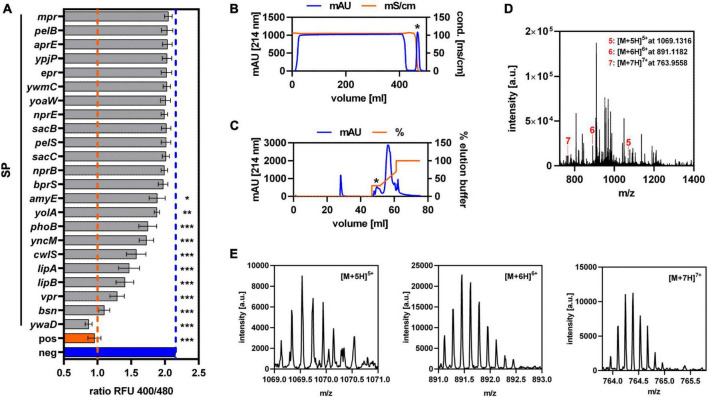
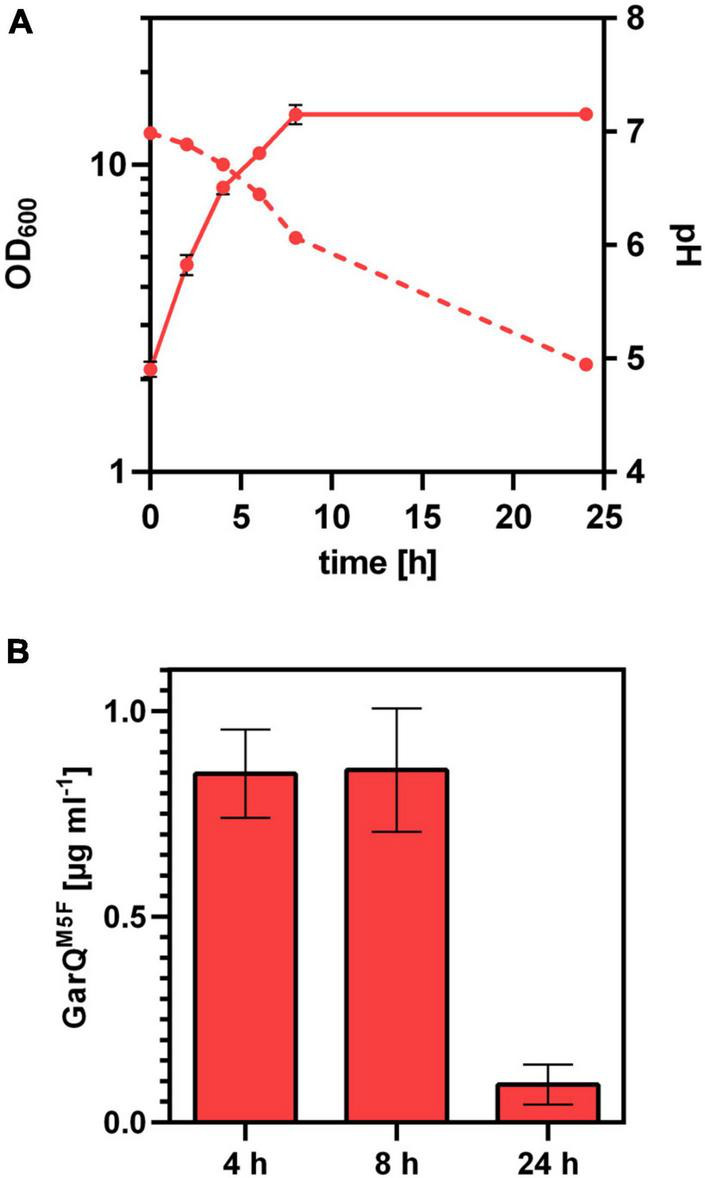
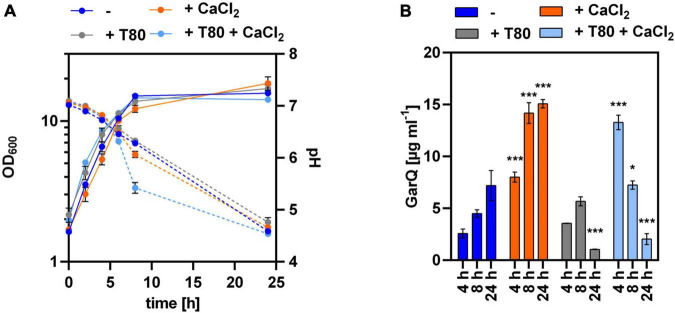
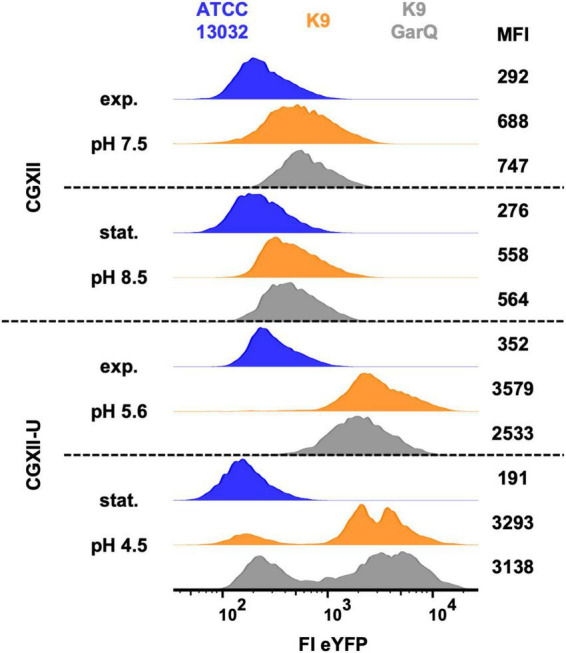
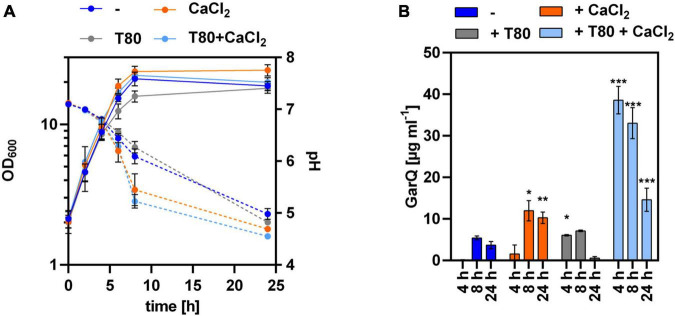
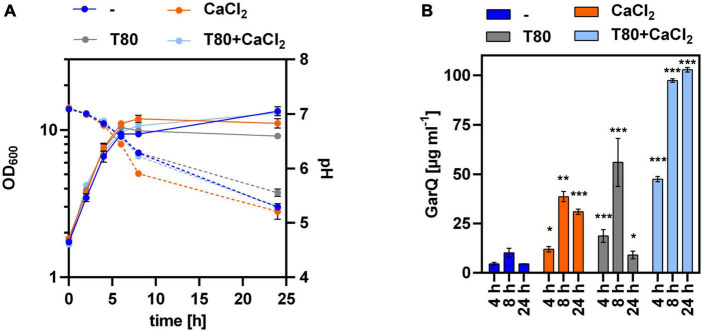
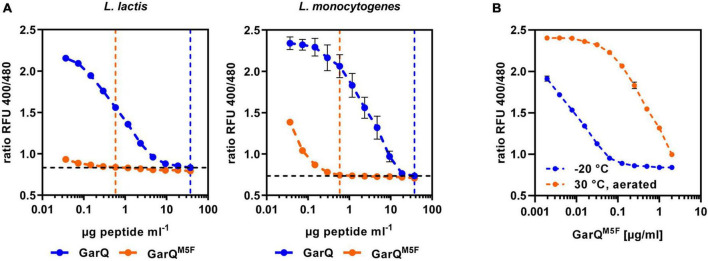
Bacteriocins are antimicrobial peptides applied in food preservation and are interesting candidates as alternatives to conventional antibiotics or as microbiome modulators. Recently, we established as a suitable production host for various bacteriocins including garvicin Q (GarQ). Here, we establish secretion of GarQ by via the Sec translocon achieving GarQ titers of about 7 mg L in initial fermentations. At neutral pH, the cationic peptide is efficiently adsorbed to the negatively charged envelope of producer bacteria limiting availability of the bacteriocin in culture supernatants. A combination of CaCl and Tween 80 efficiently reduces GarQ adsorption to . Moreover, cultivation in minimal medium supplemented with CaCl and Tween 80 improves GarQ production by to about 15 mg L but Tween 80 resulted in reduced GarQ activity at later timepoints. Using a reporter strain and proteomic analyses, we identified HtrA, a protease associated with secretion stress, as another potential factor limiting GarQ production. Transferring production to HtrA-deficient K9 improves GarQ titers to close to 40 mg L. Applying conditions of low aeration prevented loss in activity at later timepoints and improved GarQ titers to about 100 mg L. This is about 50-fold higher than previously shown with a strain employing the native GarQ transporter GarCD for secretion and in the range of levels observed with the native producer B1726. Additionally, we tested several synthetic variants of GarQ and were able to show that exchange of the methionine in position 5 to a phenylalanine (GarQ) results in markedly increased activity against and . In summary, our findings shed light on several aspects of recombinant GarQ production that may also be of relevance for production with natural producers and other bacteriocins.
细菌素是用于食品保鲜的抗菌肽,作为传统抗生素的替代品或微生物组调节剂,是很有吸引力的候选物。最近,我们确定[具体菌株名称未给出]是包括加维菌素Q(GarQ)在内的多种细菌素的合适生产宿主。在此,我们通过Sec转运体实现了[具体菌株名称未给出]对GarQ的分泌,在初始发酵中GarQ的滴度达到约7 mg/L。在中性pH下,阳离子肽有效地吸附到产细菌带负电荷的包膜上,限制了细菌素在培养上清液中的可用性。氯化钙和吐温80的组合有效地减少了GarQ对[具体菌株名称未给出]的吸附。此外,在补充有氯化钙和吐温80的基本培养基中培养可将GarQ的产量提高到约15 mg/L,但吐温80在后期导致GarQ活性降低。使用报告菌株和蛋白质组学分析,我们鉴定出与分泌应激相关的蛋白酶HtrA是限制GarQ产量的另一个潜在因素。将生产转移到缺乏HtrA的[具体菌株名称未给出]K9可将GarQ滴度提高到接近40 mg/L。采用低通气条件可防止后期活性损失,并将GarQ滴度提高到约100 mg/L。这比之前使用采用天然GarQ转运体GarCD进行分泌的[具体菌株名称未给出]菌株所显示的水平高出约50倍,并且处于天然生产者[具体菌株名称未给出]B1726所观察到的水平范围内。此外,我们测试了GarQ的几种合成变体,能够表明将第5位的甲硫氨酸替换为苯丙氨酸(GarQ)可显著提高对[具体目标菌名称未给出]和[具体目标菌名称未给出]的活性。总之,我们的研究结果揭示了重组GarQ生产的几个方面,这些方面可能也与天然生产者和其他细菌素的生产相关。