Chowdhury Mohammed A, Zhang Jing J, Rizk Rodrigue, Chen William C W
Division of Basic Biomedical Sciences, Sanford School of Medicine, University of South Dakota, Vermillion, SD, United States.
Department of Public Health and Health Sciences, Health Sciences Ph.D. Program, School of Health Sciences, University of South Dakota, Vermillion, SD, United States.
Front Physiol. 2024 Jan 9;14:1344885. doi: 10.3389/fphys.2023.1344885. eCollection 2023.
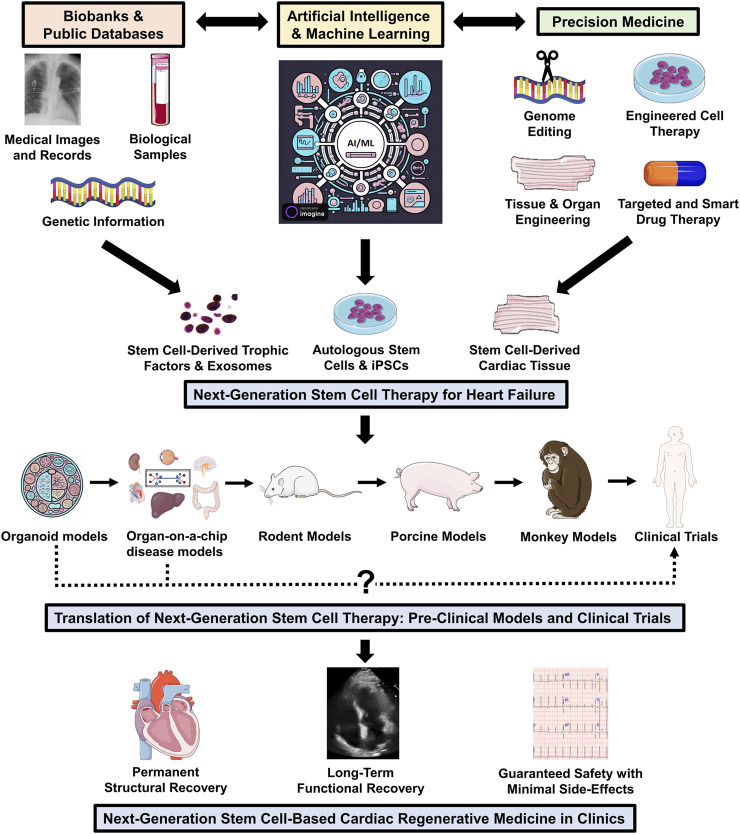
Stem/progenitor cells have been widely evaluated as a promising therapeutic option for heart failure (HF). Numerous clinical trials with stem/progenitor cell-based therapy (SCT) for HF have demonstrated encouraging results, but not without limitations or discrepancies. Recent technological advancements in multiomics, bioinformatics, precision medicine, artificial intelligence (AI), and machine learning (ML) provide new approaches and insights for stem cell research and therapeutic development. Integration of these new technologies into stem/progenitor cell therapy for HF may help address: 1) the technical challenges to obtain reliable and high-quality therapeutic precursor cells, 2) the discrepancies between preclinical and clinical studies, and 3) the personalized selection of optimal therapeutic cell types/populations for individual patients in the context of precision medicine. This review summarizes the current status of SCT for HF in clinics and provides new perspectives on the development of computation-aided SCT in the era of precision medicine and AI/ML.
干细胞/祖细胞已被广泛评估为心力衰竭(HF)一种很有前景的治疗选择。众多针对HF的基于干细胞/祖细胞疗法(SCT)的临床试验已取得了令人鼓舞的结果,但并非没有局限性或差异。多组学、生物信息学、精准医学、人工智能(AI)和机器学习(ML)领域的最新技术进展为干细胞研究和治疗开发提供了新方法和见解。将这些新技术整合到针对HF的干细胞/祖细胞疗法中,可能有助于解决以下问题:1)获取可靠且高质量治疗前体细胞的技术挑战;2)临床前研究与临床研究之间的差异;3)在精准医学背景下为个体患者个性化选择最佳治疗细胞类型/群体。本综述总结了临床上HF的SCT现状,并为精准医学和AI/ML时代计算辅助SCT的发展提供了新视角。