
噬菌体:人类微生物组中不可或缺但研究不足的组成部分。
Prophages: an integral but understudied component of the human microbiome.
机构信息
Flinders Accelerator for Microbiome Exploration, College of Science and Engineering, Flinders University, Bedford Park, SA 5042, Australia.
出版信息
Microb Genom. 2024 Jan;10(1). doi: 10.1099/mgen.0.001166.
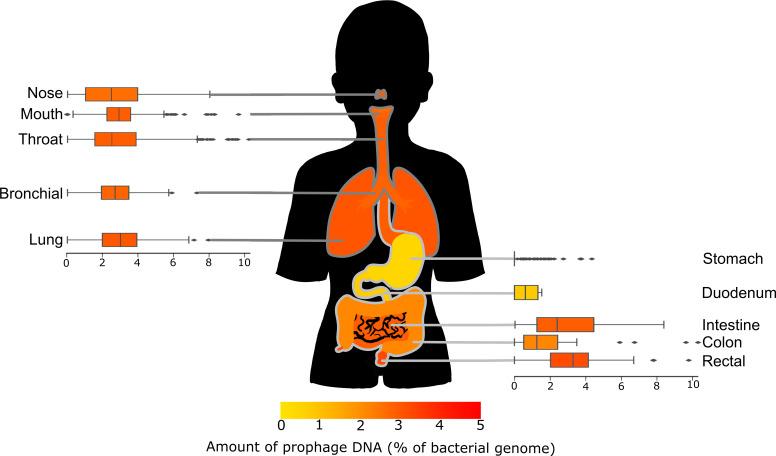
Phages integrated into a bacterial genome - called prophages - continuously monitor the vigour of the host bacteria to determine when to escape the genome and to protect their host from other phage infections, and they may provide genes that promote bacterial growth. Prophages are essential to almost all microbiomes, including the human microbiome. However, most human microbiome studies have focused on bacteria, ignoring free and integrated phages, so we know little about how these prophages affect the human microbiome. To address this gap in our knowledge, we compared the prophages identified in 14 987 bacterial genomes isolated from human body sites to characterize prophage DNA in the human microbiome. Here, we show that prophage DNA is ubiquitous, comprising on average 1-5 % of each bacterial genome. The prophage content per genome varies with the isolation site on the human body, the health of the human and whether the disease was symptomatic. The presence of prophages promotes bacterial growth and sculpts the microbiome. However, the disparities caused by prophages vary throughout the body.
整合到细菌基因组中的噬菌体——称为原噬菌体——持续监测宿主细菌的活力,以确定何时逃离基因组,并保护宿主免受其他噬菌体感染,它们还可能提供促进细菌生长的基因。原噬菌体对几乎所有微生物组都至关重要,包括人类微生物组。然而,大多数人类微生物组研究都集中在细菌上,忽略了自由和整合的噬菌体,因此我们对这些原噬菌体如何影响人类微生物组知之甚少。为了填补我们知识中的这一空白,我们比较了从人体部位分离的 14987 个细菌基因组中鉴定出的原噬菌体,以表征人类微生物组中的原噬菌体 DNA。在这里,我们表明原噬菌体 DNA 无处不在,平均占每个细菌基因组的 1-5%。每个基因组的原噬菌体含量随人体的分离部位、人类的健康状况以及疾病是否有症状而变化。原噬菌体的存在促进了细菌的生长,并塑造了微生物组。然而,原噬菌体造成的差异在全身范围内有所不同。




 Zotero 插件