Department of Biology, Institute of Microbiology and Swiss Institute of Bioinformatics, ETH Zürich, Zürich, Switzerland.
Department of Health Sciences and Technology, Institute of Food, Nutrition and Health, ETH Zürich, Zürich, Switzerland.
Microbiome. 2021 Mar 29;9(1):77. doi: 10.1186/s40168-021-01033-w.
Temperate phages influence the density, diversity and function of bacterial populations. Historically, they have been described as carriers of toxins. More recently, they have also been recognised as direct modulators of the gut microbiome, and indirectly of host health and disease. Despite recent advances in studying prophages using non-targeted sequencing approaches, methodological challenges in identifying inducible prophages in bacterial genomes and quantifying their activity have limited our understanding of prophage-host interactions.
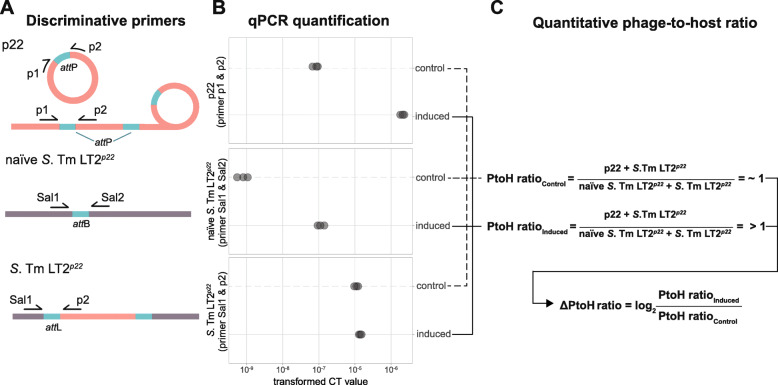
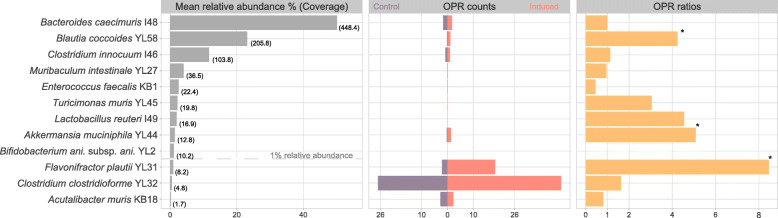
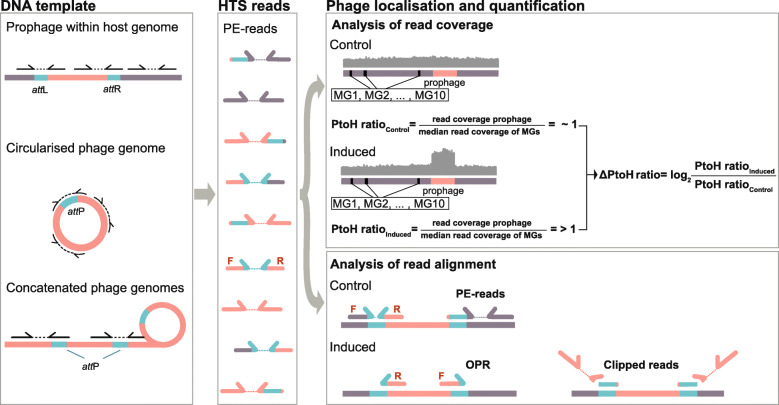
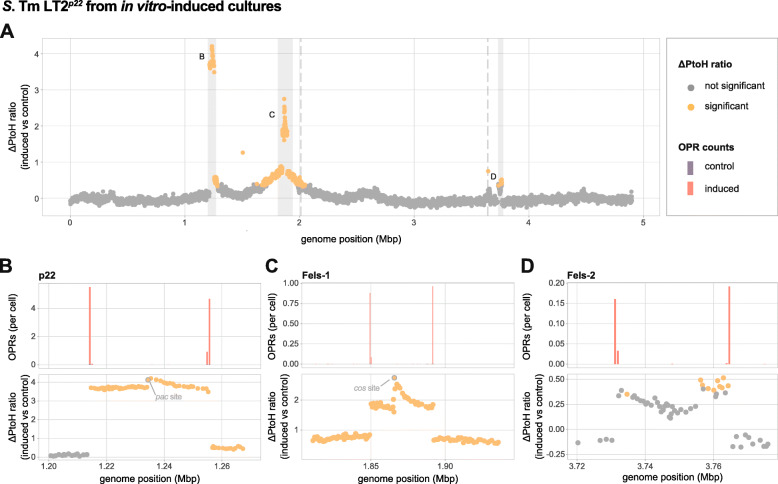
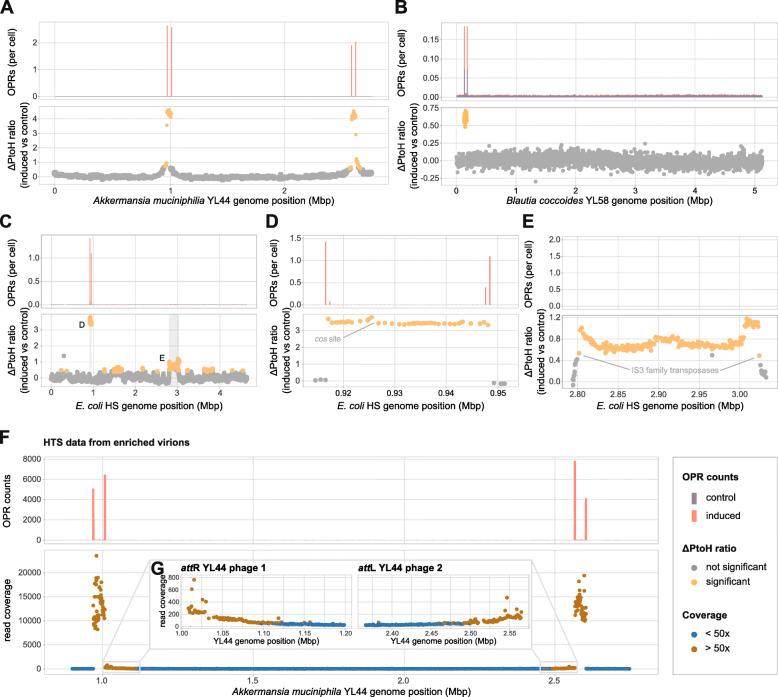
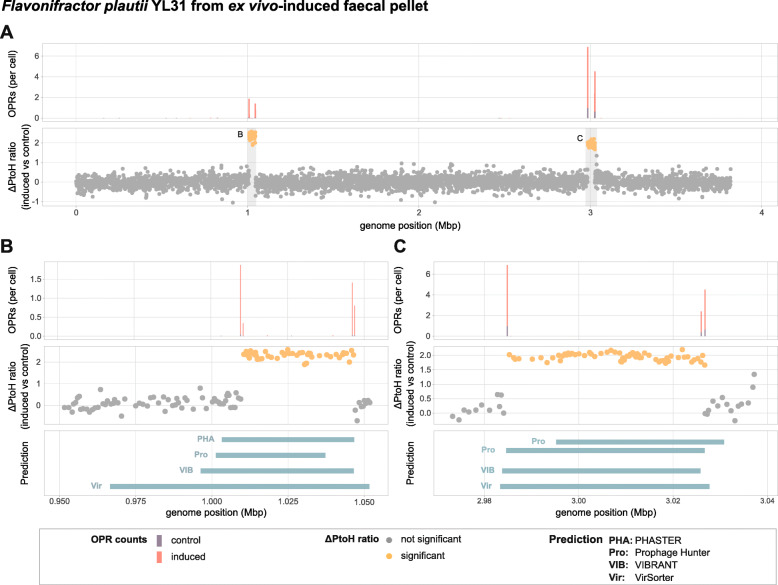
We present methods for using high-throughput sequencing data to locate inducible prophages, including those previously undiscovered, to quantify prophage activity and to investigate their replication. We first used the well-established Salmonella enterica serovar Typhimurium/p22 system to validate our methods for (i) quantifying phage-to-host ratios and (ii) accurately locating inducible prophages in the reference genome based on phage-to-host ratio differences and read alignment alterations between induced and non-induced prophages. Investigating prophages in bacterial strains from a murine gut model microbiota known as Oligo-MM or sDMDMm2, we located five novel inducible prophages in three strains, quantified their activity and showed signatures of lateral transduction potential for two of them. Furthermore, we show that the methods were also applicable to metagenomes of induced faecal samples from Oligo-MM mice, including for strains with a relative abundance below 1%, illustrating its potential for the discovery of inducible prophages also in more complex metagenomes. Finally, we show that predictions of prophage locations in reference genomes of the strains we studied were variable and inconsistent for four bioinformatic tools we tested, which highlights the importance of their experimental validation.
This study demonstrates that the integration of experimental induction and bioinformatic analysis presented here is a powerful approach to accurately locate inducible prophages using high-throughput sequencing data and to quantify their activity. The ability to generate such quantitative information will be critical in helping us to gain better insights into the factors that determine phage activity and how prophage-bacteria interactions influence our microbiome and impact human health. Video abstract.
温和噬菌体影响细菌种群的密度、多样性和功能。历史上,它们被描述为毒素的载体。最近,它们也被认为是肠道微生物组的直接调节剂,并间接地影响宿主健康和疾病。尽管最近在使用非靶向测序方法研究噬菌体方面取得了进展,但在鉴定细菌基因组中可诱导噬菌体并量化其活性方面存在方法学挑战,限制了我们对噬菌体-宿主相互作用的理解。
我们提出了使用高通量测序数据定位可诱导噬菌体的方法,包括以前未发现的噬菌体,以量化噬菌体的活性并研究它们的复制。我们首先使用成熟的沙门氏菌血清型 Typhimurium/p22 系统来验证我们的方法,用于(i)量化噬菌体与宿主的比例,以及(ii)根据噬菌体与宿主的比例差异和诱导与非诱导噬菌体之间的读取比对变化,在参考基因组中准确定位可诱导噬菌体。在一种称为 Oligo-MM 或 sDMDMm2 的鼠肠道模型微生物群的细菌菌株中研究噬菌体,我们在三个菌株中定位了五个新的可诱导噬菌体,量化了它们的活性,并展示了它们具有侧向转导潜力的特征。此外,我们还表明,该方法也适用于 Oligo-MM 小鼠诱导粪便样本的宏基因组,包括相对丰度低于 1%的菌株,这说明了它在更复杂的宏基因组中发现可诱导噬菌体的潜力。最后,我们表明,在所研究的菌株的参考基因组中,四种生物信息学工具预测的噬菌体位置是可变的和不一致的,这突出了它们的实验验证的重要性。
本研究表明,实验诱导与生物信息学分析的整合是一种使用高通量测序数据准确定位可诱导噬菌体并量化其活性的强大方法。生成这种定量信息的能力对于帮助我们更好地了解决定噬菌体活性的因素以及噬菌体-细菌相互作用如何影响我们的微生物组并影响人类健康将是至关重要的。