Department of Chemistry, University of Basel, BPR 1096, Mattenstrasse 22, 4058 Basel, Switzerland.
NCCR-Molecular Systems Engineering, BPR 1095, Mattenstrasse 24a, 4058 Basel, Switzerland.
Biomacromolecules. 2024 Feb 12;25(2):754-766. doi: 10.1021/acs.biomac.3c00943. Epub 2024 Jan 24.
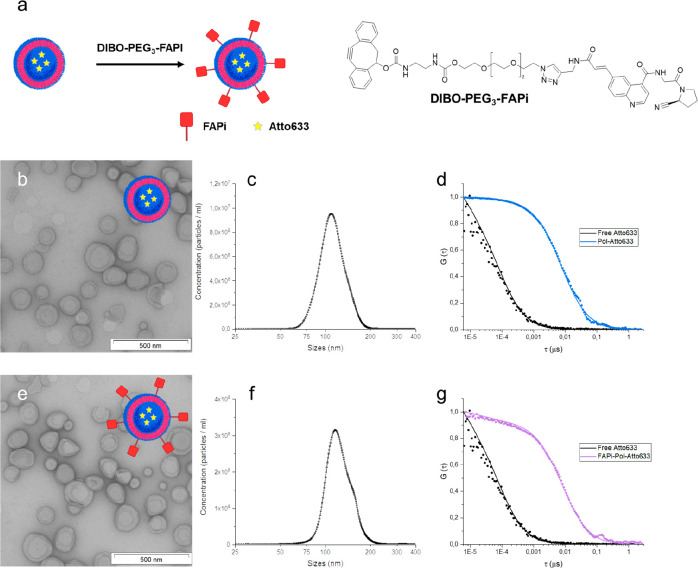
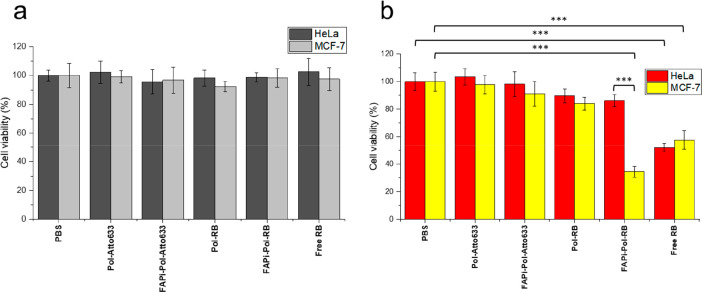
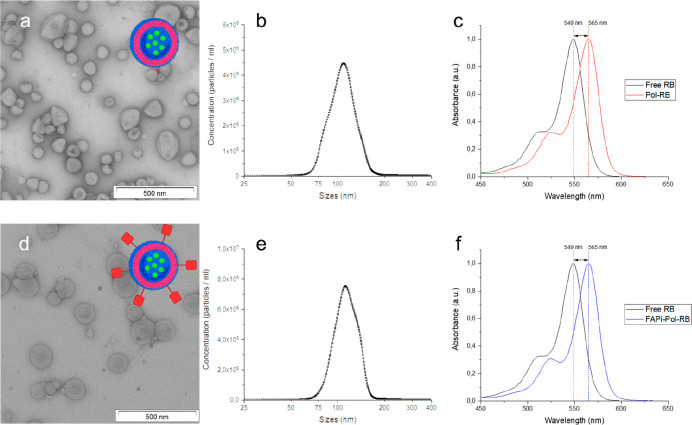
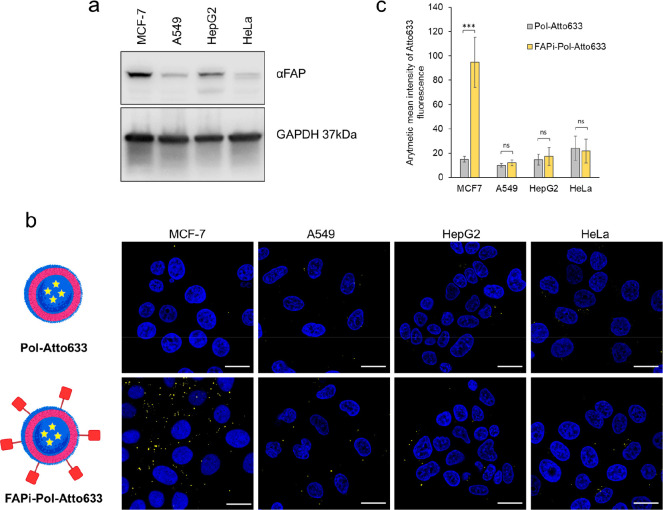
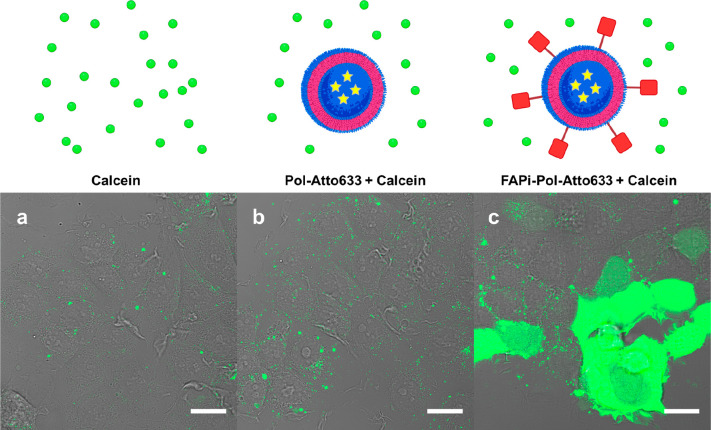
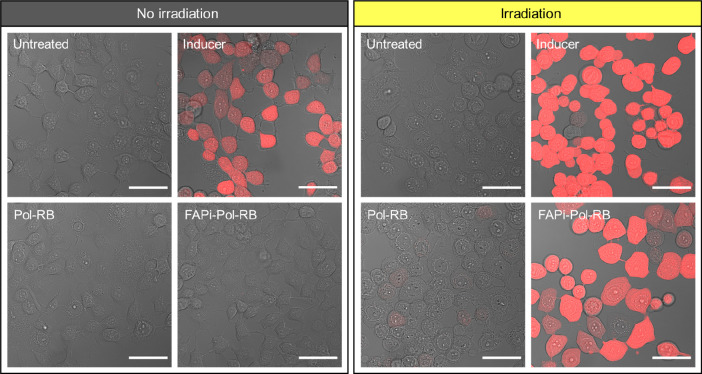
As current chemo- and photodynamic cancer therapies are associated with severe side effects due to a lack of specificity and to systemic toxicity, innovative solutions in terms of targeting and controlled functionality are in high demand. Here, we present the development of a polymersome nanocarrier equipped with targeting molecules and loaded with photosensitizers for efficient uptake and light-activated cell killing. Polymersomes were self-assembled in the presence of photosensitizers from a mixture of nonfunctionalized and functionalized PDMS--PMOXA diblock copolymers, the latter designed for coupling with targeting ligands. By encapsulation inside the polymersomes, the photosensitizer Rose Bengal was protected, and its uptake into cells was mediated by the nanocarrier. Inhibitor of fibroblast activation protein α (FAPi), a ligand for FAP, was attached to the polymersomes' surface and improved their uptake in MCF-7 breast cancer cells expressing relatively high levels of FAP on their surface. Once internalized by MCF-7, irradiation of Rose Bengal-loaded FAPi-polymersomes generated reactive oxygen species at levels high enough to induce cell death. By combining photosensitizer encapsulation and specific targeting, polymersomes represent ideal candidates as therapeutic nanocarriers in cancer treatment.
由于当前的化疗和光动力癌症疗法由于缺乏特异性和全身毒性而存在严重的副作用,因此对于靶向和控制功能的创新解决方案的需求很高。在这里,我们展示了一种聚合物囊泡纳米载体的开发,该载体配备了靶向分子并负载了光敏剂,可实现高效摄取和光激活细胞杀伤。聚合物囊泡是在光敏剂存在下自组装的,光敏剂来自未功能化和功能化 PDMS-PMOXA 嵌段共聚物的混合物,后者设计用于与靶向配体偶联。通过封装在聚合物囊泡内部,保护了光敏剂玫瑰红,并通过纳米载体介导其进入细胞。成纤维细胞激活蛋白 α (FAPα) 的抑制剂,一种 FAP 的配体,被连接到聚合物囊泡的表面,并提高了它们在 MCF-7 乳腺癌细胞中的摄取,该细胞在其表面表达相对高水平的 FAP。一旦被 MCF-7 内化,负载玫瑰红的 FAPi-聚合物囊泡的辐照会产生足够高的活性氧物种,从而诱导细胞死亡。通过将光敏剂封装和特异性靶向相结合,聚合物囊泡成为癌症治疗中理想的治疗性纳米载体候选物。